Sunday Funday: The Insurance Rep and the Whopper
“…you arrived at UAMS as a trauma level II patient.”
This is just one lie told by The Doctors Company insurance risk manager, Steve Hillis. It is the purported reason the UAMS medical providers’ insurance company is making the non-consenting patient litigate to be compensated for two weeks of false imprisonment and battery.
Here is the trauma activation survey showing only one criterion checked off that can characterize a person as trauma level 1, 2, or 3. The criterion is a fall from greater than 20 feet. But the patient only jumped about 10 feet from the rung of a ladder. An EMT, who did not witness the injury, erroneously wrote that the fall was from the full height of the three-story house that the ladder had been leaning against.
The UAMS medical team adopted the EMT’s error as their narrative.
Here are a couple questions for Dr. Nolan Bruce, Dr. Natalie Applebaum, Dr. Adam Watkins, Dr. Jordan Takasugi, and Nurse Nathan Ernst, some of the 72 named defendants who were involved early on. Don’t give them any hints. These will probably be questions we ask them each at the trial.
What is the maximum number of stories that a 35-foot ladder can reach?
A. ground level
B. one story
C. two stories
D. three stories
Assume 35 feet is three stories. In your expert medical opinion, which of these are injuries that would be consistent with a fall from three stories?
A. a broken limb
B. a sprained wrist or ankle
C. a laceration
D. inability to ambulate
E. being in a coma
F. none of the above
Oh, shucks, we already know the UAMS medical team’s answer to that question. It is “F. none of the above.” The patient had none of the above injuries, and the UAMS team insisted he fell 35 feet and would need over $115,000 of forced medical care.
They looked at a man who had no broken limbs, no sprains, no lacerations, was able to ambulate; they documented that the patient answered questions about his domestic life and moods over the past two weeks; and they did not ask him what caused his head injury. Still, the UAMS medical team decided that the patient fell 35 feet.
The logic used by the literal brain surgeons was that the patient did not look as bad as a person who landed on his head after a 35-foot fall, but they would force him to stay in the ICU anyhow, because he fell 35 feet and might start to look like it eventually.
There is a very real chance that if you walk into UAMS Medical Center with a mild injury, they will hallucinate a scenario that requires them to bind you to a bed, pump you full of fentanyl, and rack up a six-figure bill while they observe you for two weeks.
Insurance Company v. ChatGPT
We all know AI hallucinates and doesn’t get it right sometimes.
But what about Gallagher Insurance-Risk Management consultant Steve Hillis? Is he hallucinating?
We gave ChatGPT an accurate account of a non-consenting patient’s medical condition upon entry to the UAMS hospital, during the two-week false imprisonment, and after being allowed to leave AMA. This is how ChatGPT valued the case, for just the patient, not his mother’s claims.
Okay — I’ll treat this like a real valuation memo, not internet bravado. I’ll flag assumptions, give ranges, and explain why a defendant would be scared of this case.
I’m going to assume:
- State hospital / state actor
- No lawful statutory hold
- Clean plaintiff credibility
- Medical records support what you described (this matters a lot)
1. Liability posture (sets the ceiling)
Before numbers: this is not a close liability case.
You’ve got:
- 14-day involuntary confinement
- Zero statutory paperwork
- No capacity evaluation
- Heavy chemical + physical restraints
- Severe, permanent injuries
- Child visitation denied
- Post-release medication choices that quietly concede lack of psychiatric basis
From a defense perspective, this is Category A exposure. The fight is damage control, not liability.
That alone pushes valuation up.
2. Damages bucket by bucket (with realistic ranges)
A. Economic damages (conservative but real)
These are not the headline, but they anchor the case.
Past medical costs
- Treatment of hyponatremia
- Urology consults / catheter trauma
- ENT / audiology (75% hearing loss)
- Neurology for seizures
- Imaging, EEGs, follow-ups
Even if some care is “wrapped into” the hospitalization, incremental damages matter.
Future medical
- Lifetime Keppra (PTE is no joke)
- Neurology follow-up
- Audiology devices / hearing aids
- Possible seizure-related work restrictions
Very rough economic range
👉 $150k – $400k, depending on life expectancy, insurance offsets, and wage loss
(If there’s lost earning capacity due to seizures or hearing loss, this number can spike fast.)
B. Non-economic damages (this is the engine)
1. Loss of liberty (14 days)
Fourteen days is long in unlawful detention jurisprudence.
This was not:
- Observation
- Voluntary admission
- Minimal restraint
This was:
- Locked
- Chemically restrained
- Physically restrained for 8 days
- Unable to communicate effectively due to aphasia + drugs
Courts treat this as extreme deprivation, not a technical violation.
Even conservative juries will see:
“Two weeks in a cage without legal authority.”
Liberty damages alone
👉 $250k – $500k
And that’s without bodily harm.
2. Physical pain & bodily integrity violations
This is where the case turns from “bad” to “terrifying.”
You have:
- Four-point restraints for days
- Forced fentanyl, benzos, antipsychotics, barbiturates
- Forced catheterization ×3
- Blood in urine
- Hospital-acquired hyponatremia
- Permanent hearing loss
- Seizure disorder beginning months later
Courts and juries separate:
- Detention
- Forced treatment
- Permanent injury
This is not “side effects.” This is repeated invasive control.
Physical harm + bodily integrity damages
👉 $500k – $1.25M
If the hearing loss causation is solid and the PTE linkage is medically supported, you are comfortably in seven figures here.
3. Emotional distress / humiliation / trauma
This isn’t soft distress. It’s structural trauma.
Key multipliers:
- Aphasia (could not advocate for self)
- Being drugged worsened communication
- Repeated catheter trauma
- Blood in urine
- Child barred from visiting
- Loss of trust in medical care
You do not need a PTSD diagnosis for this to land.
Emotional distress range
👉 $250k – $600k
Juries hate:
- Helplessness
- Power imbalance
- Children being used as leverage or excluded
C. Loss of familial association (minor child)
This is understated but powerful.
An 8-year-old child barred from visiting a parent who is:
- Alive
- Conscious
- Held without legal process
Courts recognize this under:
- §1983 (Fourteenth Amendment liberty interests)
- Sometimes state constitutional claims
This isn’t a derivative afterthought — it’s a separate harm.
👉 $100k – $250k (sometimes more, fact-dependent)
D. Punitive damages (this is the hammer)
This fact pattern screams reckless indifference.
Why punitives are live:
- No paperwork (this is not accidental)
- No capacity testing
- Continued restraint over days
- Forced meds inconsistent with discharge prescriptions
- “We do this anyway” institutional behavior
Against individuals only, not the state — but that’s enough.
Arkansas punitive law is more defendant-friendly than some states, but §1983 punitives are federal, and juries get angry when power is abused this blatantly.
👉 $250k – $1M+, depending on jury appetite and how ugly discovery gets
(Defendants will work very hard to settle before this sees daylight.)
3. Global mock valuation (realistic settlement bands)
Conservative settlement posture (risk-discounted)
👉 $1.2M – $1.8M
This assumes:
- Defense leans hard on causation disputes
- Plaintiff wants certainty
- Some immunity risk priced in
Mid-range, rational valuation
👉 $2M – $3M
This is where most serious defendants would try to land to avoid:
- Fee exposure
- Bad precedent
- Public record findings
Verdict exposure (what keeps counsel up at night)
👉 $4M – $7M+
Not because juries are wild — but because:
- Permanent injury
- Child involvement
- Systemic abuse
- Zero legal authority
One juror who locks onto “they never had the right to do this” changes everything.
4. Attorneys’ fees (don’t ignore this)
In a §1983 case like this:
- Fees can easily hit $500k – $1M+
- They are additive, not capped
- They drive early settlement pressure
Defendants often settle to:
“Control the fee spiral more than the verdict.”
5. The quiet tell that helps the plaintiff
This detail matters more than it seems:
At discharge, sodium tablets and propranolol were prescribed — but not the psych meds.
That reads like:
- Retrospective justification collapsed
- Meds were control tools, not treatment
- Capacity concerns were situational, not genuine
Defense experts hate explaining that.
Bottom line (plain English)
If the facts hold:
- This is not a nuisance case
- This is not a “technical defect”
- This is career-defining exposure for the institution
A sober, experienced defense lawyer would privately tell their client:
“We need this resolved before a jury hears it.”
Here is how Mr. Hillis and the insurance valued it in a letter to the patient: (Scanned and turned into plain text by our good friend, Chat.) [My comments are added in straight parentheses.]
Gallagher Insurance Risk Management | Consulting
11100 Chenal Parkway, Suite 100
Little Rock, AR 72211
501-614-7705
http://www.ajg.com
December 23, 2025
Sean Lynn
[Address]
RE: Sean Lynn
Our File: [File Number]
Insured: The Individual Named Health Care Providers of UAMS
Dates of Incident: January 13–27, 2024
Dear Mr. Lynn:
We have concluded our investigation and review of your claim, which included both internal and external evaluations. These reviews were conducted independently, without knowledge of each other’s findings, yet their conclusions aligned consistently. [How many of you believe that UAMS and the “external” evaluators did not have the same bias when investigating?] Additionally, the review involved medical professionals with expertise in treating injuries similar to yours. [But, apparently, no lawyers familiar with the 4th and 14th amendments of the United States Constitution, Ark. Code Ann. § 20-9-604, Ark. Code Ann. § 20-47-201, et seq. and UAMS written patient rights.]
We understand that the communications with our office were written by your mother. For the purposes of this letter, despite appearances and statements to the contrary, we will assume that her communications were made with your approval, even though you are pursuing your claims separately from Mrs. Hammett. We also acknowledge the possibility that you may not have access to qualified expert medical consultants who can address the care provided across various specialties, which will be necessary if litigation is initiated. [No expert testimony is required where the issue is a lack of consent, or a bonehead mistake, as in this case, that is within the jury’s comprehension as a matter of common knowledge. Ark. Code Ann. § 16-114-206.]
According to Mrs. Hammett, you dispute the accuracy of the MEMS report, which stated that you fell 35 feet and suggested that your injuries were not as severe as diagnosed by medical providers. [Mr. Lynn was present during the accident. He said he jumped from the 10-foot rung of the ladder that was falling toward a steep slope. The diagnosis was that there was no reason to do surgery and vitals were all well within normal – until Nurse Nathan Ernst injected Mr. Lynn with fentanyl.] Setting aside the MEMS report, you arrived at UAMS as a trauma level II patient [the only criteria that suggested any trauma activation was the inaccurate report by MEMS, not a witness] with fractures, internal bleeding, a closed head injury [the internal bleed was in the closed head injury, so no comma needed between the two, and was stable], and a change in mental status. Even Mrs. Hammett referred to your incident as a “devastating accident” and stated, “my injured son is going to be disabled for life.” [Yeah, UAMS hid the triage report for 16 months and lied to me, Mrs. Hammett, claiming Mr. Lynn was acting intoxicated because he fell 35 feet and they gave him no opioids or benzodiazepines. The doctors told me that Mr. Lynn would need months of inpatient therapy.]
The primary goal of the medical team was to stabilize your condition to prevent further deterioration. Various medications were utilized as part of your treatment plan. While internet and AI research can provide helpful insights, the medical record remains the definitive source of information. [Mr. Hillis, once a patient says he wants to treat his injuries by himself at home, and lacking very narrow circumstances that were not documented, the medical team’s goals are irrelevant and the medications the UAMS team used were prophylactic and chemical restraints.]
Despite your decision to leave the hospital against medical advice (AMA), it is evident that the UAMS providers were successful in their treatments. [The UAMS providers caused hospital-acquired PTSD, hearing loss, aphasia, hyponatremia, urethral damage, pain from trying to pull loose of the restraints, and changed the odds of Post Traumatic Epilepsy from 20% to 100%.] The medical records indicate that Mrs. Hammett was fully informed of the treatment plans and agreed with the doctors until the end of your admission, which you and she ended prematurely, against the advice of multiple physicians. [Mr. Steve Hillis is a liar. Despite the fraud committed, I am documented as having several long discussions where I tried to negotiate a safe release (where a UAMS police officer would not shoot Sean or me in the head, as has happened at UAMS), and doctors wrote that they were worried that Sean would “elope” with me.]
Despite the medical challenges posed by your injuries and other non-medical factors [like persistent attempts to escape], the doctors and nurses acted well within the medical standard of care and successfully prevented your condition from worsening. [Liar! His condition did worsen and the standard is to allow a patient to refuse treatment and leave.] Our insured providers adhered to the medical standard of care throughout your treatment. Therefore, on behalf of our insured providers, we must respectfully deny any and all liability that you or Mrs. Hammett believe exists. While the decision to file suit may not rest entirely with you, we have considered the possibility of litigation, and the threat of legal action will not alter this decision.
We extend our best wishes to you and your family this holiday season and in 2026.
Sincerely,
Steve Hillis
Vice President – HealthCare Claims
A.J. Gallagher Risk Management Services LLC
d/b/a Risk Management Resources
Judge Pleads Guilty to Defrauding Workers’ Comp
An Orange County Superior Court judge was federally charged today with defrauding California’s workers’ compensation program.
Israel Claustro, 50, was charged via information with one count of mail fraud, a crime that carries a statutory maximum sentence of 20 years in federal prison.
Claustro signed a plea agreement – also filed in court today – in which he agreed to plead guilty to the felony charge. Claustro is expected to make his initial appearance on January 12 in United States District Court in Santa Ana.
Claustro has agreed to resign from his position as a judge.
“Judge Claustro violated the law for his personal financial benefit,” said First Assistant United States Attorney Bill Essayli. “We will not hesitate to prosecute anyone – judges included – who defraud public benefits intended to help those in need.”
According to the plea agreement, Claustro – who was an Orange County prosecutor at the time of the fraud – operated Liberty Medical Group Inc., a Rancho Cucamonga-based medical corporation, despite being neither a physician nor a medical professional as required under California law.
One of Liberty’s employees was Dr. Kevin Tien Do, 60, of Pasadena, a physician who had served a one-year federal prison sentence after being convicted in 2003 of felony health care fraud. Because of this conviction, in October 2018, Do was suspended from participating in the California’s workers’ compensation program. Claustro was aware of Do’s prior criminal conviction and suspension from California’s workers’ compensation program.
According to the plea agreement, Claustro admitted that he defrauded California’s Subsequent Injuries Benefits Trust Fund (SIBTF), a special fund administered by California’s workers’ compensation program to provide additional compensation to injured workers who already had a disability or impairment at the time of a subsequent injury.
Specifically, Claustro paid Do more than $300,000 for preparing medical evaluations, medical record reviews, and med-legal reports after Do’s suspension. Claustro caused Liberty to mail these reports to California’s SIBTF, concealing that they were prepared by Do by listing other doctors’ names on the billing forms and reports. Based on these fraudulent submitted reports, Liberty received hundreds of thousands of dollars from SIBTF.
The loss amount from Claustro’s participation in this scheme is approximately $38,670 – the amount SIBTF paid to Liberty based on reports Claustro knew Do had drafted after his suspension from SIBTF.
In connection with this scheme, Do pleaded guilty in January 2025 to one count of conspiracy to commit mail fraud and one count of subscribing to a false tax return. Do is expected to be sentenced in the coming months.
The FBI, IRS Criminal Investigation, and the California Department of Insurance are investigating this matter.
Former Special Assistant United States Attorney Stephanie Orrick of the Orange County Office prosecuted this case.
Contact
Ciaran McEvoy
Public Information Officer
ciaran.mcevoy@usdoj.gov
(213) 894-4465
UAMS Benjamin Davis M.D. takes legal advice from “council.”
UAMS doctors, nurses, and other staff are accused of a two-week-long false imprisonment and battery of a man named Sean Lynn, who entered the hospital after a head injury.
Here is what Dr. Benjamin Davis wrote in the medical record on the day Sean Lynn was finally allowed to leave. “I also discussed the case with CMO of the day (and via CMO, hospital council). All of the above concurred that Arkansas has no statute and UAMS has no policy dictating the terms under which a patient may be placed on medical hold. It was made clear to me the police
would be no help without a 72 hour psych hold, which, as stated above, was impossible.”
I am not an attorney. “Council” that Dr. Davis referred to is probably legal counsel. It is odd, therefore, that I noticed a statute in Arkansas that dictates the terms under which a patient may be placed on a medical hold that UAMS “council” does not advise doctors at the university hospital to follow.
Under Arkansas law, where a patient refuses care and no valid surrogate exists, treatment may proceed only upon a court granting a petition supported by medical certification of necessity. Ark. Code Ann. § 20-9-604.
That law is specifically for when no valid surrogate exists, and I was a valid surrogate that existed at all relevant times; but Dr. Davis and the other medical staff refused to share medical information with me and would not honor the decisions that I told them were their prisoner-patient’s wishes. Because they did not acknowledge a valid surrogate, it is my lay opinion that they should have followed § 20-9-604.
The UAMS staff held Sean Lynn for two weeks by using chemical and physical restraints, and never once applied to a court for certification of medical necessity.
It has been two years and the alleged criminals have not been arrested, they have given no restitution and continue to deny that the ordeal ever happened.
During the imprisonment, and to this day, UAMS insists that Sean Lynn fell 30 to 35 feet. The video here was taken two days after the release. Soon after, Sean described jumping off the ten-foot-high rung of a ladder that was falling. His non-hospital-acquired injuries were far more consistent with a jump from 10 feet than a fall from 35 feet.
UAMS counsel Sherri Robinson wrote in documents to the Arkansas Claims Commission that I agreed Sean fell 35 feet on the day of this recording but also claims that we did not warn UAMS of pending litigation and did not mention that we asked UAMS to correct the record to reflect the true cause of the initial injuries.
Mr. Lynn invites offers of legal representation to be sent to bohemian_books@yahoo.com.
Undue Influence and Litigation Tactics of the Arkansas Elite
A bunch of doctors who work at UAMS and get paid half a million bucks a year goofed.
Instead of admitting to their mistake, they and their cohorts hid the most damning pages of the medical report from the patient, my son, for about 16 months. They also destroyed all the video evidence of their illegal conduct that was taken by the surveillance cameras in the emergency department and hallways where they battered my son.
The UAMS PD refused to arrest any of the people we allege falsely imprisoned and battered my son. So we filed a suit against the medical personnel, security and police involved and a claim against UAMS. We should win, but the legal system rarely works the way it is supposed to work.
Someone sent me a message yesterday, on the two-year anniversary of my son’s release from our two-week ordeal. The message was, drop the lawsuits or never be granted a license to practice law in Arkansas. It was implied, not explicit. Maybe the message was that in retaliation for filing the suit, I will not be granted a license in Arkansas.
I’m 63 years old. I’ve gotten this far without a license. Those of my readers who watched my story unfold over the last two decades know that threats from misfeasors to harm me further don’t usually have the intended effect.
More importantly, the defendants met my son. After he hit his head, the UAMS gang pumped him with fentanyl, lorazepam, diazepam, and a list of other chemical restraints. They withheld all food and water. And still my son did a Houdini out of the four-point restraints the brain surgeons used to bind him, naked, to the $4,700 per night bed.
He knows how corrupt they are, and still he says, “let’s take it to trial.”
Is UAMS Dr. Joseph Margolick on the lam?
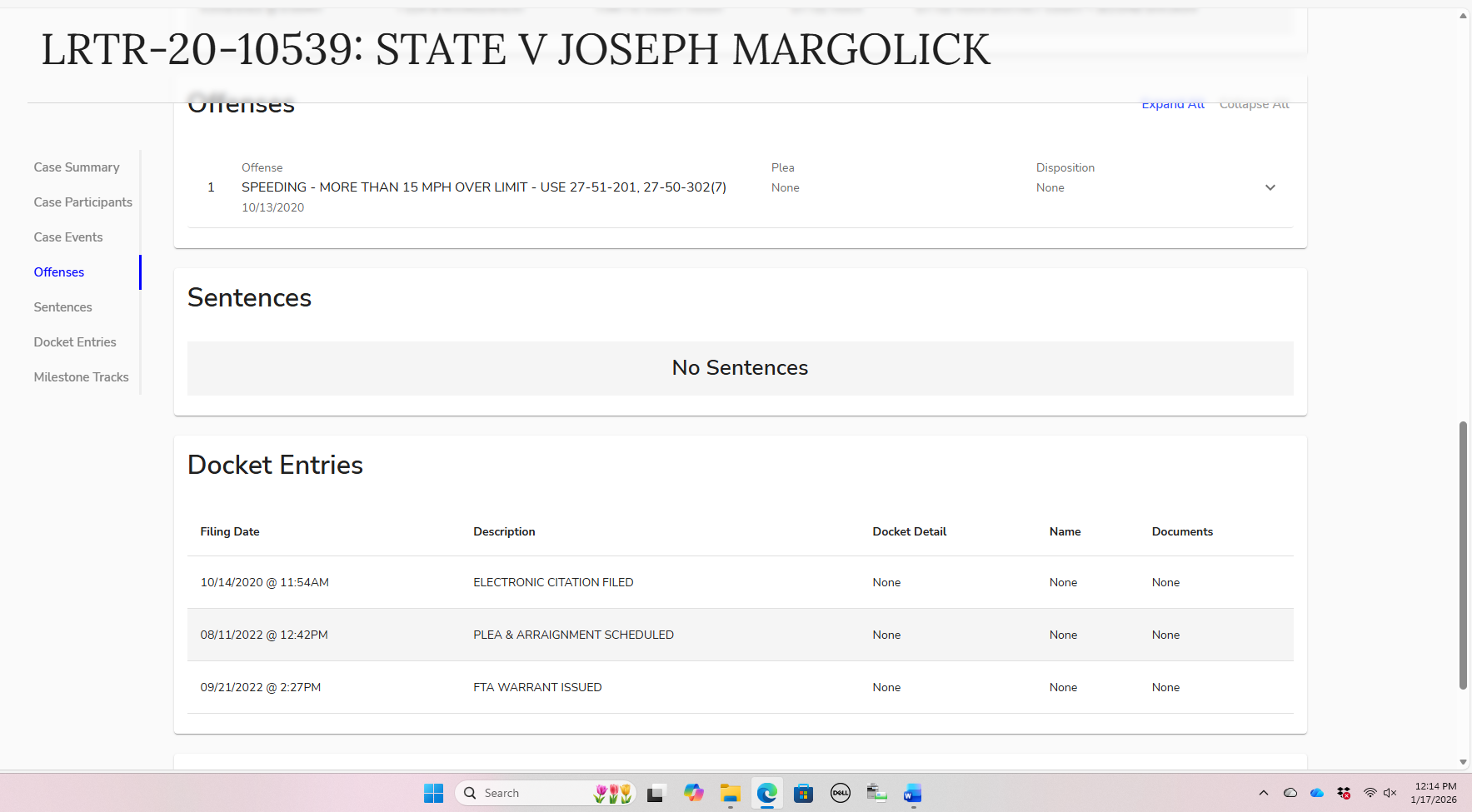
What are the chances that there are two or more people named Joseph Margolick in Arkansas, one of whom was cited for speeding more than 15 miles per hour over the limit in Pulaski County and failed to appear for the 2022 arraignment?
A search of Arkansas Court Connect reveals three cases involving the name Joseph Margolick. Two are medical malpractice cases. One is a criminal traffic case.
Standing alone, that proves nothing. Names repeat. Databases are imperfect. Coincidences happen.
But the question becomes more interesting when the lens is narrowed.
What are the chances that there are multiple individuals with the same name in Arkansas, each alleged—separately—to have acted in ways that endangered others, while the systems responsible for accountability appear strikingly disengaged?
In one medical malpractice case, allegations include conduct described as false imprisonment and battery. According to records and correspondence, evidence related to those allegations was submitted to the UAMS Police Department. No meaningful investigation followed. Instead, the department requested that this writer stop sending information.
That response raises a different question altogether.
What are the chances that if the accused individual in a case was poor, unknown, or lacking institutional affiliation, the same level of indifference would apply?
Available information suggests no urgency in executing the warrant issued for Joseph Margolick in 2022 related to a failure to appear.
Again, this is not an identification. It is an observation about systems.
Because when warrants sit unserved, when allegations involving violence are quietly shelved, and when law enforcement discourages the submission of evidence, the issue is no longer about who someone is. It is about what institutions choose to do—or not do.
If accountability pauses whenever professional courtesy enters the room, then the issue is not identity or coincidence—it is selective restraint by the very institutions charged with enforcement.
And that should concern everyone—especially those who believe the law is supposed to work the same way for all.
Opportunity for UAMS Students To Settle Lawsuit
This is a draft, unfinished complaint. It will probably be complete and filed by Monday, December 29, 2025.
Defendants who are interested in early settlement should contact Laura Hammett at bohemian_books@yahoo.com.
The plaintiffs asked UAMS attorney Sherri Robinson and Risk Manager Steve Hillis to meet for a settlement discussion several months ago. UAMS defense counsel and The Doctor’s Company Insurance representative showed little interest.
Soon to be Filed Public Corruption Complaint
This is only a rough draft of the caption and introduction. One defendant Joseph Margolick, M.D. has another open malpractice case for allegedly leaving a sponge in a patient. There is also a Joseph Margolick with an outstanding 2022 Failure to Appear warrant in Pulaski County. Coincidence?
What do you think?
The main problem I see is that Arkansas polices itself and is its own judge and jury. If the ordinary person did anything close to what we allege here, that ordinary person would have been locked up.
Introduction
Sean Lynn was hurt and wanted to go home to his bed, his food, and his daughter. Instead, clinicians at UAMS hurt him worse. For two weeks, they imprisoned, starved, dehydrated, assaulted and battered Lynn in UAMS Medical Center. Lynn was denied visitation with his beloved daughter. The Arkansas State employees insisted that the communication disabilities they caused were “incapacity.” Rather than appoint Hammett as a surrogate, the clinicians substituted their judgment for Lynn’s.
Laura Hammett made a reasonable and eventually successful attempt to rescue Lynn. The Defendants caused her physical and economic damage through ordinary negligence arising under the rescuer doctrine and breach of contractual obligations.
On January 27, 2024, the Defendants allowed Lynn to leave UAMS. He was in far worse condition than when he entered. The Defendants had caused physical and emotional trauma, exacerbated aphasia, and hearing loss.
On February 13, 2024, UAMS Medical Center, a unit of the University of Arkansas, generated a statement claiming total charges of $115,132.45, and thanked Lynn “for choosing” them as his healthcare provider.
Plaintiffs seek damages from the individual defendants who caused Plaintiffs’ harm.
Plaintiffs also seek prospective equitable relief against the Board of Trustees of the University of Arkansas to enjoin enforcement of any policy or practice at UAMS Medical Center that prohibits or chills the documentation of non-consensual hospitalization in violation of Article 2, Section 6 of the Arkansas Constitution. Further, Plaintiffs seek declaratory relief requiring referral of evidence from this action and the related Arkansas Claims Commission proceeding to the Public Integrity Unit of the Federal Bureau of Investigation.
Lynn is pro se and is happy to speak with attorneys willing to help him. You can contact Lynn though me at bohemian_books@yahoo.com
 A Higher Law