ABC Guide to Lawyering
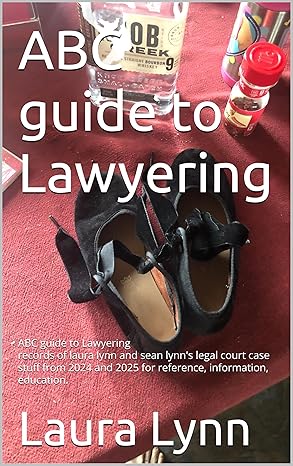
This book was actually my son Sean’s idea, and it’s published through his Amazon account. Amazon takes the bulk of the sale price—Sean says he earns only a few cents per copy—but his goal was never the money. He wants to share what he went through: the medical battery and false imprisonment he endured at UAMS, and the obstacles he’s faced while pursuing a settlement with the state-run hospital.~~~
There is a lengthy sample that you can read on your phone. It is a good long-weekend-cozy-in-bed book.
Another Toothless Tiger Law
This would be a wonderful law, except that recovery under the law relies on government prosecution of corrupt judicial officers. In other words, it will almost never happen.
A.C.A. § 16-106-111
§ 16-106-111. Exception to judicial immunity
(a) The General Assembly finds that:
(1) The common law doctrine of judicial immunity from civil suit has been accepted by the courts under Peterson v. Judges of Jefferson County Circuit Court, 2014 Ark. 228 (per curiam) and Pierson v. Ray, 386 U.S. 547 (1967), and is state law; and
(2) An exception to this blanket grant of judicial immunity is necessary to protect the public from certain criminal and unethical acts committed by judges and justices.
(b) A person who has had an adverse decision against him or her in a court in this state may file a claim in the circuit court with jurisdiction against a judge or justice who made the adverse decision in the judge or justice’s individual capacity if the judge or justice:
(1) Made or influenced the adverse decision as a result of bribery;
(2) Has been found guilty of, or pleaded guilty to, nolo contendere to, or the equivalent of nolo contendere to, a criminal offense for conduct constituting bribery in any state or federal court; and
(3) The bribery conviction described in subdivision (b)(2) of this section resulted from the conduct described in subdivision (b)(1) of this section.
(c) A person is entitled to the following remedies if he or she prevails on a claim under subsection (b) of this section:
(2) Damages, including without limitation punitive damages; and
(d) A prosecuting attorney may bring a cause of action under this section, and may, in his or her discretion, use any proceeds recovered in the proceeding to:
(1) Cover the prosecuting attorney’s costs of the proceeding in which the adverse decision described in subsection (b) of this section occurred;
(2) Give to the victim or the estate of the victim of the crime that the prosecuting attorney was prosecuting in the proceeding in which the adverse decision described in subsection (b) under this section occurred;
(3) Donate to a nonprofit victims’ rights advocacy group; or
(4) Donate to the State Treasury.
(e) The statute of limitations for a cause of action under this section:
(2) Begins to run the day the judge or justice is found guilty of, or pleads guilty to, nolo contendere to, or the equivalent of nolo contendere to, a criminal offense for conduct constituting bribery in any state or federal court.
(f)(1) If a cause of action is timely filed under this section and the judge or justice is deceased at the time of the filing or dies during the pendency of the cause of action, the person or the estate of the person filing the cause of action may proceed against the estate of the judge or justice.
(2) The estate of a person may proceed with a cause of action under this section against a judge, justice, or the estate of the judge or justice, if the person dies before the cause of action accrues or during the pendency of the action.
(1) “Adverse decision” means a ruling in which a judge’s or justice’s order differs from the relief or request sought by a litigant on a motion or objection in a civil or criminal matter;
(2) “Bribery” means giving, offering, accepting, or agreeing to accept money or any other benefit, pecuniary or otherwise, for the purpose of affecting the outcome of a court proceeding or decision; and
(3) “Person” means any individual, corporation, business trust, estate, trust, partnership, limited liability company, association, joint venture, government, governmental subdivision, agency, or instrumentality, public corporation, or any other legal or commercial entity.
UAMS Torture Victim in His Own Words
Arkansas Claims Commissioners Dee Holcomb, Henry Kinslow, and Paul Morris issued a sua sponte order on November 14, 2025, denying ADA accommodations to a disabled man. Sean Lynn is suing UAMS for imprisoning and battering him for two weeks in 2024. The torture resulted in a disrupted oscillator chain in his left ear and exacerbated aphasia that lingers on two years later.
Being drugged with Fentanyl, a list of benzodiazepines, and barbiturates, then bound to a bed, naked for much of the time, and chased down hallways and stairs when trying to escape, caused Lynn symptoms of PTSD.
Holcomb, Kinslow, and Morris said that when I, a co-claimant and Sean’s mother, wrote our joint documents, I was engaged in the unauthorized practice of law. The Commissioners made a vague reference to some unnamed persons who may or may not have been co-claimants and may or may not have had communication disabilities, who were not allowed to join on documents they filed.
The Commissioners wrote: “While Ms. Hammett is entitled to represent herself before the Commission with regard to her individual claims, any attempt by her to represent Mr. Lynn would appear to be the unauthorized practice of law (and similar attempts have been rejected in other matters).”
The Commissioners might claim that they did not say I attempted to represent Mr. Lynn, as “any” could mean there was no attempt, but if there was an attempt, it would “appear” to be criminal conduct. The last corrupt jurist I dealt with, Federal Judge Lee P. Rudofsky, disagreed with that interpretation of the word “any.” When I wrote that “any” credit card usage I made on a Capital One Account was for consumer goods, and therefore subject to the FDCPA, Judge Rudofsky said that was an admission that I used the credit card and did not pay it off. The Eighth Circuit Court of Appeals agreed with Judge Rudofsky wholeheartedly.
I think the language of the order issued by the Commissioners gives them the wiggle room to say they were expressing “concern” and not making a definitive statement. But if Sean and I did not object and ask for reconsideration of the order, history would be rewritten, and the law of the case and issue preclusion would say that I was practicing law without a license.
Inexplicably, the Commissioners have looked at our claims for over a year and never expressed one bit of concern that doctors and nurses at UAMS forced Sean to ingest dangerous drugs, used physical restraints, and catheterized him instead of letting him get up to use the toilet over a two-week period– without offering him an attorney to defend him from this false imprisonment. UAMS PD refused to investigate our allegations of criminal conduct by UAMS staff. And UAMS Security deleted all the videos of the alleged criminal conduct.
The YouTube video of one of the many discussions Sean and I had about the torture at UAMS was posted three days ago, but it was recorded about a year ago. It is on Sean’s YouTube channel. Show your support for autonomy over our bodies and access to justice by liking and subscribing.
Arkansas Claims Commission Questions Whether Claimant Is Entitled to ADA Accommodations; Shows No Concern that UAMS Doctors Falsely Imprison and Batter “Patients”
Arkansas Claims Commissioners Dee Holcomb, Henry Kinslow, and Paul Morris issued an order today in the civil claim that alleges doctors and other medical staff at UAMS committed criminal battery and false imprisonment against a man who hit his head when he jumped from the 10-foot-high rung of a falling ladder. Aphasia caused by a stable brain bleed was exacerbated by forced drugging and smashing the patient’s head against hard objects to physically restrain him in the $10,000 per night hospital room. The Commissioners expressed concern that the patient’s co-claimant and accommodator was practicing law. The Commissioners did not express any concern whatsoever about the battery, false imprisonment, and destruction of evidence by the half-million-dollar-per-year salaried doctors at the state-run hospital.
Here are the order and a motion for reconsideration that were both filed today.
 A Higher Law