UPDATE (June 16, 2024) Ninth Circuit Court of Appeals teaches Pro Se Litigant and the District Court Judges and $450 per Hour Attorneys: Federal Court Lacks Jurisdiction – Order Must Be Vacated
In Hammett v. Sherman, et al, the court went to unprecedented lengths, sanctioning the unauthorized practice of law, to transfer assets from the pro se litigant to attorneys and their wealthy clients, also attorneys.
The case is on appeal in Federal Court. It is likely that the California State Courts would not allow this case to have proceeded. Allowing a derivative action advocated by a non-lawyer to proceed is tantamount to authorizing the advocate to practice law.
Here is a list of district court judges who insisted that the derivative case on behalf of Silver Strand Plaza, LLC proceed on the merits, even though it was filed by someone who is not an attorney.
Janis L. Sammartino, nominated by former President George W. Bush.
Todd W. Robinson, nominated by former President Donald Trump.
Linda Lopez, nominated by President Joseph Biden.
While researching for this blog post, I came across an interesting story about Judge Sammartino’s son, a convicted sex offender who had sex with his 17-year-old student while teaching at San Diego’s most prestigious private schools in 2020. It will be interesting to find more about how the 36-year-old judge’s son was treated by the court. Click here to read the story on the NYPost.
One “reason” the judge’s son gave for violating his young student was that he had a bike accident that caused a head injury. My son fell two stories onto his head, and though it caused brain damage to his speech center and hearing loss, his reasoning was not diminished at all, and was in fact improved. Of course, every injury is different, and each individual might respond differently, but I can just imagine Janis Sammartino and her lawyer friends sitting around coming up with this bullshit excuse. Why not attribute his bad conduct to seeing his unethical mother get away with her corruption and his resultant feeling of entitlement?
Also, the Ninth Circuit Court of Appeal brought a case to the attention of all litigants and asked for supplemental briefing.
Carden v. Arkoma Assocs., 494 U.S. 185 (1990), a decades old SCOTUS case, decided that any entity other than a corporation, such as a limited partnership, is a citizen in each state where any member is a citizen. This includes even limited partners’ citizenship. That makes it impossible for the federal courts to take diversity jurisdiction. (I have not done all the research yet. My supplemental brief will be expounded upon.)
While digging into Carden, I realized that, without the derivative malpractice case against the attorney defendants, the remining damages against the attorney defendants fell far below the $75,000 minimum threshold for federal diversity jurisdiction. Those defendants should have been bifurcated out of the case six years ago, and the remaining conversion case sent to state court.
Jurisdictional problems should be brought up by the Court. Kudos to the Ninth Circuit for doing its job, even if they ignored the jurisdictional error for two previous bids at interlocutory appeal of the order for attorney fees on the anti-SLAPP motion brought by the attorney defendants and their $450 per hour attorneys.
Judge Sammartino, Judge Robinson, and Judge Lopez just wasted an insane amount of public and private resources by keeping the case active in the federal court system for over 300 documents. The Court of Appeals and a sickly old lady who is not an attorney had to school the team of highly paid attorneys and the team of corrupt judges.
Your tax dollars and your justice system at work.
Courts that Tax the Poor and Middleclass
You have a dispute with a corporation like ZIPS Car Wash, First American Home Warranty or Portfolio Recovery Group.
The company took money from you that you did not owe, did not provide the service you paid for or tried to extort money from you.
You tried writing “letters”, poor reviews on the internet, and begged by telephone for the company to correct itself. All to no avail.
So, you decide to take them to court.
In my experience, the courts often discourage non-attorneys from filing a suit.
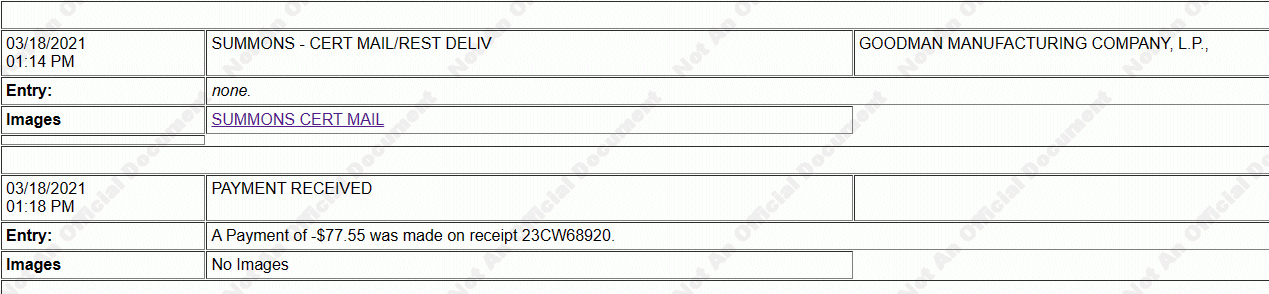
In the small claims division in Faulkner County Arkansas, I filed a suit against Goodman Manufacturing for selling a faulty HVAC to me. The court charged me $12.55 on top of the filing fee, supposedly to serve the suit on Goodman by certified mail.
Eventually, Goodman wrote a motion to dismiss based on improper service and showed a copy of the service envelope with a regular stamp on it. The court is collecting over $10 extra per plaintiff, and if the plaintiff has a good case that concerns a company that has lawyered up, the case can be thrown out on a technicality. (One of the other defendants settled with me, so I know it was a good case.) See the FREE Doc of the Day at the end of the post.
In a case in the Federal District Court of Southern California, five of the defendants were attorneys who were accused of committing malpractice on a company that I was a shareholder in. There were other harms against me claimed in the same lawsuit. The malpractice claim is what is called “derivative”. A derivative suit cannot be filed by a non-attorney. Who knew?
The court allowed me to proceed on the derivative suit and denied me leave to hire an attorney to explain what a derivative suit was unless I hired the attorney to represent me in the entire case. That might have cost more than I would recover. There was no fee shifting provision that would allow me to recover the costs of the lawsuit.
When I discovered on my own that by proceeding on the derivative suit I might be charged with practicing law without a license, I brought it to the Court’s attention as a voluntary dismissal. Judge Sammartino decided that I dismissed because the attorneys were going to prevail and ordered me to pay their attorney fees on an anti-SLAPP motion. Never mind that malpractice and conversion claims are not subject to the fee shifting anti-SLAPP statute.
In the Federal Court in the Eastern District of Arkansas, there are conflicting rules about non-attorneys using electronic filing. One says non-attorneys cannot use electronic filing. Period. That is the rule Judge Lee P. Rudofsky enforced against me. There is another rule that says a person can gain permission to use electronic filing by filing a motion. I tried that, to no avail.
“Conventional” paper filing taxes the pro se litigant. Instead of filing whenever convenient, the non-attorney must drive to the courthouse during business hours or mail the documents and cross her fingers.
I went into an important hearing on the case once and learned that my adversary’s attorneys received an order by electronic service the day before that I did not get in the mail yet. They had an opportunity to research the law before we discussed it, and I did not.
Each of the approximately 100 documents I filed in the case cost me about $100 extra to copy four times and using the GSA mileage expense to drive to the courthouse and home. That is $10,000 I could not spend on discovery, like depositions and subpoenas. I have an autoimmune disease and was forced to go into public to file. (Once I went to the courthouse on the last day to file. I was feeling a little more lousy than usual, so I went to an urgent care after and found out I had COVID. If I had electronic filing, I would not have exposed others to the disease.)
What can be done about this taxation of the poor and middleclass that can’t afford to pay an attorney hundreds of dollars an hour for representation?
It will probably take a Constitutional challenge to the laws that discriminate against the majority class. Where judges like Janis L. Sammartino, Lee P. Rudofsky or the Clerk of the Court are misapplying the law or ignoring the law, it means filing an appeal and prevailing.
Good luck.
If you have a story about systemic bias in the courts, please shoot an email to bohemian_books@yahoo.com.
Doc of the Day
Isn’t It Ironic: How an Honest Clerk Corrects a Docket Entry – Not Like John Morrill’s Gang
I filed a civil rights complaint against the Clerk of the Court in the Southern District of California.
It stemmed from when deputy clerk, Jude or JPP, did a little favor for the opposing party. Try to follow.
In the underlying suit, I named one person in two capacities. One as a co-trustee of a living trust, the other as an individual. I was required to issue and serve two summonses to the same human, Linda R. Kramer.
For some reason, the Clerk left Kramer as an individual off the docket. This was very strange, because I originally named her as an individual only, and then filed an amended complaint naming her in the both capacities. So, the individual was left out in both iterations. Or her attorney and Clerk Jude colluded in an attempt to leave the individual out of the suit.
Linda’s attorney filed a response to the complaint timely, but he wrote that he represented only the two co-trustees on the cover. The attorney’s helper did not ask the clerk of the court to add Linda Kramer as an individual when he input the filing.
I filed a motion for clerk’s default against the individual two days after the response was due. (That is pursuant to Federal Rules of Civil Procedure 55(a), for you legal types.)
Instead of filing a motion to set aside pursuant to FRCP 55(c), the attorney, Keith Cochran, asked Clerk Jude to change the docket entry to include the individual. The clerk did this favor. He did not add a note that said the entry was updated two days after the document was due and filed.
When I saw the change, I blew a gasket, read the riot act to everyone I could get on the phone and the clerk changed the entry back. Again, no notation of the change.
Then Clerk Jude refused to enter the default.
Judge Janis Sammartino thought it was just fine for Linda to skip a step. In fact, Janis added a snarky footnote in her order denying me any relief. She admonished me not to impugn the good character of the clerk or any staff of the court. It seemed intimidating to me, a pro se litigant who was up against six firms. I think the judge violated criminal code 18 U.S.C. sec. 241 – conspiracy against rights.
I let my suit against the clerk be dismissed. I am running low on energy and money and was not going to collect anything for my trouble. The clerk had free to him representation by a capable man with the Arkansas Attorney General’s office; the office the presiding judge worked in previously, as Solicitor General.
But I am appealing Judge Sammartino’s orders denying default against Linda Kramer and denying sanctions against attorney Keith Cochran.
Ironically, the defendants filed a joint paper today and the attorney entering it only named his clients. He left out Linda Kramer in both capacities and half a dozen other defendants.
Guess what? The appellate court clerk corrected the docket…with a note of the change.
And that, my friends, is Thursday’s Doc of the Day … in advance.
Judge Janis L. Sammartino’s Dishonest Statements Reiterated by Appellate Brief
The Doc of the Day is my Informal Reply Brief in a case that was originally presided over by Federal District Judge Janis L. Sammartino. The case was transferred to Judge Todd W. Robinson, and then passed off to Judge Linda Lopez. The subsequent judges failed to correct Judge Sammartino’s errors on reconsideration.
Enjoy reading the FREE document.
This is not legal advice. I am not an attorney.
In fact, I hope to find an attorney to represent me if the Ninth Circuit Court of Appeals remands with instructions to give me leave to amend or proceed to discovery. That way my attorney can file the derivative claims against the attorneys who gave dual representation to the LLC and parties who had conflicting interests.
Contact me at bohemian_books@yahoo.com.
Stupid Attorney Tricks: First Honorary Mention to Keith Cochran of Fitzgerald Knaier, LLP
Writing the caption of a court case is an exacting task. Lawyers seem to get off on getting their clients off on a technicality. One pro se case in Florida was dismissed because the non-attorneys named “First American Home Warranty Corp.”, instead of “First American Home Warranty of Florida”. I kid you not.
Attorney Keith Cochran appears to me to have tried a new trick. He left one party he later claimed to represent off the cover of his first response to the First Amended Complaint that was served to Linda R. Kramer as a co-trustee of a trust and Linda R. Kramer as an individual. Separate copies of the complaint were served and two acknowledgements were signed by Linda R. Kramer.
The clerk failed to enter the individual on the docket when he entered all the other defendants. Kramer and her husband Erik Hunsaker were not named as co-trustees on the original complaint.
Apparently, the clerk did not notice his error when he added the co-trustees. Apparently, the clerk did not notice his error when entering the notices of acknowledgement.
I suspect the plan was to go through the proceedings to finality and then, if I won, pop up and say Linda R. Kramer was not included as an individual. They could put the blame on me, for failing to notice that Kramer was entered in only one capacity and only represented in one capacity.
If I filed a motion for default under FRCP 55 that late in the game, Kramer would have a good argument that there was too much prejudice to her defense.
I am not certain that the clerk’s original error was by mistake. It could have been and Mr. Cochran seized the opportunity, dropping the individual off the list of parties he represented.
Unfortunately for the defendants, I caught the error and filed for default.
Mr. Cochran’s paralegal swore under penalty of perjury: “As a paralegal for over five years, I had never encountered a party not being listed on the ECF system. I believed that by selecting the single option for Linda R. Kramer on the system, it encompassed both Linda R. Kramer as an individual and as co-trustee of the Lynn and Erik’s Trust.”
Um, ok, so why did he remove Linda R. Kramer as an individual from the cover of the document he was filing? Or was it a convenient coincidence that the paralegal and the clerk both omitted the individual?
The Doc of the Day attached below for free download is paralegal Robert M. Wilson’s declaration. Bonus docs are the MTD filed timely (naming only the co-trustees), my motion for “clerk’s default judgment”, an opposition to my motion and my improved motion for clerk’s default.
This would all be much ado about nothing. But Mr. Cochran chose to call the clerk and ask a favor, instead of filing a motion to set aside default. The clerk agreed to add the third party to the docket entry as if it was done timely. He did not make the expected notation that he altered the docket entry two days after the attorney filed.
This caused me to have a melt-down. I called the clerk’s office and spoke to a few individuals. A female clerk told me the addition of Kramer as an individual was improper.
I read the riot act to Mr. Cochran. I told him I had a copy of the original, unaltered docket entry.
Presto, the clerk changed the docket entry back, but refused to enter default.
I did my usual bitch and complain in court documents. The judge, Janis L. Sammartino, instead of correcting the clerk, made a snarky threat to me about “impugning” the clerk in her dismissal of my complaint.
I am appealing the decisions regarding the default and several other decisions.
Attorney Cochran’s argument on appeal is citing caselaw that discusses Default Judgments entered by the judge, not the clerk.
Will the Ninth Circuit Court of Appeals act like the clerk’s default and default judgment granted by a judge are the same thing and there is no need to file a motion under FRCP 55(c) to set aside a clerk’s default?
Stay tuned.
Did Judge Sammartino, a clerk, Attorney Keith Cochran and my sister Lynn Kramer commit conspiracy against rights?
I think so.
Here is the pertinent language in the code 18 U.S.C. 241:
If two or more persons conspire to injure, oppress, threaten, or intimidate any person in any State in the free exercise or enjoyment of any right or privilege secured to him by the Constitution or laws of the United States, or because of his having so exercised the same they shall be fined under this title or imprisoned not more than ten years, or both.
This is what I allege happened, as I wrote it within an informal appellate brief filed in the Ninth Circuit Court of Appeals:
(“Sherman” is Mary Sherman, the member-manager of Silver Strand Plaza, LLC. “Kramer” is Lynn Kramer. Both are my sisters.)
Sherman allowed Kramer to transfer her shares in SSP to a living trust that benefitted and had her husband as co-trustee. This was disallowed by the SSP OA and I received no notification of a vote as required by the OA.
Sherman stalled transmitting the updated member list to me until after I filed my complaint in which I named Kramer as an individual, but not her trust. I did not know Kramer transferred her shares to a trust until I received the updated member list. I had to make an immediate amendment to the complaint.
I had to receive leave to file electronically, so the Clerk of the Court filed my documents for me until Docket entry 9 on July 16, 2019. I did not notice Linda R. Kramer missing from the docket. After I filed the FAC to add the trustees of the Lynn and Erik’s Trust (which I think might be a misnomer for the Erik and Lynn’s Trust), the Clerk added the new defendants, but Linda R. Kramer as an individual was either removed or had never been included. Kramer seized upon the opportunity to try to extract herself from the litigation as an individual by excluding herself as an individual from her response to the complaint. I informed the deputy clerk of the error and asked him specifically if he could grant a default. He said yes. After I filed a less than stellar motion for default, he informed me of a case that had a successful motion for default filed to use as a template.
While I was correcting my motion, the deputy clerk did a favor for Kramer by adding her to the docket entry 19, her trustee’s response, without notating the correction. (The District Court Clerk in the Eastern District of Arkansas always notes every change made to the docket entries.) After the clerk learned that I had taken a copy of the original docket entries, the clerk changed the altered entry back, again without notation of the change. This appeared to me that I would receive unequal treatment on this case. It reminded me of activity on my custody case. It showed an intent to falsify the record for my litigation adversaries, which is malicious.
My allegation against the district court clerk is plausible, supported by evidence and it is true.
Kramer knew about my horrible experience in family court. She told me I “took on the mafia and won.” She knew that I checked into a hospital with anxiety and depression caused in major part by my experience in court. It was especially cruel for her to abuse the process by enlisting the Clerk to alter the docket, like was done to me in my family law case. In that paper file case, the alterations started small and culminated in the entire 14 volumes going missing for years at a time.
I immediately reported the falsification of the record to the Court through filed documents. The Court gave me no relief, and in fact threatened me for making the report, as I will discuss further in another section.
I filed a 42 USC 1983 case in Arkansas district court concerning the clerk’s misconduct. It was dismissed before reaching the merits on issues concerning immunities. I disagreed with the MTD but did not respond. I was low on energy.
Throughout these proceedings and the 42 USC 1983 suit the Clerk did not provide the electronic history of changes to the docket. The system software was changed subsequently, and I am afraid that evidence has now been destroyed.
The harm, because the clerk changed the alteration back, was the innate harm implicit in the violation of my Constitutional Rights. I made the reasonable inference that the court would not provide me a fair adjudication of my grievances. And I was right.
In response to the alteration of the docket and the improper collusion between attorney Keith Cochran and the deputy clerk to deny me a clerk’s default against Linda R. Kramer as an individual, I asked for sanctions under Rule 11 and for the court to order the clerk to enter default.
[After Judge Sammartino denied my relief and threatened and intimidated me from bringing any corrupt conduct to the court’s attention] I asked Judge Sammartino to recuse, Doc. 153.
[Lynn] Kramer as an individual was in default by excluding herself from the MTD filed timely on behalf of the co-trustees of the Lynn and Erik’s Trust.
[The Ninth Circuit Court of Appeals asked:]
What issues are you asking the court to review in this case? What do you think the district court did wrong?
Whether omitting one of two capacities in which Linda Kramer was named from the list of represented defendants joined on the cover of an MTD means that separate defendant was in default. If so, whether the clerk must grant default, which can only be set aside after a successful motion to set it aside that explains that the party was omitted by error and why she should be allowed to late file.
The clerk erred and the court upheld the error by allowing the clerk to look to a footnote on page 6 of the MTD, Doc. 19-1, and make an improper inference that the attorney who wrote the MTD represented Ms. Kramer in all her capacities.
The court erred by writing an intimidating footnote in her Order of March 23, 2020, Doc. 111. “The Court cautions Plaintiff against impugning the Clerk or other staff of this Court or District based on gratuitous speculation regarding relationships of favoritism toward litigants or their counsel. See, e.g., ECF No. 85 at 2, 4. Such accusations should not be made lightly and, absent evidence supporting such claims, the Court will not countenance them.”
My testimony given through declaration and documents certified under Rule 11 was evidence, exhibits attached were evidence, and the revision history of the docket software was available to the court.
The court erred by failing to follow simple procedure, FRCP Rule 55(a) and (c).
The court erred by failing to sanction attorney Keith Cochran and his firm for convincing the clerk to include Linda Kramer as an individual on the electronic record days after her deadline and violating Rule 11 in defending his misconduct.
[The Ninth Circuit Court of Appeals asked:]
What law supports these issues on appeal? (You may refer to cases and statutes, but you are not required to do so.)
In determining whether to grant default, a clerk may look no further than the cover of a document. If a separate defendant is left off the list of represented defendants, in other words not joined, whether purposefully or inadvertently, they must file a motion to have default set aside pursuant to F.R.C.P. Rule 55.
Obviously, Linda R. Kramer as an individual was not joined to the co-trustees’ timely response. That separate defendant was not on the docket until two days after the MTD was filed as Doc. 19.
***********************
I did not cite 18 U.S.C. 241, Conspiracy Against Rights in the brief. I wonder if the Justices of the Ninth Circuit will notice the criminal conduct on their own, and if they will uphold our Constitution as they are sworn to do.
You may download the entire brief which is posted below.
Email: bohemian_books@yahoo.com
Steppingstone to SCOTUS
Did you miss me?
I’ve spent the last seven days writing an informal appellate brief for the Ninth Circuit.
The 9th accommodates pro se litigants. They have a form to fill out that does not require a table of contents, a table of authorities,,,heck, they don’t even require a layperson to include citations to caselaw.
I’m not aware of the statistics for how many pro se appeals are successful at the Ninth Circuit Court of Appeals compared to other courts around the country. At least they don’t waste our time, energy and money as badly as say, the Eighth Circuit.
I filed a notice of appeal at the 8th, paid the filing fee and those rat bastards denied me summarily. It was a case against judge Susan Weaver that was denied at the Eastern District of Arkansas by Judge Billy Roy Wilson. Injustices Steven M. Colloton, Raymond W. Gruender and Bobby E. Shepherd didn’t wait for me to file a brief. Zippity-zip, they affirmed the pack of lies old man Wilson wrote when he threw my case out in favor of all defendants before co-defendant Attorney William Zac White even filed a motion to dismiss.
The system is rigged against pro se litigants, meaning the common person who can’t afford to hire an attorney.
I’ve been ill these last few years. I haven’t had the energy to fight.
When the 8th circuit denied my appeal without letting me file a brief, I should have filed a motion for reconsideration and then a petition for certiorari to the United States Supreme Court. I didn’t.
I’m sure I will get another chance.
In the meantime, here is the informal brief that kept me too busy to visit with you, my dear reader.
 A Higher Law

