Will the Eighth Circuit Court of Appeals Allow Judge Lee P. Rudofsky and His Pet Debt Buyer to Conceal the Truth? Let’s Hope Not.
Hot off the press! This is the culmination of a solid week’s work compressing two years’ work into less than 5,200 words.
For those of you who don’t want to download the file, here it is as cut and pasted from a Word Doc.
IN THE UNITED STATES COURT OF APPEALS
| LAURA LYNN HAMMETT, an individual, Plaintiff-Appellant, vs. PORTFOLIO RECOVERY ASSOCIATES, LLC, a Limited Liability Company; DOES 1-99 Defendant-Appellees | ) ) ) ) ) ) ) ) ) ) ) ) ) ) | Case Nos.: 23-2638 and 23-3093 |
Laura Lynn Hammett’s Motion for Public Access to the Record
Table of Contents
- Grounds and Relief
- Complying With the Disclosure Restrictions is Unconstitutionally Burdensome as Applied in this Case
- The Forms and Policies are Already in the Public Domain
- The District Court Condoned Abuse of the Protective Order
- PRA’s Practices Should not be Emulated
- PRA is Trying to Protect Inaccurate and Stale Information
- Reversing Privacy Designations is an Appropriate Sanction for Spoliation of Evidence
- There is a Strong Presumption of Public Access to Court Records
- The Circuit Court May Make Less Restrictive Protections Against Disclosure
- Grounds and Relief
The District Court allowed PRA to turn the case into a Star Chamber. Lies and deceit were covered up by designating data that is central to this case and forms that are available to the public elsewhere as “confidential” and “under seal”. PRA should not be allowed to cloak bad behavior in secrecy.
The public’s right to access to court records is particularly important in this case because PRA rarely goes to trial and makes confidentiality a customary part of its settlements. A FOIA request for the CFPB 2015 action against PRA came back void, as did a request for copies of evidence on PRA v. Mejia. (Affidavit ¶¶ 6,7)
Citizens of the Eighth Circuit who are similarly situated to me, who received abusive and harassing phone calls from PRA about an alleged debt that is insufficiently documented, should not need to reinvent the wheel when pursuing justice against the debt buyer and its army of attorneys.
The District Court approved a patently overbroad Protective Order (“PO”) giving PRA the ability to unilaterally declare any information to be confidential. PRA insisted PO paragraph 13 required all information designated confidential to be filed under seal and never become part of the public record and the Court agreed. The Court denied my numerous challenges to the designations.
Seeing is believing. (Affidavit ¶ 35)
The public should be able to see PRA’s relevant policy for handling waivers of debt for tax purposes; PRA’s relevant policy for handling recipients of calls who PRA believes to be in California who don’t want to be recorded; the spoliation of evidence by PRA and its predecessor. (Affidavit ¶ 10)
PRA argued several times that my objections to the designations were untimely. My objections were timely. More telling, the Court granted the first PRA motion to file under seal on the day it was filed, R. Doc.50 and R. Doc. 51, TEO respectively. I was denied leave to file electronically, so I filed a motion to reconsider the next day. I bemoaned the Court for granting the privacy designation before my objections were due. R. Doc.54, at 3.
Please give the public access to the account records, recordings and written policies referred to in the Eighth Circuit’s record by allowing direct quotations and paraphrasing in the briefs, and allowing the pages that are referred to directly in the briefs to be attached as an addendum, despite the confidentiality designation in the District Court. (Affidavit ¶ 17)
Please deem the confidentiality of the expert report and rebuttal as belonging to me, so I may disclose the statements that won’t harm or cause strife between me and my loved ones.
The only redactions should be those set forth in F.R.C.P. 5.2(a) and those that PRA supports with compelling reasons that outweigh the important goal of transparency. Matters that are already in the public domain should not be deemed confidential. (F.R.C.P. 5.2(d))
PRA redacted some material from the documents that are under seal. The Court allowed these redactions despite my argument. For example, the bill of sale has whited out data. (R. Doc. 76, Exhibit 1 A)
Please mandate that the redactions be removed or do not allow those redacted documents to be used by PRA as evidence. (FRE 106)
2. Complying With the Disclosure Restrictions is Unconstitutionally Burdensome as Applied in this Case
Lack of experience, respect for authority and fear of being incarcerated for contempt made me overly cautious when I filed my Opposition to Defendant’s Motion for Summary Judgment (“MSJ”), R. Doc. 99. To me, “under seal” means the public can know nothing about the document, not its title, no quotations, not even a synopsis. (Affidavit ¶ 18)
After I filed under seal in response to the MSJ that was redacted and had several exhibits under seal, PRA and the Court discussed openly documents I kept confidential. (See the Court’s Consolidated Order (R. Doc. 173) and Order on Summary Judgment and Reconsideration (R. Doc. 237) in general.)
The Court quoted heavily from the under-seal documents. Several examples are in R. Doc. 173, at 5. (Affidavit ¶ 19) But the Court’s recitation of what was under seal is jaw dropping inaccurate. (Affidavit ¶¶ 10, 11, 12, 13, 14, 15)
Despite revealing things that were confidential and revealing things that were under seal, sometimes inaccurately, the District Court made threatening comments that if I did the same thing as the Court I would be sanctioned. (R. Doc. 124, at 7) (The Court said, “because if I had concluded that what you wrote did actually reveal or paraphrase something that was confidential, you could be on the hook for attorney’s fees and significant moneys for the Defendants’ costs in doing this motion.”) The Court’s duplicity created more anxiety for me and chilled my free speech. (Affidavit ¶¶ 20, 21)
The District Court denied access to electronic filing to me because I am not an attorney. (R. Docs. 7, 8, 9, and 18) Conventional filing is more expensive and more burdensome. I am low income, have medical issues and awful clerical skills. The extra work involved for maintaining privacy is the door of justice slamming in my face. (Affidavit ¶¶ 22, 23)
Licensed attorneys have difficulty with filing under seal and redactions. (Affidavit ¶¶ 24, 25)
PRA filed my credit report marked “CONFIDENTIAL”, and my unredacted birthdate and social security number on two other documents onto PACER. (Affidavit ¶ 24)
The clerical work and restrictions with the threat of contempt sanctions effectively bars me, a non-attorney living on a $639 per month pension, from proceeding on my grievance in the most effective way.
It is likely that everything I want to write about is already a matter of public record and therefore can be discussed. Still, I hope the Ninth Circuit gives explicit permission to disregard the privacy designations condoned by the District Court. (Affidavit ¶ 26)
3. The Forms and Policies are Already in the Public Domain
PRA has designated as Confidential, and thereby obtained leave to file those documents under seal, documents where the protected content, such as form, is publicly available. Yet publicly available documents and information cannot be subject to such protection. See Seattle Times Co. v. Rhinehart, 467 U.S. 20, 34 (1984) (“[P]art[ies] may disseminate the identical information covered by the protective order as long as the information is gained through means independent of the court’s processes.”).
PO, R. Doc.46-0, ¶ 5 states inter alia, “[a] party shall make such designation only with respect to discovery materials revealing [] categories of information not known to the general public.”
PO ¶ 16 states, inter alia, “[i]f a producing party knowingly discloses its own confidential or privileged information in a pleading filed in the Court’s public record or in a publication disseminated to the general public, the producing party shall be deemed thereby to have consented to the removal of that designation with respect to the information disclosed.” Therefore, PRA is deemed to have consented to removal of confidentiality from the forms of the bill of sale, affidavits, PRANet, “Data Load”, and call log, which PRA filed elsewhere in publications disseminated to the general public.
The forms in this case were disclosed to the public in other cases. For example, PRANet and call log documents extremely similar to those filed under seal in this case were filed in a case called Evans v. PRA, USDC New Jersey, 1:15-cv-1455. Those documents were attached as Exhibits D and E to R. Doc. 163, at 12-21. The same forms were filed in this case as Exhibits D and E to the Motion for Summary Judgment, Doc 76-7 and 76-8. The District Court allowed those documents to remain under seal.
In the Evans case, PRA filed a data load document, R. Doc. 163, at 11, of the same format as the data load document filed under seal by PRA in this case, R. Doc. 76-6, Exhibit C in both cases. The difference between the two data load documents is that in Evans, there was a note at the bottom stating, “Data printed by [PRA] from electronic records provided by [original creditor] pursuant to the sale of accounts from [original creditor] to [PRA] on 9/28/2012”. There is no similar note in this case. (It is acceptable to tell the public what is not on the sealed documents.)
PRA chose not to redact the central facts from the transcript of the June 14, 2023 hearing. (R. Doc. 270) Those facts are now in the public domain. (Affidavit ¶¶ 27, 28) For example, the spoliation of four pieces of Old Account Level Documents was discussed at R. Doc. 261 at 50:4 to 52:7. The corresponding documents are R. Doc. 76, Exhibit E, Bates No. PRA_HAMMETT_000209[1] and PRA_HAMMETT_000216. The number of documents showing is 3 and 5. OALD, directly below, says something else. Spoliation of evidence shows the reason PRA and the District Court kept the account notes for the underlying account under seal was to hide the truth from the public. (Affidavit ¶¶ 9, 28)
PRA’s calling pattern to my cell phone for the period from September 2020 to February 18, 2021 is known to me already. It is as I described in my complaint, written under Rule 11 and verified (R. Doc.1, p. 34). Likewise, PRA’s calling pattern, policy and practices are known to the millions of people PRA collects from each year. (Affidavit ¶ 29)
It is notable that in Evans, Mr. Evans claimed PRA called him as many as six or seven times per day, but the PRA generated “call history” shows a maximum of three calls on one day and no more than two calls any other day.
The District Court knows that protective orders cannot bestow confidentiality on information already known to the receiving party, especially when already in the public domain. In addition to the more thorough discourse at the hearing of December 1, 2021, the Court gave a discourse found in the transcript of (R. Doc. 124, at 13-14).
As Arkansas Solicitor General, the Court advocated for the People in the case of Planned Parenthood of Arkansas & Eastern Oklahoma Inc., et al v. Cindy Gillespie, Director, Arkansas Department of Human Services, USDC ARED Case No. 4:15-CV-00566-KGB (“PPAR”). (See supplemental authority R. Doc.278) He withdrew from the case before the opposition to a proposed protective order was filed, PPAR Doc. 179 and 217 respectively. But presumably, the then Solicitor General was intimately involved in strategy planning and read the protective order from Planned Parenthood of Greater Texas Family Planning and Preventative Health Services, Inc, et al., v. Charles Smith, et al., USDC TXWD Case No. 1:15-CV-01058-SS (“PPTX”) attached as Exhibit A, R. Doc.217-1. The District Court allowed confidentiality in this case that his colleagues at the Attorney General’s Office argue is bad for the People.
4. The District Court Condoned Abuse of the Protective Order
The restrictions on public access offered in the PO were not appropriate in the first place and then were expanded and administered incorrectly, above my numerous objections. Objections can be found in R. Docs. 24, 30, 54, 65, 68, 79, 161, 162, 163, 173…(Affidavit ¶ 30)
At the hearing on my opposition to the proposed PO, the Court answered my inquiry into what cannot be designated confidential.[2] His discourse alleviated my concerns that I specified in my written opposition to the protective order (R. Doc. 30, especially at 4 to 6). (Affidavit ¶¶ 31, 32) See ¶ 30 (“Order paragraph 12 shifts the burden the legislature put onto the party who wants confidentiality to the opposing party.”) and ¶ 32 (“The party requesting a protective order must make a specific demonstration of facts in support of the request, as opposed to conclusory or speculative statements about the need for a protective order, and the harm which will be suffered without one. [citation]”).
Then the Court did not uphold the promised restrictions.
PRA gave no compelling reason for filing under seal or redacted. The Court’s “reason” for granting motions to file under seal was not sustainable. For example, “I am going to seal it, but not because I am making a substantive determination necessarily on the propriety of what is requested under seal in the motion for leave, just because for administrative ease, I don’t think that’s a big deal.” (R. Doc. 124, at 4) On the contrary, sealing documents is a big deal.
PRA misstated PO ¶ 13 on each of its motions to file under seal:
“The Protective Order states that any confidential material disclosed in any motion, brief, exhibit, or other filing with the Court should be filed under seal. [R. Doc. 46] at. [¶] 13.” (R. Doc.50, ¶ 2 for example)
The actual PO, R. Doc. 46 at ¶ 13:
“The parties shall endeavor not to include confidential discovery material as exhibits to filings or in any filed pleading with the Court except as to the extent necessary. To the extent that any confidential discovery material filed with the Court during this Suit is desired by the filing party to be placed under seal, it shall be so filed in compliance with the provisions of the Local Rules of this Court. Specifically, no party shall file a document under seal without first having obtained an order granting leave to file under seal on a showing of particularized need. Additionally, if practicable and for any filing under seal, the parties will comply with Fed. R. Civ. P. 5.2’s mandate. (Dkt. No. 23, ¶ 5).”
The PO does not say that any confidential material “should” be filed under seal. It allows for a motion for a court order based on particularized need.
Conclusionary statements like those proffered by PRA should not suffice. The Court allowed PRA to file documents under seal based on one generic paragraph in its procession of motions to file under seal.
For example, R. Doc.50, ¶ 1: “In response to Plaintiff, Laura Lynn Hammett’s (“Plaintiff”), Partial Motion for Summary Judgment (Dkt.37), PRA will be filing its Opposition brief on December 13, 2021 and will be attaching exhibits and disclosing information from materials that have been designated as Confidential under the Protective Order (Dkt. 46).”
The transcript redactions were not allowable either, for various reasons. One example: PRA gave an alleged explanation of why it set the alleged debt to zero. R. Doc. 157, at 40-41. The redacted version is R. Doc. 193. The explanation was ludicrous, as PRA did not follow the alleged secret policy for any of the other plaintiffs in the ARED cases and it is not the same as PRA’s written policy. (Bates Number PRA_HAMMETT_000338. R. Doc. 68, at 139) Support for my contention was given at R. Doc. 173, at 2. The District Court not only bought into PRA’s lie, it allowed the lie to be designated confidential. (Affidavit ¶ 16)
5. PRA’s Practices Should not be Emulated
PRA was allowed to keep its telephone log and PRANet record confidential based on its claim that its competitors could profit from mimicking PRA’s business practices. Using PRA’s business practices is likely to be disastrous for its competitors. In March 2023, PRA agreed to its second settlement with the CFPB in 8 years, paying a $12,000,000 fine on top of $12M restitution for alleged collection activity without proper documentation, that violated the 2015 Consent Agreement, similar to PRA’s collection activity against me. (R. Doc 225 at 12) (Affidavit ¶ 33)
PRA is a wholly owned subsidiary of PRA Group, Inc. The parent company’s stock value plummeted by about 57% from $42.56 per share on February 28, 2023 to as low as $18.00 September 22, 2023. (Affidavit ¶ 34)
PRA claims a reason for secrecy is to deter its competitors from plagiarizing PRA’s formats.
Frankly, there is nothing ingenious or unique about the forms. For example, look at the telephone log. (R. Doc. 59 at 2 to 7) This is a run of the mill phone log.
PRA’s competitors would be subject to copyright infringement if they made forms that mimicked PRA’s forms too closely.
6. PRA is Trying to Protect Inaccurate and Stale Information
Another excuse given for PRA to designate its self-generated call log as confidential is that it doesn’t want competitors to know its calling pattern.
The call logs are inaccurate. PRA claims the number of calls it made that went to voicemail, that don’t show up on my Verizon record, was much lower than my memory of the number of calls I received from September 2020 to February 2021.
A comparison of documents that are currently under seal shows contradictions between the PRA Policy (R. Doc. 68, at 238, Bates No. PRA_HAMMETT_000437), PRA call log (R. Doc. 68, at 2, PRA_HAMMETT_201), the Verizon call log[3] (R. Doc. 166, Exhibit 4) and the PRANet record (R. Doc. 68, at 9, PRA_HAMMETT_000208). Here are a few examples, as I would present them to the jury or the public:
First, read the PRA Policy cited above, first of three white bullet points in the bottom box that begins with the word “Every”.
Now look at the second call on the PRA call log.
Try to find documentation of that call on the PRANet record. You can’t.
Let’s look at a call with a different outcome. Look at the Verizon call log for a call on December 9, 2020 at 12:42 p.m. It came in from 978.471.4567. The same call registered on the PRA call log. (Remember to add an hour.) There is no documentation of a call on PRANet for December 9, 2020. That seems to be a violation of PRA Policy.
In fact, there is no documentation on PRANet for any calls between 11/18/2020 and 2/18/2021. There are plenty of recorded conversations between those dates.
There were two calls documented on the Verizon call log between PRA and my cell phone on February 11, 2021 at 6:48 and 6:49 p.m. The incoming call was up to 1 minute from (760) 823-3149. I returned the call immediately after, for another 1 minute or less.
The PRA call log shows no call from me to PRA at 7:49. It does not show that I answered a call that day. PRANet shows no call for that day.
A representative at Verizon told me that calls that go to my voicemail don’t show up on the Verizon call log. I verified that as correct for several of the calls that PRA call log shows as going to voicemail. They don’t show up on the Verizon log. For example, look for a call on PRA call log for November 29, 2020. There is a call at the same date and time on the Verizon log. But that was me calling my son.
The phone log provided by PRA shows 29 calls connected (not including voicemail). There are only 6 notations of connected calls during the same time frame on the PRANet record.
The Justices will probably want to see if what I just said is true. The public would want to see it for themselves also.
Competitors cannot know PRA’s calling pattern from PRA’s log. The log is inaccurate. The pattern is different for calls made to my landline and my cell phone. The pattern shown is different from my memory. The pattern violates Regulation F, so PRA should not repeat its pattern.
PRA whited out the price on the bill of sale. Even if PRA is compelled to disclose the price, the stale information from 2013 cannot benefit a competitor.
7. Reversing Privacy Designations is an Appropriate Sanction for Spoliation of Evidence
In PRA v. Mejia, Missouri Court of Appeals, WD 79175, the lower court ordered severe spoliation sanctions against PRA. Mejia was represented by able counsel. The Court found PRA liable without a trial and only let the jury decide damages.
Once a request is made for retention of evidence, subsequent destruction will not be tolerated and a document retention policy will not act as a shield. Stevenson v. Union Pac. R.R., Co., 354 F.3d 739, 746-50 (8th Cir. 2004). There may also be a duty to create and preserve evidence where standard procedures and public policy require the creation of a document. Smith v. United States, 128 F. Supp. 2d 1227, 1233-34 (E.D. Ark. 2000) (court made adverse inference under spoliation doctrine where physician failed to dictate post-surgical note).
There must be a finding of intentional destruction indicating a desire to suppress truth. Lewy, 836 F.2d at 1111-12.; Rodgers v. CWR Constr., Inc., 33 S.W.3d 506 (Ark. 2000); Goff, 27 S.W.3d at 389. There must also be a finding of prejudice to the opposing party. Stevenson, 354 F.3d at 748. PRA had a desire to suppress the truth. Seeing the indisputable evidence that its records were inaccurate, PRA devised a false narrative that it called a “motion for summary judgment”, based on erroneous records hidden from public scrutiny. Tragically, the Court betrayed the trust of the people. The only supposedly neutral party who would ever see the records, the Court concluded PRA’s tall tales were true.
8. There is a Strong Presumption of Public Access to Court Records
A district “court may, ‘for good cause, issue an order to protect a party or person from annoyance embarrassment, oppression, or undue burden or expense.’ Fed. R. Civ. P. 26(c)(l). The ‘requirement of a showing of good cause to support the issuance of a protective order indicates that “the burden is upon the movant to show the necessity of its issuance, which contemplates a particular and specific demonstration of fact as distinguished from stereotyped and conclusory statements.’” In re Terra Int’l, 134 F.3d 302,306 (5th Cir. 1998) (quoting United States v. Garrett, 571 F. 2d 1323, 1326 n.3 (5th Cir. 1978)); see also In re Violation of Rule 28(D), 635 F.3d 1352, 1358 (Fed. Cir. 2011) (‘Parties frequently abuse Rule 26(c) by seeking protective orders for material not covered by the rule.’).” (quoting PPAR)
“’[T]here is a stark difference between so-called “protective orders” entered pursuant to the discovery provisions of Federal Rule of Civil Procedure 26, on the one hand, and orders to seal [judicial] records, on the other.’ Shane Grp., Inc. v. Blue Cross Blue Shield of Mich., 825 F.3d 299, 305 (6th Cir. 2016). ‘[T]he common-law right of access applies to judicial records in civil proceedings.’ IDT Corp. v. eBay, 709 F.3d 1220, 1222 (8th Cir. 2013). Courts recognize a ‘strong presumption in favor of openness’ as to court records. Shane Grp., Inc, 825 F.3d at 299 (quoting Brown & Williamson Tobacco Corp. v. F.T.C., 710 F.2d 1165, 1179 (6th Cir. 1983)). ‘Only the most compelling reasons can justify non-disclosure of judicial records.’ In re Knoxville News-Sentinel Co., 723 F.2d 470,476 (6th Cir. 1983). (quoting PPAR)
9. The Circuit Court May Make Less Restrictive Protections Against Disclosure
F.T.C. v. AbbVie Products LLC, 713 F.3d 54, 62-71, 2013-1 Trade Cas. (CCH) ¶ 78315 (11th Cir. 2013) (exhibit attached to a complaint was a “judicial record” because the complaint was a “judicial record” therefore a strong presumption of public access applied and the district court did not abuse its discretion in granting a motion to unseal the exhibit attached to an FTC complaint challenging a patentee’s reverse settlement payment.)
Patents have more reason for confidentiality than the common business records pertaining to an individual account.
Quoting from Hyatt v. Lee, F. Supp. 3d, 2017 WL 1737630, *1-*4 (D.D.C. 2017) “While not all the documents [the designating party] wishes to have sealed are equivalent with respect to their impact on judicial decision-making, many of these documents were the very ones filed by or relied upon by the parties. The public interest in these documents is heightened because they allow the public to understand the rulings as well as the contours of the disputes between the parties.[] Currently,” PRA has “not adequately identified the harms associated with disclosing various documents.” PRA “makes broad statements to justify redactions.” In Hyatt, the Court said “[f]or example, the very first item on Mr. Hyatt’s table of justifications seems to redact over 40 pages of a memorandum supporting a motion for summary judgment for two stated reasons: ‘PTO application file to remain confidential under 35 U.S.C. § 122’ and ‘Valuable Trade Secrets.’ As stated above, and as conceded by Mr. Hyatt, that the PTO must keep documents in confidence does not mean the Court must seal a motion for summary judgment. The contours of secrecy and confidentiality when [] challenging the PTO’s decision in a Federal Court are not coterminous. Moreover, ‘valuable trade secrets’ is insufficient to explain over forty pages of redactions.”
Chicago Mercantile Exchange, Inc. v. Technology Research Gp., LLC, F. Supp.2d, 2011 WL 3510934, *3–*4 (N.D. Ill. Aug. 9, 2011) (granting motion to unseal an invalidity summary judgment motion for later use in a reexamination proceeding since good cause had not been show to maintain the confidentiality of the court papers—“Once a protective order is entered, a party must continue to show good cause for confidentiality when challenged. ‘If a party does not show good cause to justify the ongoing concealment of certain information, the protective order may be dissolved or modified to unseal that information.’ In this case, CME has failed to satisfy its heavy burden of establishing that it would suffer a ‘clearly defined and serious injury’ if the filings and documents associated with its motion for summary judgment of invalidity are unsealed. In its response to TRG’s motion, the only injury that is presented to the Court is the following: ‘it is readily apparent that CME operates in a highly competitive field and public dissemination of information about CME’s business operations and technical information would subject CME to an undue risk of commercial or competitive harm. Good cause therefore exists for maintaining all of these [documents] under seal.’ Such a generalized claim of injury is insufficient to establish good cause under Rule 26. Specific examples or articulated reasoning must be provided to satisfy Rule 26’s good cause requirement. CME’s broad assertion of a competitive injury thus clearly falls short of this requirement. Because good cause has not been established, the filings and documents associated with CME’s motion for summary judgment of invalidity can be properly unsealed.)
“The right of access is not limited to evidence,9 and applies to various material, such as [] exhibits16 and transcripts.17 The transcript of a judicial proceeding is so closely related to the ability to attend the proceeding itself that maintaining secrecy is appropriate only if closing the courtroom was appropriate.18” [4](§ 83. Particular types of court records, 76 C.J.S. Records § 83)
“With respect to appeals, the strong presumption of public disclosure applies only to the materials that formed the basis of the parties’ dispute and the lower court’s resolution” (§ 83. Particular types of court records citing Baxter Intern., Inc. v. Abbott Laboratories, 297 F.3d 544, 52 Fed. R. Serv. 3d 1132 (7th Cir. 2002)) “The common law presumption of access to judicial records and documents does not attach to documents filed in connection with a motion to dismiss and excluded by the court because those documents do not play any role in the district court’s adjudication of the motion to dismiss.” (id. citing Trustees of Purdue University v. Wolfspeed, Inc., 620 F. Supp. 3d 393 (M.D. N.C. 2022).
The District Court did not exclude any of the documents under seal from its decision making process, though it should have. The public must be able to see that a court is ignoring blatant falsification of business documents and blatant perjury by an official of a wholly owned subsidiary of a publicly traded company that has a billion dollars in assets and $2.6 billion in access to credit.
“Giving a party carte blanche to designate as confidential any information it pleases renders the proposed order improperly overbroad. See Citizens First Nat ‘l Bank of Princeton v. Cincinnati Ins. Co., 178 F.3d 943, 945 (7th Cir. 1999) (holding invalid protective orders “giving each party carte blanche to decide what portions of the record shall be kept secret”).” (quoting PPAR)
“The Protective Order does not define ambiguous terms such as ‘confidential’ or ‘sensitive,’ thereby giving [PRA] the ability to deem anything they wish confidential. Under the terms of the Protective Order, information is ‘confidential’ simply on [PRA’s] say-so.” (id.)
I, Laura Lynn Hammett, Plaintiff in pro se, beg this Ninth Circuit Court of Appeals to unseal all documents designated by PRA as confidential, except those it can give reason to leave out of the public’s view in its opposition. I ask for leave to rescind my own confidential designation of all except my medical records and the expert witness report and rebuttal.
Respectfully submitted,
October 4, 2023
Laura Lynn Hammett
Bohemian_books@yahoo.com
Plaintiff Pro Se
[1] Because sealed documents are not available on PACER, I might be off about electronic page numbers and will use Bates Numbers as a secondary citation.
[2] That dialogue was omitted from the transcript. See R. Doc.267, motion to settle the record at p.2 to 4. The Court denied the inaccuracy based in part upon listening to “the audio recording”, (R. Doc. 279, at 2), despite the Court Reporter telling me in writing that he had no recording. A motion to settle the record in the Eighth Circuit is forthcoming.
[3] PRA did not provide a call log from a third-party Telephone Service Provider. I asked for the Verizon call log to be confidential to protect third parties. I agree to lift the confidentiality.
[4] Citations were by hyperlinked footnote. 9. U.S. v. Martin, 746 F.2d 964 (3d Cir. 1984); 16. 2 citations omitted. United States ex rel. Barko v. Halliburton Company, 4 F. Supp. 3d 161 (D.D.C. 2014) 17. Georgia American Ins. Co. v. Varnum, 182 Ga. App. 907, 357 S.E.2d 609 (1987) 18. Newsday LLC v. County of Nassau, 730 F.3d 156 (2d Cir. 2013)
People with Brain Fog Forget Things. They Don’t Remember Things that Didn’t Happen.
Have you ever had something you said in a court hearing left out of the transcript? Share you experience in the comments, or email bohemian_books@yahoo.com.
Here is my experience of having a long dialogue with the Court getting cut out, discussed in a notice of supplemental authority. Hopefully this will help lift the fog from Judge Lee P. Rudofsky’s brain.
Courts that Tax the Poor and Middleclass
You have a dispute with a corporation like ZIPS Car Wash, First American Home Warranty or Portfolio Recovery Group.
The company took money from you that you did not owe, did not provide the service you paid for or tried to extort money from you.
You tried writing “letters”, poor reviews on the internet, and begged by telephone for the company to correct itself. All to no avail.
So, you decide to take them to court.
In my experience, the courts often discourage non-attorneys from filing a suit.
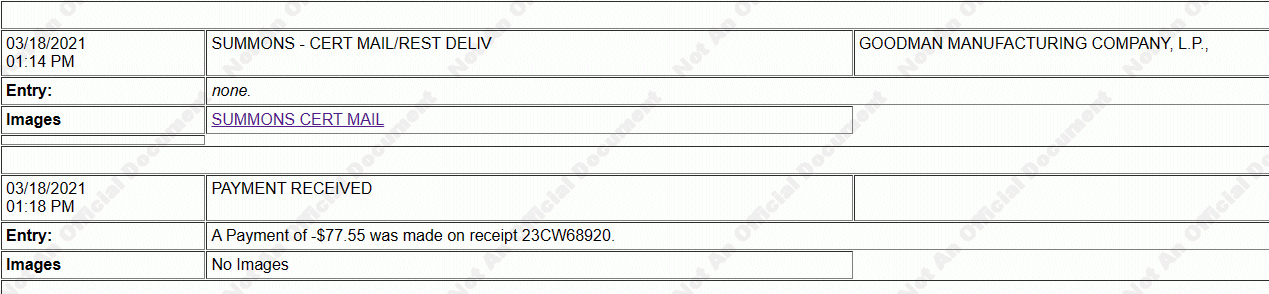
In the small claims division in Faulkner County Arkansas, I filed a suit against Goodman Manufacturing for selling a faulty HVAC to me. The court charged me $12.55 on top of the filing fee, supposedly to serve the suit on Goodman by certified mail.
Eventually, Goodman wrote a motion to dismiss based on improper service and showed a copy of the service envelope with a regular stamp on it. The court is collecting over $10 extra per plaintiff, and if the plaintiff has a good case that concerns a company that has lawyered up, the case can be thrown out on a technicality. (One of the other defendants settled with me, so I know it was a good case.) See the FREE Doc of the Day at the end of the post.
In a case in the Federal District Court of Southern California, five of the defendants were attorneys who were accused of committing malpractice on a company that I was a shareholder in. There were other harms against me claimed in the same lawsuit. The malpractice claim is what is called “derivative”. A derivative suit cannot be filed by a non-attorney. Who knew?
The court allowed me to proceed on the derivative suit and denied me leave to hire an attorney to explain what a derivative suit was unless I hired the attorney to represent me in the entire case. That might have cost more than I would recover. There was no fee shifting provision that would allow me to recover the costs of the lawsuit.
When I discovered on my own that by proceeding on the derivative suit I might be charged with practicing law without a license, I brought it to the Court’s attention as a voluntary dismissal. Judge Sammartino decided that I dismissed because the attorneys were going to prevail and ordered me to pay their attorney fees on an anti-SLAPP motion. Never mind that malpractice and conversion claims are not subject to the fee shifting anti-SLAPP statute.
In the Federal Court in the Eastern District of Arkansas, there are conflicting rules about non-attorneys using electronic filing. One says non-attorneys cannot use electronic filing. Period. That is the rule Judge Lee P. Rudofsky enforced against me. There is another rule that says a person can gain permission to use electronic filing by filing a motion. I tried that, to no avail.
“Conventional” paper filing taxes the pro se litigant. Instead of filing whenever convenient, the non-attorney must drive to the courthouse during business hours or mail the documents and cross her fingers.
I went into an important hearing on the case once and learned that my adversary’s attorneys received an order by electronic service the day before that I did not get in the mail yet. They had an opportunity to research the law before we discussed it, and I did not.
Each of the approximately 100 documents I filed in the case cost me about $100 extra to copy four times and using the GSA mileage expense to drive to the courthouse and home. That is $10,000 I could not spend on discovery, like depositions and subpoenas. I have an autoimmune disease and was forced to go into public to file. (Once I went to the courthouse on the last day to file. I was feeling a little more lousy than usual, so I went to an urgent care after and found out I had COVID. If I had electronic filing, I would not have exposed others to the disease.)
What can be done about this taxation of the poor and middleclass that can’t afford to pay an attorney hundreds of dollars an hour for representation?
It will probably take a Constitutional challenge to the laws that discriminate against the majority class. Where judges like Janis L. Sammartino, Lee P. Rudofsky or the Clerk of the Court are misapplying the law or ignoring the law, it means filing an appeal and prevailing.
Good luck.
If you have a story about systemic bias in the courts, please shoot an email to bohemian_books@yahoo.com.
Doc of the Day
Testaliars. What should be the penalty for spoliation and perjury in a civil suit?
“Testaliars” is what Consumer Attorney Jerry Jarzombek calls agents and attorneys representing creditors who frequently falsify affidavits or present erroneous legal documents to the court, according to an article by Deborah L. Cohen published in the ABA Journal called “Pennies on the Dollar”.
“They are scavengers, buzzards picking at the decaying carcass of a debt,” Mr. Jarzombek was quoted as saying.
My appellate brief in a case against Portfolio Recovery Associates, LLC, is due on November 6th. You can read about some of PRA’s dishonesty when it is complete. Unfortunately, the presiding judge, Trump appointee Lee P. Rudofsky, was less than honest in his opinions, as well.
Some of the dishonest statements require discussion of documents that are filed under seal. So, I am working on a motion to unseal those records.
Any brave attorney who wants to help on the case, please contact me at bohemian_books@yahoo.com. You can probably get this case turned around on appeal, and there is a fee shifting provision in the FDCPA. PRA settled with the CFPB with $12M in a fine for doing some of the things I claimed PRA did to me. PRA settled a case similar to mine where the jury awarded $82M in punitive damages.
The sanctions for spoliation of evidence and perjury should be enough to make taking this case worthwhile for an attorney who is ready to retire.
Therapist Said Karma Would Get PRA Group, Inc.
She was right!
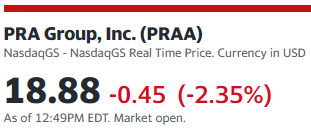
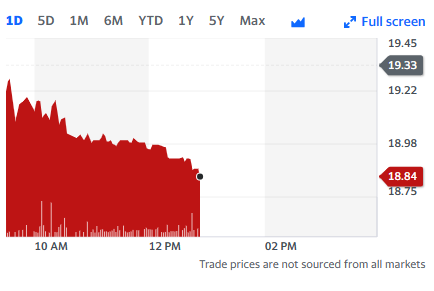
Data and graph by Yahoo Finance.
It keeps falling, but I need to take a break from the blog for a long weekend.
Can’t wait to see what happens when the Eighth Circuit Court of Appeals tells Judge Lee P. Rudofsky that he needs to let a jury decide what the damages are when a debt collector forces a person to sue to make the phone calls stop.
What Would Make Portfolio Recovery Associates Stop Making Annoying Phone Calls? An Open Email to the World’s Most Litigious Debt Buyer
Dear Counsel,
Troutman Pepper is well aware that the bill of sale offered as evidence of the alleged debt was not adequate proof, as I argued, because there was no reference to the -6049 account nor to me.
Assuming my appeal is successful, I intend to inform the jury that I incurred further damages during the pendency of the appeal. These include but are not limited to an increase in anxiety.
My sleep pattern is disrupted again, and I have had only about four hours of sleep per night for about three weeks. The sleep I have is filled with lucid dreams about traumatic experiences that I had buried by 2017.
While awake, I am ruminating on PRA’s implied threat that it will attack my husband, who keeps his finances completely separate from mine, which might cause discord in an amazing marriage.
The Court was wrong when he said suing PRA was my choice. Filing suit caused PRA to set the balance to zero, regardless if it was a waiver with an IRC violation or an admission that the debt arose from a data error or fraud. Filing suit presumably would stop PRA from making further annoying phone calls to me after the 30 day verification period. PRA said it stopped calling the -6000 number in 2013, then started calling it again seven years later.
If you know any other way to get PRA to stop calling a person forever, other than suing Portfolio Recovery or giving them an extorted payment, let me know.
Thank you,
Laura Lynn Hammett
***********************
Please leave your comments below, or email bohemian_books@yahoo.com
A Conversation with Federal District Judge Lee P. Rudofsky
*WARNING! WARNING! This is parody.
The judge’s actual words are in black. I moved whole sentences around a bit. Maybe I should practice law; I already truncate sentences and splice phrases from different paragraphs together. I did change third person to second person “you” statements without using [brackets]. Where I am surmising what Judge Rudofsky is thinking, the text is blue. The way I wish I could write in my appellate brief is in red.
Judge Rudofsky:
Pending before the Court is Defendant PRA’s Motion for Taxable Costs. Pursuant to Rule 54(d)(1) and 28 U.S.C. § 1920, PRA requests $8356.18 in costs. You make numerous arguments as to why the Court should not impose the requested costs. Your arguments are not persuasive. No arguments or reasoning can influence me, because I have a solemn pact to protect the interests of Walmart, and PRA buys billions of dollars of worthless debts from GE Capital Walmart. We gotta get PRA paid. Accordingly, the Court GRANTS PRA’s Motion.
Laura Lynn:
But you are not following the law and you are falsifying the record.
Judge Rudofsky:
I do want to tell you that I am not one of those judges who gets concerned or worried or upset about appeals. I get paid the same whether I get it right or get it wrong. In fact, the cabal gives me extra points if I keep the masses in their place. I’m on the fast track to a position as Grand Poobah.
Laura Lynn:
But, your honor, I am a 61-year-old with severe Hashimoto’s Disease and stress related insomnia. It is difficult for me to take a job, because I never know if I will have the energy to leave the house. I am trying to make money writing, but that is difficult. That is why I didn’t use my bachelor’s degree in journalism right after graduation and worked in real estate instead. I lost all my relatively liquid assets in the COVID-Crash and live on a $639 per month pension.
Judge Rudofsky:
Liar! Elsewhere you state that your monthly income is $630.
Laura Lynn:
I’m sorry. It’s not that I was too tired to look up my deposit receipts or my pinky finger slipped when I reached for the 9. I was trying to keep one extra vegetarian salad at Chipotle each month without reporting it.
Judge Rudofsky:
Plebeian. You also cite to 15 U.S.C. § 1692(k). § 1692 does not have a subsection (k). You mean § 1692k.
Laura Lynn:
I beg your forgiveness. My sister Mary Sherman is right. I am a “moron”.
It seems a little Draconian though, to make me pay more than a year’s pension for the debt buyer’s costs, when I could not afford to pay for the depositions that you said would help my case.
Judge Rudofsky:
You have not shown that you are currently so destitute that awarding taxable costs would be inequitable. You do not note what your expenses are.
I do not believe that you can’t get by on $639 per hour and still pay PRA’s costs. Attorneys like James Trefil get paid half that and pay their bills. Well, maybe not James Trefil, but you understand my point.
Laura Lynn:
But Your Honor, I said $639 per month.
Judge Rudofsky:
That does not create — a more favorable situation for you were this to go to a jury than you had before. In fact, if it does anything, it hurts you, but I just don’t think it makes any difference one way or the — or the other. Notwithstanding your status of a poverty level income, you appear to concede that you have assets of at least $70,000 in a capital account.
Laura Lynn:
Your Honor, (exasperated), that money is being held by my sisters who refuse to dissolve a family-owned limited liability company that has no purpose to exist, other than to hold my capital. That is what one of my 12 lawsuits over a lifetime is about. That Court, Judge Linda Lopez, said that my sisters are using reasonable business judgment to decide that my capital is assets of the company and dissolution is not required as long as the company holds assets.
It is on appeal.
Judge Rudofsky:
Oh, that is wonderful. I’m sure Linda appreciates you appealing. I think it’s a great part of our system and, quite frankly, it makes me feel better that there are other judges looking over my shoulder who can tell me if they think I got it right.
Laura Lynn:
What if they think you got it wrong?
***************************
Please consider helping me defray the costs of appealing this order. I am considering framing a question to SCOTUS: When a federal district judge, who cannot be fired according to the will of the people, dismantles the FDCPA, is he making an unconstitutional power grab?
You can CashApp a donation to $CoolOldStuff. Or contact me at bohemian_books@yahoo.com. Especially if you can contribute free legal representation or know an organization that pays filing fees for people who can’t qualify as in forma pauperis. Thank you. (This is a gift to an individual, not a 501(c)(3) nonprofit organization.)
Satan and Federal Court Judge Lee P. Rudofsky
No, I am not saying Judge Lee P. Rudofsky is Satan or the Anti-Christ.
I am just saying that we can learn a lesson by comparing the two.
Judge Rudofsky has now granted Portfolio Recovery Associates motion for me to pay their costs of defending against a lawsuit arising from incessant phone calls PRA made in an attempt to collect money I did not owe to them.
Along the way, Judge Rudofsky twisted words, lied, deceived and may have orchestrated the falsification of a transcript. I will detail my claims in my appeal and in other posts on this blog. Here is the big picture.
Judge Rudofsky is incredibly intelligent.
He studied at Cornell. He studied at Harvard. He lived in Israel for a year, and I presume he speaks Hebrew well. He writes in English with a silver “tongue”.
But intellect is not an indication of integrity. And Judge Rudofsky lacks integrity.
He lies. He deceives. He has no compassion nor empathy for the ordinary person.
He is a dangerous man.
(Being dangerous can be taken as a compliment of sorts. Sometimes I call my husband “cute”. Then I playfully correct myself. “I mean you look sexy and dangerous.” Judge Rudofsky should not take my comment about him as a compliment.)
Here are a few verses about Satan taken from the King James Version that remind me of Judge Lee Rudofsky.
Genesis 3:1
Now the serpent was more subtil than any beast of the field which the Lord God had made.
2 Corinthians 11:14-15
And no marvel; for Satan himself is transformed into an angel of light.
Therefore it is no great thing if his ministers also be transformed as the ministers of righteousness; whose end shall be according to their works.
1 Peter 5:8
Be sober, be vigilant; because your adversary the devil, as a roaring lion, walketh about, seeking whom he may devour:
2 Corinthians 11:3
But I fear, lest by any means, as the serpent beguiled Eve through his subtilty… [which refers to Genesis 3:4-5) And the serpent said unto the woman, Ye shall not surely die: For God doth know that in the day ye eat thereof, then your eyes shall be opened, and ye shall be as gods, knowing good and evil.
And Eve fell for it. Be on your guard. When you read orders written by Judge Rudofsky, know that he is tweeking the truth, whether through subtle deception or outright lies. If your case is disambiguated from the plaintiff who failed in front of Judge Rudofsky, the Judge may fictionalize the evidence to fall under the precedent that fulfils his agenda.
His agenda is to please those who control the most money, in exchange for prestige, power and possessions.
2 Timothy 3:13
But evil men and seducers shall wax worse and worse, deceiving, and being deceived.
Matthew 7:15-17
Beware of false prophets, which come to you in sheep’s clothing, but inwardly they are ravening wolves.
Ye shall know them by their fruits. Do men gather grapes of thorns, or figs of thistles?
Even so every good tree bringeth forth good fruit; but a corrupt tree bringeth forth evil fruit.
Judge Rudofsky’s fruit is evil. He presided on a case filed by a self-represented, low-income, sickly woman against a billion-dollar debt buyer. He admittedly misquoted the plaintiff to say she agreed she owed a debt, ignoring the score of clear and concise statements that the woman did not owe the debt. He refused to let a jury decide.
The woman told the judge that all her assets other than those that are protected in bankruptcy were lost or taken from her since COVID-19. She showed that her efforts to re-enter the workforce by reviving her writing career resulted in a loss, at least in 2022. She said that she went to other courts to try to recover some of those assets but lost at the trial court and is on appeal. (Only 20% of appeals are successful and the number by self-represented litigants approaches zero.)
Judge Rudofsky ordered the woman, me, to pay over a year’s pension in costs anyhow. This is not a direct quote, but to paraphrase, he said “let her eat cake.”
Are Judges Approving Tax Evasion on Debt Collector Portfolio Recovery Associates’ Cases?
Excerpt of class action settlement from Pollak et al v. PRA:
“PRA will provide, without imposing any condition or charge whatsoever, a credit to each account belonging to a Non-Zero Balance Class Member (“Account”), in an amount not to exceed the outstanding balance of each Account, up to $500.00 per Non-Zero Balance Class Member and collectively up to $1,092,000.00. No cash payment will result from any credit provided to a Non-Zero Balance Class Member’s account(s), and PRA agrees not to issue any Non-Zero Balance Class Member a form I099-C due to the credit.“
The PRA Group, Inc. subsidiary emphasized, toward the beginning of the settlement agreement, “PRA has denied, and continues to deny, each claim and allegation of wrongdoing Plaintiff alleges in the Litigation. PRA also has denied, and continues to deny, inter alia, any allegations that Plaintiff or the Settlement Class suffered any damage whatsoever, were harmed in any way, or are entitled to any relief as a result of any conduct on the part of PRA as alleged by Plaintiff in this Litigation.”
In the case I filed against PRA, they denied, denied, denied. Judge Lee P. Rudofsky agreed with PRA. He said I owed money to PRA and no reasonable juror would disagree with him. But PRA lawyers from Rose Law Firm, Troutman Pepper and PRA big-wig Meryl Dreano all told the judge that Portfolio Recovery set my balance to zero as a “waiver” and had no intention of filing a 1099-C due to the waiver.
Judge Rudofsky winked at PRA and said, you’re right, setting the balance to zero was a “waiver”, but don’t bother complying with the tax code. That is just for the little people.
The Pollak plaintiffs were not suing for the misrepresentation of the amount or character of a debt. They alleged that the notorious debt collector sent letters threatening litigation with no intent of litigating.
The amount per plaintiff in Pollak is under the mandatory reporting requirement of $600. The money is still taxable, and the aggregate is over a million dollars. There are other tax rules I’ve noticed where the IRS discourages breaking up payments into many small chunks as to evade detection from the IRS of what is one giant transfer of wealth, in the hopes the transfer can be made tax free. The instructions for 1099-C say: “Do not combine multiple cancellations of a debt to determine whether you meet the $600 reporting requirement unless the separate cancellations are under a plan to evade the Form 1099-C requirements.” (emphasis added) It is probably worthwhile for the IRS to investigate the number of recipients of these $500 settlements who reported the gain. This is tippy toe right up to the line. Maybe our law makers can add a few more words to the tax code. Perhaps, “all class action settlements must be reported on the new form 1099-CA.”
At least in my case, PRA could have been crediting my account to zero because I did not owe the debt, as I claimed, in which case they were not conspiring and encouraging what they believed was tax evasion. But no, PRA insisted that it was a waiver and therefore they must admit they had the intent of orchestrating tax evasion. (I’ve already informed the IRS about what transpired.)
One attorney who served PRA on both cases was James Trefil. How many other cases did Mr. Trefil participate and counsel the defendant debt buyer and convince the Courts to ignore the Internal Revenue Code?
(If you know judges who approved settlements of $600 or more per debtor with no 1099-C issued, inform us in the comments or send the case info to me at bohemian_books@yahoo.com. If you send a file stamped copy of the agreement, it will be posted as a Doc of the Day.)
Dark Money, The Federalist Society and Dangerous Judge Lee P. Rudofsky
Those of you who have read this blog since before March 16, 2022 may have noticed a distinct change in my assessment of Judge Lee P. Rudofsky and even a shift in my political leanings.
I am and have always been a Libertarian and Populist. But, not to “waste” my vote, I often register in one of the two predominant parties. For instance, in 2016, I did not want Hillary Clinton to win the presidency. My reasoning was not about the issues. It was because I had several acquaintances in Arkansas who said they worked for Hillary in different capacities, and she is a raging bitch, completely corrupt.
I thought Donald Trump running for president was a joke. Literally. “Ha ha ha, that’s so funny.” “No, he is really running for president.”


I signed up as a Republican and voted in the primaries for someone not Trump.
Unfortunately, I was torn between two men who I would love to see in the presidency. Neither is a lawyer.
Ben Carson and Rand Paul. I think if they ran on the same ticket, they could have beat Trump.
Back in March 2022, I respected Judge Lee P. Rudofsky. I thought he was on a trajectile to the U.S. Supreme Court. I wrote an out-of-character blog post, praising the young judge. “What Court Should Look Like: The Honorable Lee P. Rudofsky Presiding”
That was before I discovered Rudofsky is a liar and cheat.
It seemed like his blatant corruption from the bench would be the end of his career.
Little did I know…
Today the magic genie inside YouTube brought up a two-year-old speech it thought might interest me. It was right.
The speaker is Senator Sheldon Whitehouse, a Democrat from Rhode Island.
Everything he said sounds true to me. The main take away is that the Federalist Society inner circle, including Judge Rudofsky and appellate counsel on my case against Portfolio Recovery Associates, LLC, Misha Tseytlin, are auditioning for promotions to judgeships all the way up to the Supreme Court.
It does not matter one bit that the actors are oppressing the ordinary person. All that matters is allegiance to the moneyed elite.
This is the first time I’ve heard of Senator Whitehouse. I listen to Federalist Society presentations for fun. How did I come to the exact conclusions as this Democrat? There must be truth and spirit in what he says.
Please accept this as your FREE Doc of the Day.
 A Higher Law