Chaos, Controversy and Court Corruption
Common people receive no relief from our courts.
The system is perfect. The people involved pervert and destroy.
Here are some of the names of court employees that have turned our court system into a piggy bank for attorneys and Big Business Billionaires.
Judge Susan Weaver, Arkansas State Court
Court Reporter Jana Perry, Arkansas State Court
Judge Lee P. Rudofsky, Federal District Court Eastern Arkansas
Judge Raymond W. Gruender, Eighth Circuit Court of Appeals
Judge Ralph R. Erikson, Eighth Circuit Court of Appeals
Judge David R. Stras, Eighth Circuit Court of Appeals
Judge Todd W. Robinson, Federal District Court, Southern California
Judge Linda Lopez, Federal District Court, Southern California
Judge Janis L. Sammartino, Federal District Court, Southern California
Clerk “Jude” or “JPP” Federal District Court, Southern California
Big Business Billionaires in health insurance, hospitals and debt collection cannot be held accountable for their unethical, often illegal practices if common people cannot access our courts.
This post is conclusionary. But read through the years of documentation I discuss in the hundreds of other posts. Download FREE Docs of the Day. Consult with me; there is a synergy to sharing experience and information.
Solutions? Demand transparency in court proceedings. Shift the focus of law enforcement from victimless crimes to white collar crime, especially honest services fraud. File legitimate complaints with regulatory agencies. Then allow individuals to use the agency findings as evidence in private claims.
My petition for writ of certiorari to SCOTUS focuses attention on these solutions. Read Sup. Ct. 24-6113. Move the court for permission to file an amicus brief or offer to take over the pro se case on contingency.
A Universal Problem: World Courts Show More Concern for Procedure than Merits
Thank you to Jojy George Koduvath for his insightful WordPress blog IndianLawLive.net. Indian law is not precedential in the United States, but it is informative.
Also, the LAWPHiL Project for posting the following court document from which I quote. This caselaw puts my thoughts on the error of our courts in relying on procedure instead of merit so well.
“The court has [the] discretion to dismiss or not to dismiss an appellant’s appeal. It is a power conferred on the court, not a duty. The ‘discretion must be a sound one, to be exercised in accordance with the tenets of justice and fair play, having in mind the circumstances obtaining in each case.’ Technicalities, however, must be avoided. The law abhors technicalities that impede the cause of justice. The court’s primary duty is to render or dispense justice. ‘A litigation is not a game of technicalities.’ ‘Law suits, unlike duels, are not to be won by a rapier’s thrust. Technicality, when it deserts its proper office as an aid to justice and becomes its great hindrance and chief enemy, deserves scant consideration from courts.’ Litigations must be decided on their merits and not on technicality. Every party litigant must be afforded the amplest opportunity for the proper and just determination of his cause, free from the unacceptable plea of technicalities. Thus, dismissal of appeals purely on technical grounds is frowned upon where the policy of the court is to encourage hearings of appeals on their merits and the rules of procedure ought not to be applied in a very rigid, technical sense; rules of procedure are used only to help secure, not override substantial justice. It is a far better and more prudent course of action for the court to excuse a technical lapse and afford the parties a review of the case on appeal to attain the ends of justice rather than dispose of the case on technicality and cause a grave injustice to the parties, giving a false impression of speedy disposal of cases while actually resulting in more delay, if not a miscarriage of justice. (Citations omitted)” 582 Phil. 600 (2008) [Per J. Chico-Nazario, Third Division] at 612-613.
https://lawphil.net/judjuris/juri2017/nov2017/gr_208224_2017.html#fnt56
Judge Susan Weaver’s Corruption: Will Supreme Court Justices Curtail Her Illegal Activity?
Please send this post to all your elderly friends in Arkansas, or thinking of retiring to Arkansas.
My reality is that Susan Weaver, Rita Gruber, Cindy Thyer and Brandon Harrison are typical elitists who think only lawyers and people with money to burn should be able to retire comfortably and have the ability to pass property on through a trust. Truth and justice do not matter to these reprehensible thugs.
I will use my last breath to expose the corruption in the judiciary and release the common person from the tyranny of officers of the court gone amuck.
Good Cause to Continue Case Against Shelter Insurance: Judge Susan Weaver is an evil, lying, conniving judge that needs to recuse.
Comes now separate and only Plaintiff, Laura Lynn Hammett, an individual, (called herein “Plaintiff” or the “Individual”) in pro se, and for her application to continue this case on the court’s calendar for good cause states as follows:
- The Court issued a notice dated October 15, 2024 that the case will be dismissed pursuant to Rule 41, Arkansas Rules of Civil Procedure, for want of prosecution, unless application to continue and showing of good cause is made within 2 weeks of the date of notice.
- Plaintiff is filing this application timely.
- Good cause exists to continue the case on the court’s calendar.
- A similar notice was issued and responded to in 2023. The same reasons apply, but there is further evidence that it is a violation of Hammett’s due process to allow Judge Susan Weaver to make any decisions on this case, or any case involving Hammett.
- It is the Court who has failed to promptly dispose of the matters before her. Plaintiff has waited patiently for the Court to decide the Motion for Recusal filed September 27, 2021 and the Motions to Dismiss filed October 20, 2021 and October 28, 2021.
- More importantly, there is a related case, Pietrczak v. Laura Lynn and Rural Revival Living Trust, 65-CV-21-20, that is on appeal, which addresses common issues with this case that should be decided consistently. The Court appears to have delayed and is now evading deciding the pending motions on the merits because the Court intends to make contradictory orders against Hammett on the two cases.
- The Motion for Recusal was brought in major part because Judge Susan Kaye Weaver presiding “conspire[ed] [with Court Reporter Jana Perry and Pietrczak attorney William “Zac” White] to make an inaccurate transcription of the hearing of August 4, 2021 [in Pietrczak].” Motion for Recusal ¶ 1.
- Plaintiff filed a lawsuit under 42 U.S.C. 1983 against Judge Weaver, Jana Perry and Pietrczak attorney William “Zac” White, Federal District Court for the Eastern District of Arkansas case no. 4:21-CV-857-BRW. The 1983 case was dismissed (erroneously) based on absolute judicial immunity and Rooker-Feldman. Plaintiff appealed. The appeal was denied summarily before briefing.
- Plaintiff had an acute case of Hashimoto’s Disease which caused Plaintiff to be too fatigued to take the 1983 case further at that time. (Plaintiff is trying to recover by following a strict dietary protocol and using stress management techniques. The Court’s misconduct is a major stressor which exacerbates Hashimoto’s Disease and Plaintiff intends to file a second 1983 case because of the subsequent falsification of the transcript of the Pietrczak hearing held March 17, 2022.) There is a “Catch 22”, as legal work that addresses debilitating stress causes more stress.
- By relying on Rooker-Feldman for her defense in the 1983 suit, Judge Weaver should make a concerted effort to resolve the issue of whether falsification of the transcripts in one case concerning Hammett shows bias against Hammett by the conspirator judge.
- As shown on Court Connect, Shelter Mutual Insurance Company, (“Shelter”), filed an opposition to the Motion for Recusal on October 1, 2021.
- Jennings Insurance, Inc., (“Jennings”), filed an opposition to the Motion for Recusal on October 4, 2021.
- Plaintiff replied to the opposition to the Motion for Recusal on October 4, 2021.
- Shelter filed a Motion to Dismiss the Second Amended Complaint on October 20, 2021.
- Jennings filed a MTD to the SAC which adopted Shelter’s MTD at ¶ 5 on October 28, 2021.
- Plaintiff filed an opposition to the Shelter MTD on October 21, 2021 and an opposition to the combined Jennings MTD on November 9, 2021.
- Shelter filed a reply to the MTD on October 26, 2021.
- Shelter and Jennings each filed an answer to the SAC on October 21, 2021.
- Jennings filed a reply to the MTD on November 17, 2021.
- The Court failed to issue an order on the Motion for Recusal and the MTDs. There was no further activity since November 17, 2021.
- On September 21, 2021 the Court issued an order dismissing the First Amended Complaint with leave to amend. The Court required Plaintiff to add “Rural Revival Living Trust” as a necessary party pursuant to Ark. R. Civ. Proc. 19.
- Plaintiff added the Trustee of the Rural Revival Living Trust as a defendant, because Plaintiff personally paid the premium for the trustee after Shelter required the trustee to be named on the policy.
- In the Brief supporting the Jennings MTD, Jennings argues that Plaintiff naming the trust as a defendant is “axiomatic as suing oneself in any capacity raises the following questions — and many others.”
- In Pietrczak, Judge Susan Weaver dismissed Laura Lynn [Hammett] as a defendant, but then proceeded to find against the Rural Revival Living Trust by default. This is one issue on appeal, labeled the Common Defense Doctrine.
- It is a clear error and appearance of bias for the Court to agree Hammett as an individual and the trust are “oneself” in this case but treat Hammett as an individual and the trust as separate defendants with non-aligned interests in Pietrczak. The Court denied Hammett’s motion to intervene in Pietrczak. It is probable that Judge Weaver neglected to rule on pending motions in this case to evade providing Hammett with more reason to overturn the order in Pietrczak which transferred Hammett’s individual interest in the subject property to a man who gave a hand-written letter describing the fraud he was committing on Hammett to his attorney William “Zac” White.
- Also, the appearance of bias of Judge Susan Weaver and her refusal to settle the record by playing the audio recording of the falsified hearings in open court is an issue on appeal in Pietrczak that should affect the outcome of this case.
- The Pietrczak order that transferred Hammett’s individual rights in the property to the defrauding party was issued on April 7, 2022.
- The April 7, 2022 order was not final, technically. Neither was an April 14, 2022 order that simply denied any and all motions in the case. Because there was no notice of the Court’s motion to modify earlier orders, there was no modification of those orders. That includes the April 7, 2022 order.
- Laura said the order of April 14, 2022 was “confusing” in an “objection” filed April 16, 2022 and the notice of appeal filed April 18, 2022. Laura expressed that she thought the April 7, 2022 order was the judgment. “There are several post judgment motions that are allowed.” The court failed to clarify her meaning before the appeal was docketed.
- The court did not write “final order” or “judgment” on the April 14, 2022 order. The clerk, under direct supervision of Judge Weaver, failed to “close” the case on the docket and failed to file a disposition.
- A licensed attorney hired to represent the Rural Revival Living Trust on Pietrczak determined that the April 7, 2022 order was final.
- On June 10, 2022, Clerk Debbie Loggins allowed for execution of the April 7, 2022 order.
- On May 22, 2024, with no jurisdiction, Judge Weaver wrote that the case was still open and would be dismissed unless a party showed cause why not. Laura showed cause why the court should “Continue the Case on the Court’s Docket Pending Order on Appeal” on May 22, 2024. Laura said, “a final judgment was filed April 7, 2022” and that the case was docketed with the Court of Appeals. Docketing to the COA relieved Judge Weaver of jurisdiction.
- On June 7, 2024, the circuit court wrote: “A final order was entered April 14, 2022; a disposition sheet was never entered following the entry of the order. Due to no disposition sheet entered in the case, the case appeared to remain open.” (Filings entered after the record on appeal lodged.)
- Judge Weaver did not ask the appellate court, who had docketed the appeal almost 19 months earlier, for permission to make the clerical changes. The changes were not reflected in the record to the appellate court.
- The confusion and deception embodied in the orders written by Judge Weaver on Pietrczak show further evidence that Judge Weaver is not trying to deliver justice. She is delivering Hammett’s property rights to a represented party, who presumably transferred a significant portion of the proceeds from selling the property Hammett had a right to to a third party, to the attorney.
Brief
The June 7, 2024 order was entered “during the pendency of an appeal”, after the appeal was docketed, with no “prior notice to all parties” and no “leave of the appellate court”. The circuit court lacked jurisdiction. The June 7, 2024 order is of no effect. Rule 60 – Relief from Judgment, Decree or Order, Ark. R. Civ. P. 60(b)
ARCP Rule 41 “Section (b) also marks a significant variation from FRCP 41(b). Under this rule, the trial court has the right to dismiss on its own motion a claim for failure to prosecute the action or failure to comply with these rules or any order of the court. Under the Federal Rule, such dismissal must be on motion of the defendant or other party affected.” Reporter’s notes to Rule 41. Judge Susan Weaver is abusing her power by calling her own failure to decide the matters assigned to the judge as required by Judicial Code of Conduct Rule 2.7 a failure of the litigant to prosecute.
“A judge shall act at all times in a manner that promotes public confidence in the [] impartiality of the judiciary [].” Judicial Code of Conduct 1.2. Deciding two cases involving the same litigant and the same issues differently is a clear indication of bias. Refusal of this Court to issue the contrary ruling on this case until after the appeal of the related case and taking it a step further by dismissing this case on false grounds violates the Rules of Judicial Conduct and the Plaintiff’s fundamental Constitutional right to equal protection under the law.
Wherefore, Plaintiff asks this Court to continue the proceedings on its calendar, and to issue a reasoned order on the two pending motions, considering the orders made in Pietrczak in the interim.
Respectfully submitted, October 27, 2024
Laura Lynn Hammett
16 Gold Lake Club Road
Conway, Arkansas 72032
(760) 966-6000
Bohemian_books@yahoo.com
Listen in On a Chat with My new Best Friend, ChatGPT: What to do about judge Susan Weaver
http://www.chatGPT.com My questions, their answers.
A plaintiff committed fraud upon the court. The defendant suspected the fraud, but took a year to find evidence. The plaintiff slipped up and put a handwritten note describing the intended fraud, written before the case was filed, into a discovery production. When the defendant presented the evidence to the court in a motion for contempt, the court dismissed the defendant, but gave default judgment against a common defense doctrine defendant, and took rights to the property away from the dismissed with prejudice defendant. Is it still fraud upon the court if the court is complicit? What can the dismissed defendant do to rectify the situation?
This situation involves a complex set of legal issues, including fraud upon the court, the court’s potential complicity, and remedies available to the dismissed defendant. Let’s break it down:
1. Is it still fraud upon the court if the court is complicit?
Yes, it can still be considered fraud upon the court, even if the court appears complicit. “Fraud upon the court” refers to fraud that directly interferes with the administration of justice and affects the integrity of the judicial process. It typically involves egregious conduct, such as fabricating evidence, bribing a judge, or other deceit that taints the proceedings in a way that prevents the court from performing its impartial role.
If a party has engaged in deliberate misconduct, and the court is either unaware or knowingly allows it to proceed, the fraud itself remains. The court’s involvement or negligence doesn’t erase the fraudulent act; it may just complicate efforts to rectify it.
2. What can the dismissed defendant do to rectify the situation?
The dismissed defendant still has potential avenues to challenge the judgment, particularly if they believe fraud upon the court was involved:
- Motion to Vacate Judgment: Under Rule 60(b)(3) of the Federal Rules of Civil Procedure (or similar state law), a party can file a motion to vacate the judgment if there was fraud, misrepresentation, or other misconduct by an adverse party. There is a one-year time limit from the judgment, but for fraud upon the court (which is a more serious offense), there is no time limit under Rule 60(d)(3).
- Appeal the Court’s Decision: If the defendant was dismissed, and the court made adverse rulings that affected their property rights, they may be able to appeal the dismissal or the court’s treatment of their rights. The appeal could argue that the court’s actions were improper based on the newly discovered evidence of fraud.
- Request an Investigation or File an Ethics Complaint: If the defendant believes the court acted improperly or was complicit in the fraud, they may also consider filing a judicial misconduct complaint. This would be a separate process from the case itself but could bring attention to any inappropriate actions by the court.
- Reopen the Case on Grounds of Fraud: If the defendant was dismissed with prejudice but their property rights were affected by the fraud, they could argue that the dismissal was based on a fraudulent proceeding. This could lead to reopening the case or filing a new case seeking relief.
3. Next Steps for the Dismissed Defendant
- Legal Strategy: The defendant should consult with a lawyer to develop a clear strategy to bring a Rule 60 motion, reopen the case, or file an appeal. The discovery of the handwritten note suggesting fraud could be key evidence.
- Timing: Since time is often a factor in these motions, especially under Rule 60(b), the defendant should act quickly if they are still within the allowable time frame.
- Fraud Upon the Court Arguments: The defendant could make strong arguments that the plaintiff’s behavior constituted fraud upon the court, which justifies setting aside the prior rulings or judgments. If successful, this could result in the reinstatement of the defendant’s rights or even a new trial.
Ultimately, if a court is truly complicit in the fraud, it makes the situation more difficult but not impossible to rectify. Higher courts or disciplinary bodies may provide the checks and balances necessary to correct the injustice.
What would You say to corrupt cops, courts and kin? Speech at Jamey Noel sentencing.
Ah, that I ever get a chance to speak directly to Judge Susan Kaye Weaver, the witch that gave my living trust property to a known fraudster, Mike Pietrczak and his attorney William Zac White.
Judge Lee P. Rudofsky, who used his academic gift and privilege to help out notorious debt buyer Portfolio Recovery Associates, LLC.
Jeff and Mary Sherman, no matter how much money they were given, it wasn’t enough.
James Trefil. He can’t even win a case against a pro se litigant unless a lower court judge throws it. So he makes up lies about his victims. (Yes, when you are a dishonest lawyer, they are your victims.)
Well, it does feel good to get that out.
Applause to the fine people who didn’t let politics and cronyism scare them away from the Jamey Noel case, who investigated, prosecuted and presided over the trial. Three cheers for Judge Larry Medlock!!!
Court Confirmed it Banned a Citizen from the “Justice Building”.
Click on this Tic Tok. Hear it for yourself. https://www.tiktok.com/t/ZP88Ftygp/
Who is the female in the background whispering to her fellow government employee? It sounds like they are telling Mrs. Betty Figueroa to stay out of the courthouse because Mrs. Figueroa complained that Judge Susan Weaver, with a total lack of jurisdiction, evicted Mrs. Figueroa from the courthouse under threat of incarceration.
This same Arkansas judge took my personal property and real estate rights from me by a court order after I was dismissed from the case with prejudice. Susan Weaver is out of control but seems to have protection for her alleged criminal activity.
If you are also a victim of Judge Susan Weaver in Searcy County, Faulkner County or Van Buren County, please call the FBI public integrity unit.
Why Does Arkansas Court Keep Proceedings Against Judge Susan Kaye Weaver Covered-up?

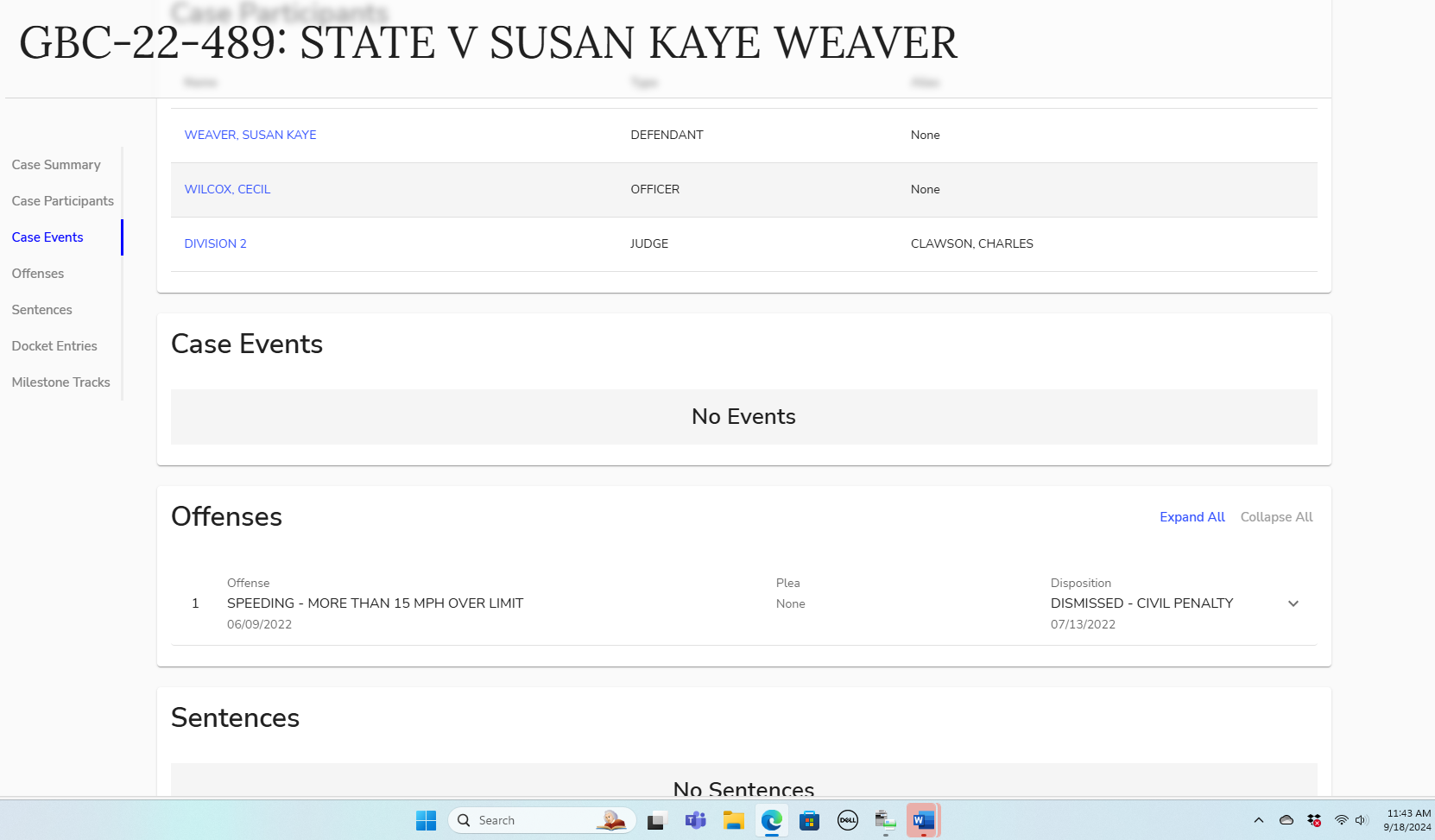

There is a lot of interest in Judge Susan Kaye Weaver of Arkansas Circuit Court on my blog today. So I looked at CourtConnect to see if anything was filed against her.
There was a case from 2022 that had not come to my attention before this. It was apparently a traffic violation for exceeding the speed limit by more than 15 miles per hour.
The problem is, there is scant record of the infraction nor of the opinions by her friend Judge Charles Clawson who presided. The ticket and the orders were not posted. It is customary to see those documents. The case was not designated “under seal” and there is no indication that any procedure was followed to allow for the Star Chamber.
Why is the Public that pays for our courts denied access to simple court documents about a sitting judicial officer?
Welcome to the new world order.
How Judge Lee P. Rudofsky Emulates Adolf Hitler
“This constant lying is not aimed at making the people believe the lie, but at ensuring that nobody believes anything anymore. And with such a people, you can then do what you please. They are deprived not only of their capacity to act but also of their capacity to think and to judge.”
- Hannah Arendt (October 14, 1906 – December 4, 1975) German historian and philosopher, “The Origins of Totalitarianism.”
These lines reflect my concern about certain judges including Lee Rudofsky and Susan Weaver’s use of lies not just to mislead, but to undermine trust in reality altogether, leaving people disoriented and passive. This is the underpinnings of a totalitarian regime.
Judge Susan Weaver Considers it Threatening to Say You Will “File Stuff” Complaining About Her Job Performance
(Transcribed from a recording between pro se litigant Betty Figueroa and Faulkner County judicial clerk “Emma”) The Arkansas state police contacted Mrs. Figueroa and threatened to arrest her if she attended an Arkansas Bar Association function. Mrs. Figueroa is a member. Judge Susan Weaver did not want Mrs. Figueroa to attend.
Betty: She filed a report on me.
Emma: The last few times I’ve talked to you, you’ve said that if she doesn’t file a response, you’re going to take it to the Supreme Court, and that is a threat.
Betty said she was tape recording all their phone conversations.
Emma: Ok, well that’s great.
Emma, later: You threatening to file stuff against Judge Weaver is a threat.
So, if you need to appeal decisions made by the unethical judge, or report her to the JDDC, it seems prudent to just do it. No warning.
Unless you want the Arkansas SWAT to arrest you for peaceful assembly.
 A Higher Law