Attorney: $829,846 – Client: 37 cents
I kid you not.
Here is a copy of the settlement check to the client. Me.
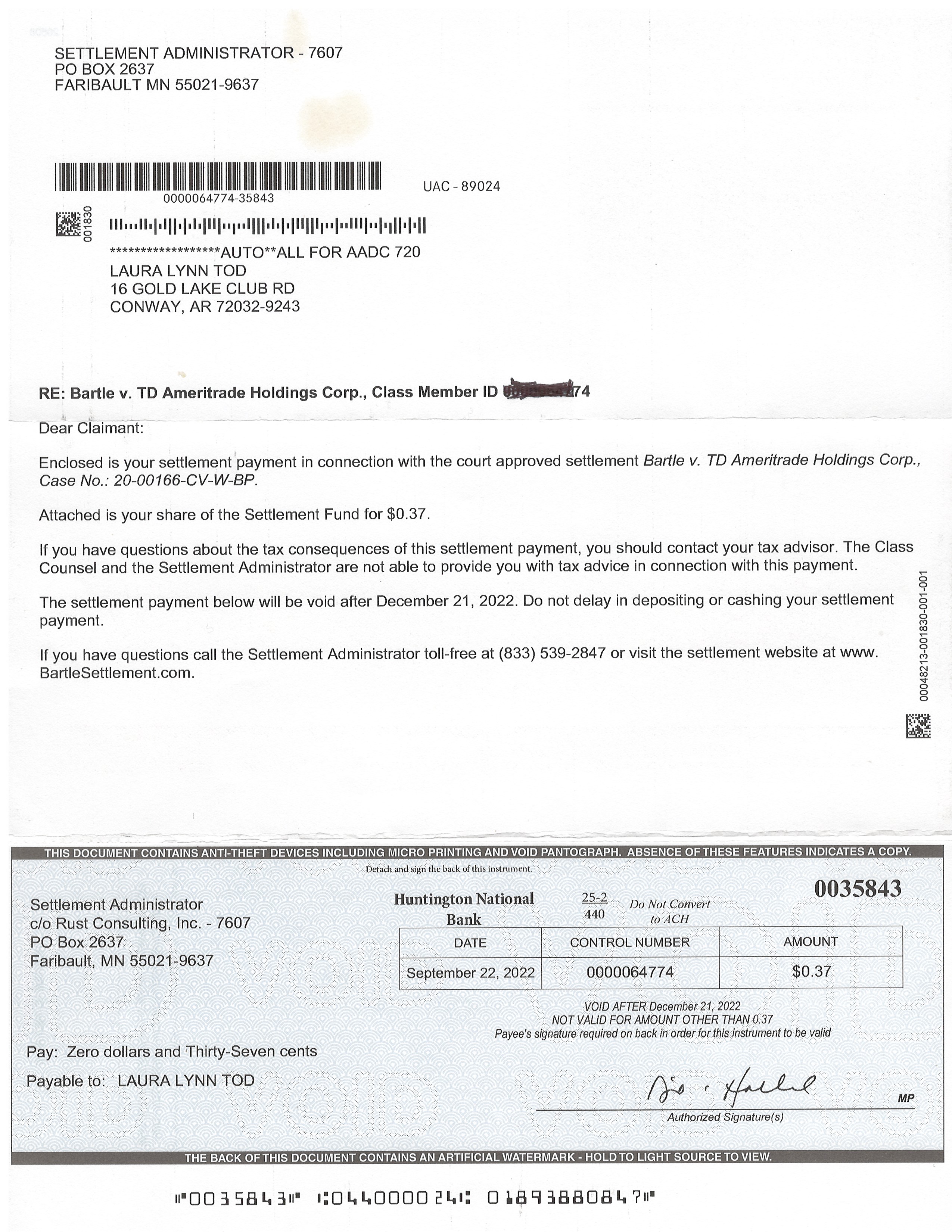
There was a class action suit against stock brokerage Scottrade. It had something to do with Scottrade reporting qualified dividends as substitute payments. The two are treated differently for income tax purposes.
Scottrade settled.
A copy of the settlement agreement can be downloaded below.
Look at section 11. That is the attorney fees section. The attorneys can ask the court for up to $829,846. Past awards in similar cases shows a pattern of judges rubberstamping the motion for attorney fees.
The total of attorney fees and disbursements to the clients (all class members) is $2,325,000. There is a shitload of class members.
My disbursement came out to 37 cents.
If the administrator had to pay retail for postage, the postage cost more than I received.
There is something out-a-wack in our legal system.
The Process of Writing an Appellant’s Brief for Pro Se Litigants
This blog’s readership is growing but I am too busy to write these days. So, I will share a brief glimpse into the work I have accomplished this week.
I am not an attorney. I am a self-represented litigant.
I am working on two appeals and a third case may be headed to trial and then appeal.
If you are faced with an appeal as a pro se litigant, it may seem like a daunting job. It overwhelmed me.
Here are some tips I used that helped me to feel the fear and do it anyways:
- Turn the job into bite size pieces.
- Read the Rules!
- Make a “skeleton”.
What I mean by a “skeleton” is that you find the rules of appellate procedure. The Supreme Court Clerk and Library in Arkansas were both helpful to me. Reach out to the Supreme Court Clerk in your jurisdiction for guidance to the rules if you can’t find them online.
Find a sample brief online that was granted. Again, the Clerk may be able to help you with this.
Make an outline that includes each mandatory section.
Then go through the Clerk’s Portion of the transcript in order, filling in the sections as you go. You should also use the Reporter’s Transcript, even if it is inaccurate, like the one Jana Perry falsified in my case. (The Supreme Court of Arkansas denied my petition for writ of mandate or certiorari to settle the record but did not say why.)
As an example, I am including a downloadable copy of my own work in progress on a case that concerns a corrupt judge, Susan Kaye Weaver. This is an interesting case with over 1,000 pages in the record. Hopefully yours is a normal case with one or a few honest errors.
My saving grace was documenting my objections all along. The opposing counsel whined about how many motions I filed. (He insisted on calling motions “pleadings”. Amateur!) But now I feel like I preserved most of my objections for appeal.
This is NOT legal advice. It is not even a complete or final document. I reserve the right to alter it in any way before filing.
UPDATE: November 23, 2022. The brief is complete! Or to be more accurate, the briefs are complete.
My case involves a trust of which I am trustee, settlor and sole beneficiary. Still, the judge wanted to keep me from advocating for “the trust”. Plaintiff should have named me as trustee, not the trust, but that is getting buried in the minutia.
I had a novel argument that I am not advocating for anyone but myself, so it is my Constitutional right to represent myself.
I am adding the two separate briefs below, one for me as an individual and one as trustee.
I’ll share some hints on how to organize your own papers after the Thanksgiving weekend.
Our God is an awesome God! Be blessed.
 A Higher Law