How a Pro Se Litigant Can Complain About Judicial Ethics Violations
“Won’t the judge get really pissed if I turn him in?”
My fellow self-represented litigant, be bold.
After all, you searched out this information because the judge is already treating you unfairly, favoring the party who is represented by attorneys. You did not try to find an unethical judge when you filed a case. And if someone else is suing you, you definitely did not hope to come across a cheat in a black robe. You hoped for a quick and economical path to justice. The judge is the one who chose to cause trouble and the judge will take as many of your rights from you as the thug can get away with. Fight back.
Statistically, most of the ethics complaints will be determined in favor of the judge. One of my complaints resulted in a “severe” public admonishment against the judicial officer, Commissioner Alan H. Friedenthal, deceased. There were private disciplinary actions taken that are consistent with complaints I filed against Judge Elizabeth Feffer (doing arbitrations, last I checked) and Judge Marjorie Steinberg (who retired in 2011).
If your judge is in Federal Court, find information here.
“The Judicial Conduct and Disability Act of 1980(link is external), 28 U.S.C. §§ 351–364, establishes a process by which any person can file a complaint alleging a federal judge has engaged in “conduct prejudicial to the effective and expeditious administration of the business of the courts” or has become, by reason of a mental or physical disability, “unable to discharge all the duties” of the judicial office.
“The Rules for Judicial-Conduct and Judicial-Disability Proceedings (pdf), as amended on March 12, 2019, provide mandatory and nationally uniform provisions governing the substantive and procedural aspects of judicial conduct and disability proceedings under the Judicial Conduct and Disability Act.
“The judicial conduct and disability review process cannot be used to challenge the correctness of a judge’s decision in a case. A judicial decision that is unfavorable to a litigant does not alone establish misconduct or a disability.”
To put it in the vernacular, an ethics complaint must address corruption, not stupidity. The way I prevailed on my complaint against Alan Friedenthal is that he was both corrupt and stupid. He made a statement in open court, in front of an honest court reporter, proudly revealing that he was reading this blog.
Here is what I wrote to the Arkansas Judicial Discipline and Disability Commission. It was early in the case. The JDDC ruled in favor of Judge Susan Weaver and this only emboldened her. You can download the appeal written years later, which discusses amongst other things, how the transcript of the hearing discussed in the JDDC complaint was fictionalized by Court Reporter Jana Perry. There has yet to be a publication of the actual audio recording.
Pro Se Peaceful Protest: Demand Justice for All
Are you tired of your designated status as a second-class citizen? Do something about it!
Here are 4 things you can do when a judge or court is treating you less than, solely based on your inability to hire an attorney or your refusal to go bankrupt in pursuit of justice:
- File a complaint with the judicial ethics commission in your jurisdiction.
- Ask by motion for recusal of a judge who appears to have a bias.
- Contact the Institute for Justice, http://www.ij.org.
- Contact the ACLU. The Arkansas chapter is at http://www.ACLUArkansas.com.
This is not an exhaustive list. Next week, I will elaborate on one per day. Then on Friday, brainstorm four more. Let’s work together to make the courts work for us, We the People.
Looking for “Friends” to Share Stories of Courtroom Discrimination with SCOTUS
Pro Se Litigant, did a judge deny you access to electronic filing;
Allow represented parties and court reporters to lie about what was in sealed evidence;
Refuse to let you use evidence collected and conclusions about practices drawn through civil investigations by district attorneys and regulatory agencies;
Twist your words;
Appear to have a bias in favor of the represented party?
Please consider writing a brief amicus brief to the Supreme Court of the United States asking for the highest court to grant certiorari, meaning they will consider our cause.
Contact me at bohemian_books@yahoo.com if you want to explore the potential of highlighting your experience, to try to gain access to justice for common people who can’t afford to pay an attorney.
The legality of Recording: Where were Trump and RFK?
Just a few days ago, my tip to victims of harassing phone calls by Portfolio Recovery Associates was to tape all the calls themselves. This is because PRA lies in court and destroys evidence of the calls.
What I forgot to mention, is that when PRA called me, each call began with an admonishment that the call was recorded. Presumably, PRA was giving permission for all parties to record.
In Arkansas, only one party needs to give permission to record. Each state has its own rules, and whether the rules of the caller or receiver take precedence can fill an entire law review article.
In the video of a private conversation between RFK Jr. and Donald Trump posted by RFK the third, we have no indication where either party is located. I read five articles by MSM and not a single one discussed the state of origin or the state in which the call was received.
That information is necessary to evaluate the legality of sharing the recording with the world.
Ethics is another issue.
I agree with all RFK’s platforms. It is his integrity that I am questioning. (I already think Joe and Donald lack integrity.) I agree with the younger Robert Kennedy. The audio ought to be heard by the voters. I am concerned that RFK, presidential hopeful, was so apologetic to our face for doing the right thing. Own it, Bobbie!
Here is another brilliant idea. Let’s make a law that all presidential candidates may be recorded, wiretapped, and have to produce accurate copies of their childhood journals for public consumption. Not really, but instead of listening to politicians blow smoke up our asses, a little transparency would be a breath of fresh air.
Hey, while I’m creating utopia, let’s put surveillance equipment in all judges’ chambers and on their telephones. Wouldn’t We the People finally hear the truth, the whole truth, and nothing but the truth, so help them God?
Can I hire an attorney on limited scope if I am pro se? It depends.
Advocate Lucinda, Your Empowerment Lawyer, explains the advantage of hiring an attorney on limited scope if you represent yourself in court.
The problem is that the rules are different from state to state, in federal court and even between federal district courts in the same circuit. For example, the Central District in California, which covers Los Angeles, offers a clinic or free limited scope representation to pro se litigants. Its sister Ninth Circuit court to the south, which covers San Diego, forbids parties who cannot afford an attorney for all purposes to hire an attorney to explain distinct issues.
In fact, I asked Judge Janis L. Sammartino to allow me to hire an attorney to explain derivative actions to me. I later learned on my own that a derivative action is on behalf of an entity, like an LLC. A pro se litigant is not allowed to advocate a derivative action. Yet, Judge Sammartino forbid me from hiring an attorney on limited scope to represent the LLC in that small cut out claim.
This issue may be discussed in the petition for writ of certiorari I am preparing for the United States Supreme Court. Here is one of my two questions (as a work in progress):
Whether discriminatory practices against the vast majority property class, those who cannot afford legal representation, violate Constitutional due process and the United Nation’s Declaration of Human Rights, Article One?
The case I am using to present the question is in the Eighth Circuit and was presided over by Judge Lee P. Rudofsky at the District Court of Eastern Arkansas. If you are an attorney who wants to earn a quill, I am borrowing money to pay the filing fees and printing and would appreciate representation on contingency. Shoot an email to bohemian_books@yahoo.com if you can practice at the Supreme Court and want to take charge. Or if you can fund hiring an attorney on a fee basis and want to help the rest of us open the gates to justice.
Portfolio Recovery Associates Dumps Numbers Then Lies About the Quantity of Calls They Made
Trump appointed judge Lee P. Rudofsky does not want a jury to hear the evidence in my case against Portfolio Recovery Associates who were collecting an alleged debt generated by Capital One. His last job was as attorney for Walmart and Walmart branded debt from Capital One Credit Cards is sold to Portfolio Recovery Associates.
It wouldn’t help his homeys if the PRA Group subsidiary was exposed.
I know for a fact that PRA made more calls to me than they listed on the call log they generated. I answered the calls. After I told PRA I was filing a lawsuit, all the calls stopped.
Never again did I receive the scripted call, “Hi this is [representative’s name or assumed name] calling on a recorded line for Laura Lynn.” Those calls had the same background noise, the same cadence, and similar neighbor spoofed numbers.
One of the reps told me PRA “owned” all the numbers it called from. I returned calls to those numbers and reached PRA. That changed after PRA produced the falsified phone records.
All of a sudden, none of the numbers worked any longer. PRA was too lazy and stupid to differentiate between the numbers it admitted to calling from and the numbers it actually called from but omitted from its records. It dumped all of them.
Many courts would consider that to be “spoliation” and give a negative inference against the party who destroyed the evidence. Not Judge Rudofsky.
Luckily, I recorded some of the calls to numbers that were on my telephone service provider’s records. My assistant who helped demonstrate that my phone worked made a boo boo. He accidently said it was February 2021. I hadn’t sued until after that, so it was 2022. The last calls from PRA came in February 2021.
If you found this blog because you are getting annoying calls from Portfolio Recovery Associates, hopefully you will learn from my experience. I should have documented even more. It would have been better for me if I wrote down each time I received a call or missed a call from the neighbor spoofed numbers. I should have recorded every one of the calls. I think there are programs you can get to record calls. I’m not great with technology as it is, so I haven’t learned to use any of those programs yet. I should have screenshot the call log on my phone more often and before the oldest numbers fell off the list.
Not that a judge like Lee P. Rudofsky will allow you to progress to a jury trial against PRA or any debt collector. The Eighth Circuit Court of Appeals rubber stamps district court orders against pro se litigants. But if we can document intentional errors well enough, we can possibly stop the errant judges from reaching the Supreme Court.
Challenge to Discrimination Against Pro Se Litigants Heading to the Supreme Court
Debt buying Goliath Portfolio Recovery Associates rejected an offer to settle the case brought against them by me, a pro se litigant.
As promised, here is the offer: (I had to remove references that would disclose the settlement offer PRA made in mediation, even though they made statements in court documents about my lowest offer. They lied about my lowest offer, so maybe they will claim that it isn’t a breach of contract to say you are disclosing what is in a confidential mediation and then lie about it.)
Dear Counsel,
I am open to a settlement with your clients that is 1/10th my final offer in our mediation. It is also the amount [they offered to another person with similar complaints]. PRA must agree to vacate the judgment so as not to harm my credit rating.
Please see my recent FICO score of 803 from Experian, attached. (If I get to trial, I will use this as evidence of the magnitude of emotional distress PRA is causing me by the specter of bankruptcy that is inherent in prolonged litigation, especially for a low income person like myself who is likely to lose for lack of funds rather than lack of merit.)
The agreement should be simple and bilateral. There can be a nondisclosure agreement as to the amount of the settlement, but I will spend no time trying to remove anything I’ve already disclosed about the case from the internet or any other forum. Neither party will ever contact the other party, including to litigate. This means PRA will not try to collect on the judgment (which will be vacated anyhow) nor any alleged debts owed by me, past, present or future. There should be one exclusion, which is the enforcement of this settlement agreement.
It is against the odds that my petition for writ of cert is granted (as it is rare for any pro se petition to be granted), but if it is and I get to trial, I believe a jury will award an $82 million verdict.
This offer will increase by actual costs I incur on appeal to the Supreme Court and be automatically rescinded upon issuance of a writ.
Thank you for your client’s consideration,
Laura Hammett
**********
PRA responded:
FRE 408
Ms. Hammett,
My client rejects your demand. In exchange for a full release and settlement of all claims you have or may have against PRA, my client will forego collecting its taxable costs award of $8,356.18 and any interest accrued on this amount since it was entered on August 23, 2023.
We look forward to hearing from you.
Regards,
Jim
***********
I rescinded my offer.
First glaring problem with PRA’s offer, PRA was collecting on an alleged debt with no documentation about how that debt was incurred. PRA can, by the terms it offered, sell the judgment to another PRA Group subsidiary. Then that debt buyer can come after me. My documentation won’t show the judgment was vacated.
The sneaky attorneys did not include an agreement that PRA will not sue me for anything else. They may try to get an award for costs of the appeal. Or they may come up with some other BS reason to sue me. They sue people often without any legitimate claim.
More importantly, PRA did exactly what I complained about, lied in court documents, had Judge Rudofsky lie in his written order, and PRA does similar things to hundreds of thousands of people. Just like they win by default in 90% of their collection cases, they know they can win in almost 100% of cases against pro se litigants, because most pro se litigants lose because of discriminatory court policies and practices.
Here is a quote from a pro se who reversed his criminal conviction obtained by the United States after going to the Supreme Court, Giridhar Sekhar. Talk about bringing down Goliath!
“I’m a little annoyed with the NDNY federal prosecutor Elizabeth Coombe who willfully put [an alleged perjurer] on the stand knowing that the admission was fabricated, but I think her karmic reward will be to forever be reminded by her colleagues that she was beaten at trial by a pro se defendant.”
Your Kind Words Inspire and Encourage Me to Continue to Fight for Justice for All


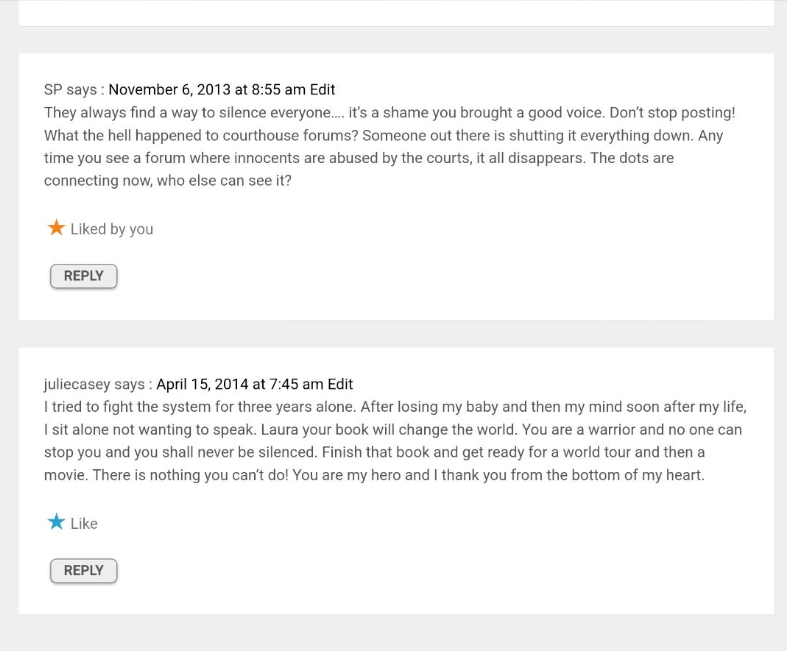
The judges at the Eighth Circuit Court of Appeals are incredibly disappointing. I know I need to petition the Supreme Court to try to effect changes that will give the rest of us (not the ones that control the money) hope. But a colonoscopy sounds better right now.
Then, like the songs of four little angels sent by God, these four readers’ comments were brought to my attention, a decade later.
They inspired and encouraged me to write and fight for justice again. Hopefully, even a grey-haired grandma can help the generations behind her.
Thank you for the love.
Pro se wisdom from a poker player

I was stressing on my Supreme Court bid against Portfolio Recovery Associates LLC and evil judge Lee P. Rudofsky. Unfortunately, the Eighth Circuit let the lower court get away with outright lies and hiding the evidence under seal. If SCOTUS doesn’t help, I will be bankrupt.
How ironic. A debt buyer tries to collect $2,297.63 from someone who has no debt. The alleged debtor sues PRA which causes them to immediately set the balance on the account they bought to zero. Then PRA tosses a bone at the poor woman to settle. The plaintiff insists on more money or going to a jury to decide what it is worth. PRA submits doctored records, lies about the plaintiff in certified court documents and offers lower and lower amounts to settle. Huh? Then the judge joins in on the lies, denies the opportunity to show even a jury the evidence and orders the pro se pensioner to pay for the goliath debt buyer’s litigation costs…even though she could not afford her own. The lawsuit sends the alleged debtor from an 803 FICO score to bankrupt.
When I heard the news the other day, that the appellate judges were going to stand behind Rudofsky with no explanation of why they disagreed with my well supported appeal, I felt like I got kicked in the gut. There is no winning for me. Paying the costs of their defense to the PRA Group company will bankrupt me. Settling for nothing means they got away with harassing another old lady and will do it again and again. But writing and publishing a petition for writ of certiorari will also bankrupt me, if I don’t win, and the chance of being one of the few cases chosen each year as a self-represented litigant approaches zero.
I was ready to quit. I made my rock bottom offer to PRA. (If they reject it, I will share the offer with you, my friends.)
Today I was scrolling through the Facebook page of another female poker player, Meg Chapman. She had these inspiring words to offer:
“If you’re worried about the cost of going for it, you should see the price of staying exactly where you are.”
We Have the Best Legal System Money Can Buy
The common citizen cannot afford to hire an attorney for representation in litigation.
The courts have both a systemic bias and personal judicial bias against the self-represented.
I am taking a case against debt buying goliath Portfolio Recovery Associates, LLC to the Supreme Court of the United States to give SCOTUS the opportunity to discuss this bias.
Here are my questions, as a work in progress:
1) Whether the difference in treatment between pro se litigants and those who are represented by attorneys discriminates based on the distinction of property, as prohibited by the United Nations Universal Declaration of Human Rights, article two.
2) Whether an appearance of bias by the court, whether systemic or personal, creates a fundamental denial of due process.
The purpose of this appeal to our highest court is to procure basic tools of due process for We, the People, that are extended now only to the moneyed elite. These include access to electronic filing; access to original recordings of hearings; and public disclosure of all but the most sensitive evidence on which disposition of a case is based, whether that be by trial or by summary judgment.
Also, we should be able to introduce evidence of a defendant’s practices that was collected by a civil investigation of a regulatory agency such as the CFPB (Consumer Financial Protection Bureau) or in a prosecutorial action by an attorney general. Judge Lee P. Rudofsky and the Eighth Circuit judges do not find the discovery the public paid for to be relevant to an individual’s case. The courts expect anyone who wants justice to come up with hundreds of thousands of dollars up front to reproduce the same discovery as done with taxpayer dollars.
Ironically, the Rules of the Supreme Court require technical compliance with the formatting and number of copies of the petition for writ of certiorari and then the briefs that is cost prohibitive for most people, including me. I have an 803 FICO score, but only bring in about $640 per month revenue. I doubt I qualify for in forma pauperis status, because it seems like the court expects a person to take on debt to proceed in court, and I am debt adverse.
Please consider helping with expenses, formatting the booklet, especially the appendix that must include about 100 orders, or legal representation. (Earn your quill!)
You can reach me at bohemian_books@yahoo.com.
 A Higher Law