A Good Attorney Helps Return Integrity to the Legal System
“Pro Se. I want to encourage you today. Remind you that as difficult as litigation is, you can do it. You have a part to play, and this video reminds you of your part, including what’s expected of you. Prepare yourself for litigation. Because there are truths about litigation that are unfortunate. And, this video looks at them. But, in light of these challenges, stay encouraged and stay focused.” – Advocate Lucinda, your empowerment lawyer
Judge Lee P. Rudofsky Ignored Obvious Mistakes in a Private Hire Court Reporter’s Transcription
Read along with the transcription Portfolio Recovery Associates bought and paid for. My transcription of the supposedly “unintelligible” sections is posted below theirs. It is crazy that Judge Lee P. Rudofsky said no reasonable juror could find that calling me again several times after this was not a violation of the FDCPA, annoying or harassing.
·2-1-21_1_1_6924407499947839669_1_150.wav
·2
·3· · · · ·Q.· · Thank you for calling Portfolio Recovery
·4· ·Associates.· My name is Ebadia Lydia (phonetic).
·5· ·Who do I have the pleasure of speaking with?
·6· · · · ·A.· · Hi.· I’m the owner of a telephone of the
·7· ·telephone — with the telephone number (760)
·8· ·966-6000.· I just received a phone call and from
·9· ·what I’m — (unintelligible) — I received a number
10· ·– from the number on the (unintelligible) which was
11· ·you — (unintelligible) — I’d be able to turn on my
12· ·tape recorder, as well.· What I would ask is to not
13· ·be called on a tape recorded line, and I’ve received
14· ·probably (unintelligible) calls since that time.
15· · · · · · · ·Each time, the person identifies
16· ·themselves by their name and says they’re calling on
17· ·a recorded line for Laura Lynn.· So I would like to
18· ·have this number removed from your calling list.
19· ·Once — on any — (unintelligible) and the court –
20· ·(unintelligible) — the person — hello?
21· · · · ·Q.· · Yes, ma’am.· I’m there.· I’m sorry.
22· ·It’s breaking up quite a bit.· I do believe I heard
23· ·the gist of what you were saying.· You don’t want to
24· ·be recorded, and you keep receiving calls after you
25· ·stated that you did not want to be called on a
·1· ·recorded line.· Was that correct?
·2· · · · ·A.· · Correct.
·3· · · · ·Q.· · Okay.
·4· · · · ·A.· · And I did say — (unintelligible) — for
·5· ·the call that I requested that in, and I am tape
·6· ·recording this call.
·7· · · · ·Q.· · And that’s no problem at all.· Now, you
·8· ·– you mentioned the name Laura Lynn.· Is that you?
·9· · · · ·A.· · That is the person that they keep asking
10· ·for and –
11· · · · ·Q.· · I see.
12· · · · ·A.· · — it is not my policy — it is not my
13· ·policy to give any information whatsoever about my
14· ·personal being with random people who call my
15· ·telephone number.
16· · · · ·Q.· · I understand.
17· · · · ·A.· · So who — who I am is none of their
18· ·business until they could identify who they are, why
19· ·they’re calling, and then if I want to discuss who I
20· ·am with them at that time, I will.
21· · · · · · · ·If not — (unintelligible) — a court
22· ·order that requires me to disclose who I am and I –
23· ·I am going to file suit against your company for
24· ·these calls that are to a number that is clearly on
25· ·the do-not-call-list.· I have no business with this
·1· ·company that I am aware of.
·2· · · · · · · ·Your — the telephone call — I am
·3· ·writing down — (unintelligible) thousands of
·4· ·dollars — phone call penalty because I am on the
·5· ·do-not-call-list — (unintelligible) name –
·6· ·permission — it is illegal.· It is a criminal act.
·7· · · · · · · ·And each time that they call me and say
·8· ·”I’m calling on a recorded line,” they — when I
·9· ·speak before they tell me that it’s a recorded line,
10· ·they are violating a criminal law.· You need to ask
11· ·the people first if you can record them before you
12· ·start recording.
13· · · · ·Q.· · What is there — (unintelligible).
14· · · · ·A.· · Hello?
15· · · · ·Q.· · Yes, ma’am.· I’m still here.· I do
16· ·apologize.· I was informing my manager what you were
17· ·telling me, just letting her know what was going on.
18· ·So I definitely understand that, and I do apologize.
19· · · · · · · ·Now, we don’t actually have a
20· ·do-not-call list.· It could be that we are actually
21· ·trying to reach the wrong — excuse me — the wrong
22· ·person.· The number that you did call in, the (760)
23· ·9666-000, that did populate something here.
24· · · · · · · ·Now, in order for me to, you know, mark
25· ·it as a wrong number, I would need to know who I’m
·1· ·calling — who I’m speaking with.· I do apologize.
·2· · · · ·A.· · No, the number is on the do-not-call
·3· ·list for the national registry.· That’s a number –
·4· ·a registry that you’re required to look at, and I
·5· ·have made a request that you do not call this
·6· ·number.· Anything that you have to say to the person
·7· ·that you are trying to reach should be put in
·8· ·writing.
·9· · · · ·Q.· · Yes, ma’am –
10· · · · ·A.· · (Unintelligible) — your company has
11· ·disrupted telephone calls that — I have been on the
12· ·phone with lawyers.· I have been on the phone — no,
13· ·it’s — doctors, and they have disrupted telephone
14· ·calls and disrupted my sleep.
15· · · · · · · ·And I have requested that –
16· ·(unintelligible) — of that telephone number gets –
17· ·(unintelligible) and for the owner of that telephone
18· ·number that you believe is the owner of that
19· ·telephone number.· So you’re — (unintelligible) –
20· · · · ·Q.· · I’m sorry, ma’am.· You’re breaking up
21· ·quite a bit.
22· · · · ·A.· · Okay.· Well, I’m sure that my tape
23· ·recording will be very clear when it’s brought in as
24· ·evidence.· So I just ask that you stop making
25· ·telephone calls to this number.
·1· · · · ·Q.· · Yes, ma’am.· I have to –
·2· · · · ·A.· · (Unintelligible) — (760) 966-6000 any
·3· ·longer.· Thank you.
·4· · · · ·Q.· · Yes, ma’am.· And it’s not me that’s
·5· ·called you.· We do have call centers — ending the
·6· ·call due to non-response.
Here is my transcription of the “unintelligible” sections:
I just received a phone call and when I said hold a moment please, they hung up, um, I received a number from the number I just dialed to reach you, and, um I wanted to be able to turn on my tape recorder as well.
I have asked in the past that uh, this number not be called on a tape recorded line. And I’ve received several calls since that time, the person identifies themselves by their name and says they’re calling on a recorded line for Laura Lynn. So I would like to have this number removed from your calling list. And, um, any correspondence that you have with this person should be made in writing, and um, hello?
[Skip down to the next supposedly “unintelligible” section.]
And I did tape record the call that I requested that in, and I am tape recording this call.
[Skip down to the next supposedly “unintelligible” section.]
If not, then I suggest that they get some kind of a court order
[Skip down to the next supposedly “unintelligible” section.]
So every time I get a call I am writing it down and I am going to enforce the $500 per call penalty because I am on the do not call list. I also believe that tape recording without permission is illegal, it is a criminal act, and each time that they call me and say I am calling on a recorded line, when I speak before they tell me that it is a recorded line, they are violating a criminal law.
[Skip down to the next supposedly “unintelligible” section.]
It is an annoyance, your company has disrupted telephone calls that I have been on the phone with lawyers, I have been on the phone with um, doctors, and they have disrupted my telephone calls, and they’ve disrupted my sleep, and I have requested that anything you have to say to the owner of that telephone number get put in writing, and be sent to the owner of that telephone number that you believe is the owner of that telephone number.
[Skip down to the next supposedly “unintelligible” section.]
I just suggest that you stop making telephone calls to this number. Do not call 760-966-6000 any longer. Thank you.
Arkansas Judge Susan Weaver’s Poker Face
There is a small scrap of paper next to my keyboard that says “Be A Word Warrior.”
Law is language based.
But communication is so much more.
Communication is tone of voice. Cadence. Facial expressions. Body language.
Yesterday in court, Judge Susan Kaye Weaver expressed herself with non-verbal communication, loud and clear.
I don’t need to speculate about whether the non-verbal communication was purposeful or involuntary tells.
The message was the same.
Pro se litigants are not welcome in what Judge Weaver refers to as her courtroom.
Yesterday was my first observation of Judge Weaver working on someone else’s case. The three hearings in my cases in front of Judge Weaver were scheduled with no other cases heard that day. Judge Weaver was a scowling, bitter woman to me at each event and friendly to opposing counsel.
Yesterday, I went to observe a disabled pro se litigant attempt to gain the court’s assistance in proving or disproving that US Bank illegally confiscated the litigant’s money.
There were two other matters argued by attorneys before the one with the unrepresented party.
At first, the judge looked gentle and kind. She smiled and even laughed with the attorneys. I thought Judge Weaver had a change of heart, perhaps a religious awakening. But I experienced cognitive dissonance. My appellate brief of her ludicrous and probably illegal orders against me was filed November 2022. The appellate court has not addressed it yet and Judge Weaver has not taken advantage of the long pause to repent of her conduct without supervisory intervention.
When it was time to address the disabled pro se litigant, Judge Susan Weaver’s triangle of shiny white teeth that lit up the room turned to a scowl. It is amazing how one’s facial expressions change the way they are seen. Susan Weaver went from being an attractive middle-aged woman to an ugly witch.
Even when Judge Weaver said words that might translate to paper as asking if the litigant wanted to hire an attorney to represent her, it sounded to me like the judge was threatening to have the pro se litigant involuntarily committed to a behavioral health facility or have a conservator appointed.
Try speaking softly. “Are you incompetent to represent yourself?” Now growl loudly, “Are You INCOMPETENT to represent yourself?” (Remember the SNL skit where two characters were debating, and one says “Jane, you ignorant slut…”)
The pro se litigant is not irrational. She has a language impediment, aphasia, caused by a Traumatic brain Injury. The judge did not offer to allow the woman a non-attorney accommodator, pursuant to the ADA.
Threatening to take the woman’s right to autonomy was like telling a deaf person they must be institutionalized because they cannot hear.
There was an out-of-area attorney in the second case on the docket yesterday. He marveled out loud at how friendly the judge was toward him.
The self-represented litigant left in tears.
Arkansas Judge Susan Weaver Ignores the Fraud in Front of Her Face – Again

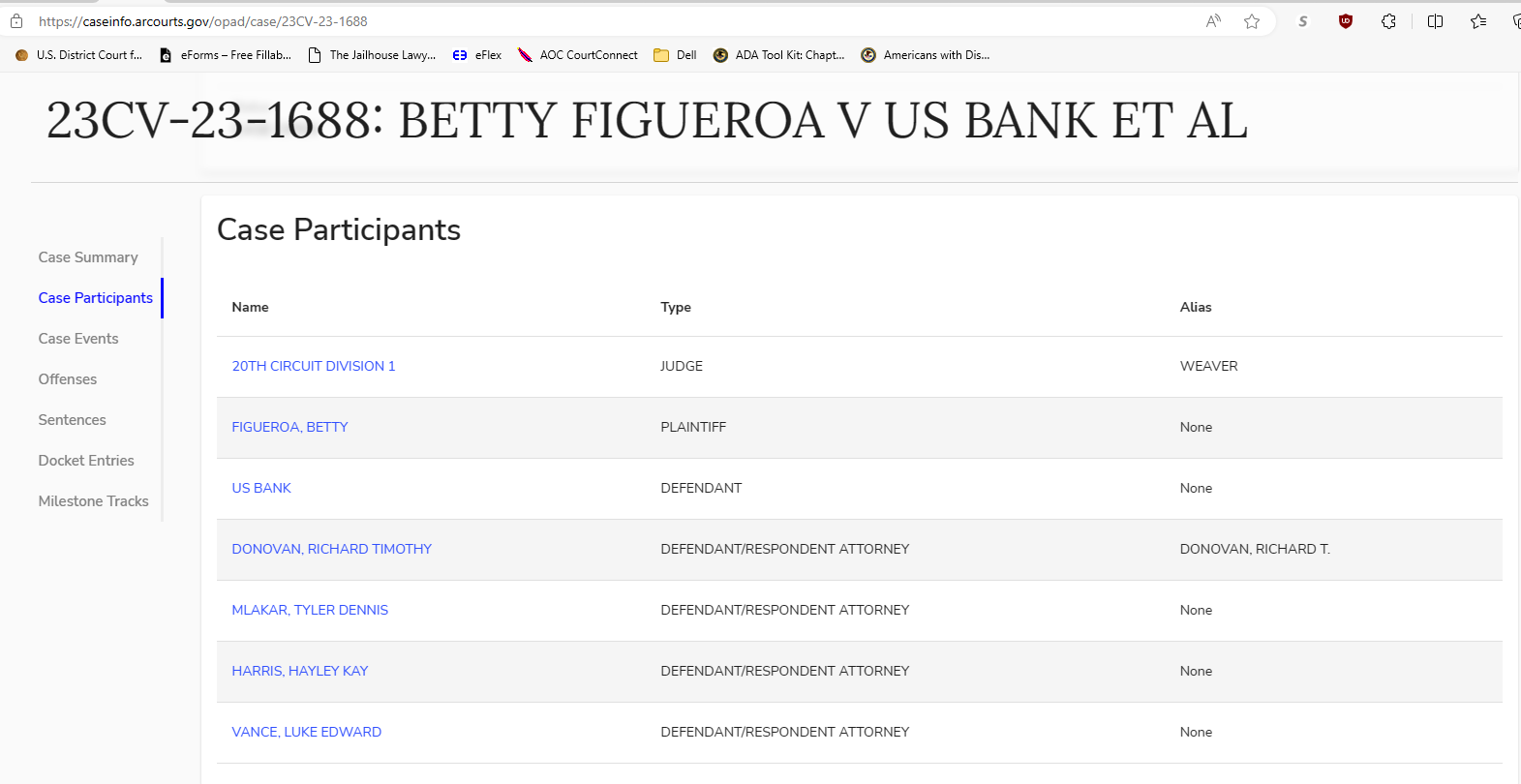
Pro Se Plaintiff Betty Figueroa tried to present a police video showing US Bank employees defrauding her on behalf of the bank during a hearing this morning. Judge Weaver would not allow the disabled litigant to bring her phone into the Courthouse.
Mrs. Figueroa told Judge Weaver that she gave the court a copy of the video on CD a few days ago and asked her to watch it. Judge Weaver sternly admonished Betty that she was not allowed to introduce evidence that way.
The video is undeniable evidence that US Bank instructed Mrs. Figueroa, with the police as an intermediary, to mail her summons and complaint to the “Customer Care Unit” instead of their “registered agent for service of process”.
US Bank argued that service was improper because it was mailed to “the Customer Care Unit”. Judge Susan Weaver agreed and dismissed the case.
Technically, Mrs. Figueroa, who has aphasia from a traumatic brain injury and therefore has impaired language skills, had the summons addressed to the wrong person – but only because that is who and where the bank employee wrote on the deposit slip was proper service.
If US Bank did the same thing to me, I would pursue relief based on fraud. I would also report Judge Weaver to the JDDC for her apparent lack of concern that US Bank, represented by Rose Law Firm, allegedly used fraudulent tactics to trick the brain damaged woman into sending a faulty summons and complaint.
Let’s back up a bit. This is a case filed by Betty Figueroa against US Bank. Mrs. Figueroa claims she opened an account before her injury. She said she added money to the account several times. “They have $50,000 in my bank account that they won’t give me.”
US Bank employees told police, as seen on video, that the “social security number she is using is compromised.” The officer, based only on the word of the bank employees, said Betty “provided them with a fraudulent social…”.
The video would be comical if it was fiction. I will obtain it through a FOIA request and post it here in my free time. lol.
The two Conway Police Department officers did not know what “In Forma Pauperis” meant, even in the context of a motion to file in forma pauperis denied by Judge Weaver. The stooges had no clue how to pronounce the Latin term. Popposerous, formpopoisis, inposisis?
Mrs. Figueroa has a hard time proving she owns the account without discovery. She doesn’t have much paper documentation. She said she used online banking and was blocked out by US Bank.
The reasons I tend to believe Mrs. Figueroa is telling the truth are many. If she was trying to access the account fraudulently, the police were called by US Bank who Mirandized Mrs. Figueroa and detained her, why wasn’t she arrested? It seems like a slam dunk. Woman walks into bank, several times, demanding access to a specific account, the bank claims she had no right to the account and the bank has law enforcement and the court’s ear. Why would US Bank fight presenting evidence in discovery? Why didn’t they slap the cuffs on her when they had the chance?
Also, I know Judge Weaver is a liar and cheat. She regularly had Court Reporter Jana Perry fictionalize transcripts in hearings on my case. Then Judge Weaver said she listened to the tapes and the transcripts were correct, but the public cannot hear the tapes. Trust her and Nixon.
I know Judge Weaver saw a hand-written, signed note by represented litigant Mike Pietrczak that describes how he and attorney William Zac White intended to defraud me of hundreds of thousands of dollars, and she transferred my property held in trust to the fraudsters without allowing me to present a case. (Appeal of that order was fully briefed about 16 months ago, but is still sitting on someone’s desk, so to speak. Pietrczak moved to Washington State and it will cost me and the government about $2 million of court resources to have the value of the property restituted and the attorneys involved disbarred.)
It is inconceivable to me why the People of the State of Arkansas continue to allow our resources to be wasted by Susan Weaver and the court click that is so openly contemptuous of the common citizen.
Who is US Bank and Rose Law Firm Afraid Of?

US Bank brought in four attorneys from Rose Law Firm of Hillary Clinton Infamy to protect them against Betty Figueroa. Mrs. Figueroa has a Traumatic Brain Injury but is representing herself in court to save attorney fees. She is trying to gain access to a bank account she claims she opened at US Bank. According to the pro se plaintiff, she was hit in the head by a gun wielding neighbor. It caused aphasia, a disability to speak properly. When she went to US Bank, sounding like she has a brain injury, US Bank said the account did not belong to Mrs. Figueroa, and she says, US Bank kept the documentation she handed to them. It was not clear whether Mrs. Figueroa has other evidence that the account belongs to her, other than her testimony.
Why is US Bank trying to avoid discovery, claiming it was not served as Mrs. Figueroa certified? It seems like hiring a team of four attorneys from a name brand firm and going through an appeal is more burdensome than providing discovery on a simple bank account through one in house attorney or even one local lawyer.
Courts that Violate Rights of the Disabled
Trump appointed Federal District Court Judge Lee P. Rudofsky pretends he is unfamiliar with Section 504 of the Rehabilitation Act of 1973, the mother of the ADA.
He was informed that I have PTSD, other anxiety disorders, Hashimoto’s Disease, other thyroid disorders and a diagnosed sleep disorder. All these conditions are accepted as disabilities that substantially limit one or more of the major life activities of impaired individuals. Yet, he failed to offer me reasonable accommodations as a pro se litigant for my disabilities.
In fact, when scheduling briefing orders, Judge Rudofsky gave me the same amount of time to file as he gave to the powerhouse attorney represented defendant; and Rudofsky refused to allow me to file electronically. So, he let the well paid attorneys file documents from the comfort of their own home offices, but forced a disabled 60 something year old to drive 60 miles round trip to file. (I could have used the USPS, but that is a good 20 mile round trip and my anxiety issues are triggered by concerns that court clerks will claim they did not receive my documents.
Another pro se litigant who has a disability, a Traumatic Brain Injury, brought some papers to the clerk of the Faulkner County Court recently, and her documents were not filed properly, even though they were hand delivered. (See the post about Mrs. Figueroa, here.)
Heck, a recent poll shows that only 18 percent of the population does not distrust the integrity of the court. Is it a generalized anxiety disorder or a healthy and realistic cynicism that causes so many to anticipate courts will deny due process? Maybe complacency about fraudulent and evil judges is the real mental disease.
Here is a widely circulated list of some of the disabilities that require accommodations.
I am not an attorney, but personally, I am going to insist that the courts comply with my rights. Betty Figueroa does not intend to let Judge Susan Weaver treat the disabled litigant as a second-class citizen, either.
Come give Mrs. Figueroa your support at a hearing on the second floor of the Faulkner County Courthouse, 8:30 am on April 18, 2024. We will meet at the park across the street for a “walk-and-talk” afterwards. Of course, wheelchair bound, deaf, speech impaired and any other disabled will be accommodated and included.
Praying for a Populist Nation.
Now it is an oligarchy and kleptocracy.
Even the judges, who were depicted as wise and honest in elementary school, are now Rudofskys and Weavers, who throw cases to the parties who have attorney representation.
When I first learned of the Kennedy-Shanahan presidential race platform, my hope was ignited. Not so much anymore.
My deeply held Christian beliefs allowed me to forgive imperfections in the candidates. Like David, both are flawed. Neither has a good track record for monogamy. RFK has a history of substance abuse and incarceration that probably stemmed from his addictions. Still, I thought both candidates shared a sincere value for the issues that I am passionate about.
Our country needs to return to populism. We should not be thinly disguised slaves to a small set of elites.
We should all have healthful food. Nancy Pelosi should not eat $8 per pint good-for-you frozen desserts, while the rest of us eat cake. Literally. The food served in prisons, senior centers and publicly run hospitals should not be high fructose corn syrup and partially hydrogenated oils with a side of MSG and BHT.
We should not send our loved ones to fight wars in other countries. We should give sanctuary to everyone who wants to become a tax paying member of our society through legal channels. We still have plenty of land and can feed all through small, sustainable farming. We can house all through Habitat for Humanity modeled sweat equity programs.
Wealthy individuals and corporations (many of whom amassed horrendous debt, like Portfolio Recovery Associates) should not be given preferential treatment in court.
I thought Kennedy-Shanahan supported this kind of populism.
It seems from their campaign fund raising that they are business as usual. They have events planned around the country that are smaller, more intimate gatherings than the usual campaign mass events. It sounds like the participants will meet RFK personally. The price tag for attendance at these events is $6,600 as a campaign contribution.
That is about 10 full months of my pension, and probably unattainable for the common person.
My hope is that We the People will realize that the criteria for access to politicians should be to those who volunteer time or based on a sliding scale.
I’m playing with the idea that the President of the United States of America should be determined by a lottery every 4 years, with a four-year training period to learn the structure of the government and the procedures for the leader’s duties before each inauguration. Each citizen over the age of 35 would receive one entry. If a leader tries to abuse his or her position, impeachment and appropriate criminal proceedings should be swift.
The average person, if given such an honor and responsibility, would probably respect their office and rise to the challenge of protecting our republic. I think most people who would not want the job would bow out.
It is only because impunity is extended to people like Judge Rudofsky and Judge Weaver that they abuse their positions of power.
We need a country that metes out access and justice equally to the Ivy Leaguer and the factory worker.
Disabled Litigant Claims Judge Susan K. Weaver Locked Her Out of Her Hearing

[UPDATE: Plaintiff Betty Figueroa said there was a hearing scheduled for the motion for reconsideration. The scheduling order is not viewable on the caseinfo.arcourts docket. According to Mrs. Figueroa, the hearing is on April 18, 2024 at 8:30 a.m. at the Faulkner County Courthouse, 510 South German Lane, Conway. Come join us for a civic lesson, and time and weather permitting, a walk-and-talk at the park across the street afterward.]
Judge Susan K. Weaver once held a hearing where I was a self-represented party and the judge forbid me to argue, give evidence, cross examine the plaintiff-witness or testify. Many days later, Judge Weaver dismissed me as a defendant with prejudice, but found my common-defense-doctrine co-defendant guilty by default. She gave property that was held in trust for me to the plaintiff, despite the plaintiff’s written statement that he was committing fraud against me and that he swore in writing that he considered us married in the eyes of God – then swore in court that I was just some old “bitch” he was banging.
It is probably easier for me to believe the headline story than it will be for you to believe it. Hear me out and look at the evidence.
Betty Figueroa contacted me after reading posts about the corrupt judge Weaver. We met in person twice. My impression is that she is either authentic, or she should win an Academy Award.
Mrs. Figueroa wears a badge that describes her disability. She has TBI, Traumatic Brain Injury. TBI is misunderstood by many, including some doctors and Judge Susan Weaver to mean the disabled is irrational.
TBI can cause neurological damage to the speech center of the brain. I have cared for a TBI patient who was as rational as he was before his accident but mixed up words. For example, he would say “M” instead of “phone”, “hub” instead of “car” and was asking for a priest, but I didn’t figure that one out until after his speech improved dramatically.
My favorite presidential candidate, Robert F. Kennedy Jr., has neurological damage that causes his voice to have a strange quality. He has a slight difficulty at times, remembering what he was going to say. I don’t know if his neurological damage was caused by blunt trauma to the head. I do know his thinking is more rational than Trump or Biden’s.
Mrs. Figueroa claims that she opened a joint account at U.S. Bank with her sole proprietorship photography business, before she was injured. After her injury, the bank treated her disrespectfully and would not give her access to her account.
Mrs. Figueroa filed a complaint in Faulkner County Circuit Court. She said she did not want to pay exorbitant attorney fees and thought it was a clear-cut case.
I am not an attorney. I read Mrs. Figueroa’s court documents. There are words and formatting I think she got wrong, but her meaning is clear.
The docket shows an entry for a summons with a dollar sign but does not have an image of the summons.
Mrs. Figueroa had a subpoena issued to U.S. Bank.
U.S. Bank, through its attorney at Rose Law Firm of Hillary Clinton fame, filed a motion to quash the subpoena, which was granted.
There are many errors made by the pro se litigant who clearly has a communication disability. There are more errors that are made by the court.
I believe Mrs. Figueroa when she says she brought a proof of service of the summons to the clerk and the clerk neglected to file it. One reason I believe her is that I witnessed the clerk fail to file a document Mrs. Figueroa handed to the clerk yesterday.
I signed and notarized an affidavit at Mrs. Figueroa’s request yesterday. It summarizes how Judge Susan Weaver denied my access to court, much like Mrs. Figuroa is complaining about. I gave two copies to Mrs. Figueroa. Mrs. Figueroa brought them to the clerk at 1:52 p.m. with a motion for reconsideration (that I will discuss later). The motion was filed but the affidavit was not. Mrs. Figueroa said the clerk kept both copies.
After Mrs. Figueroa contacted the clerk by email, as displayed at the top of the post, the error was corrected. The affidavit was filed at 4:08 p.m.
Here is the lead, buried deep.
Mrs. Figueroa requested and the court scheduled a hearing for default judgment against U.S. Bank for March 28, 2024 at 3:30 p.m. Betty Figueroa showed up for the hearing. The courtroom door was locked. Mrs. Figueroa went downstairs to the clerk’s office. (This is not the office that the court filings are made.) The clerk called upstairs and told Judge Weaver that Mrs. Figueroa was trying to get in for her hearing. Allegedly, Judge Weaver informed the clerk to send Mrs. Figueroa upstairs, and to inform the baliff that he should let her into the courtroom.
Upstairs, the bailiff told Mrs. Figueroa that the Court dismissed the case, because Mrs. Figueroa was not present for the motion for default judgment.
A few of the documents proving the plaintiff’s rendition are downloadable below. They include a letter written by the clerk who tried to help Mrs. Figueroa get into the courtroom.
The quiet and unimposing woman filed a motion for reconsideration yesterday. She included the affidavit that I signed and notarized. Unfortunately, she knows a court in Arkansas will never help her recover her bank account from U.S. Bank. Judge Weaver is here to serve herself and her lawyer friends, not the People.
Why has the JDDC not removed Judge Weaver from the bench yet? Why is Susan Kaye Weaver not in prison yet? Why are the People of the State of Arkansas allowing their most basic Constitutional rights to be violated? How is Susan Weaver able to intimidate so many lawyers into cowering in a corner while she destroys the institution of supposed justice?
These questions are not asked rhetorically. Please respond in the comments below. Or contact me privately with your own tale of horror. bohemian_books@yahoo.com

Strand-by-Strand Unraveling of Judge Lee P. Rudofsky’s Web of Lies and Deceit – Chapter Nine

We are looking at an order dismissing Portfolio Recovery Associates as defendants in an Invasion of Privacy case written by Trump Appointed Judge Lee P. Rudofsky in the Eastern District of Arkansas, 4:21-CV-000189, Docket Entry 173.
Judge Rudofsky wrote on page 5: “On December 18, 2013, PRA, LLC learned that the December 3, 2013 letter was returned as undeliverable because of a zip-code error in the address.40” Probably over half the opinion is by small font, single spaced footnotes. Footnote 40: “Ex. 1 (Dreano Decl.) to Def.’s Statement of Facts (Doc. 78-3) (Under Seal at Doc. 121) ¶ 28; Ex. E to Ex. 1 to Def.’s Statement of Facts (Doc. 78-8) (Under Seal at Doc. 121) at 5. Throughout Ms. Hammett’s Response to Defendant’s Statement of Facts, Ms. Hammett offers blanket denials without pointing to any record facts. See, e.g., Pl.’s Resp. to Def.’s Statement of Facts (Doc. 99) (Under Seal) ¶ 28. On summary judgment, Ms. Hammett cannot rely on such denials to raise a genuine dispute of material fact. Rather, she must point to record facts to support her denials. Where she fails to do so, the law directs the Court to treat her unsupported denials as an admission. [citations omitted] The Court will not flag every time Ms. Hammett has failed to address PRA, LLC’s assertions of facts. Nevertheless, this legal point applies to all of Ms. Hammett’s unsupported denials.”
So, the judge complained that Hammett did not give specifics, but refused to specify where Hammett supposedly did not give specifics. Rudofsky complained about generalities by offering a generality.
He referred to a document Hammett filed under seal, and divulged what was supposedly under seal. His rendition was inaccurate.
Hammett later filed a redacted version of the document, following the Court and PRA’s lead about what was acceptable to discuss in public. Here is that document, 198.
Judge Rudofsky accepted PRA’s written affidavit that it resent the initial letter and that letter was not returned. Here is my, Hammett’s, detailed explanation of why that was not acceptable testimony and why it was not true. At Doc. 198, page 28.
“Meryl Dreano does not work for CompuMail Information Services, Inc. (‘CompuMail’) The return address on the letters sent on behalf of PRA belongs to CompuMail. The PRANet record generated by PRA as Bates No. PRA HAMMETT 000212 shows the mail was processed by CompuMail. Therefore Ms. Dreano’ s declaration, [paragraph] 28 is impermissible hearsay. Regardless, the required disclosures must be sent in a communication. ‘communication (14c) 1. The interchange of messages or ideas by speech, writing, gestures, or conduct; the process of bringing an idea to another’s perception.’ COMMUNICATION, Black’s Law Dictionary (11th ed. 2019) The letters PRA claims were mailed did not reach Plaintiff, as the address was not her residence and the letters were not forwarded. (Hammett Affidavit [paragraph] 36, Defense Exhibit E)”
Hammett pointed to the record facts, her own affidavit.
On page 29, Hammett continued to give a detailed explanation of why PRA’s version of mailing letters to Hammett was wrong, and more importantly at the summary judgment stage, why a reasonable juror might agree with Hammett instead of Portfolio Recovery.
“Plaintiff can neither admit nor deny that the letters sent on December 19, 2013 and February 5, 2014 were not returned as undeliverable, and must therefore DENY. Plaintiff ADMITS that Plaintiff did not request validation of her debt- or otherwise respond in any way, ever, because she did not receive the letters. (Hammett Affidavit [paragraph] 36)”
Perhaps I could have gone into a bit more detail. “At no time did I walk to the mailbox that was in a bank of mailboxes at the curve in the circular road where I stayed for two nights, open the mailbox and look inside, and see an envelope addressed to ‘Laura Lynn’ or ‘Laura Lyman’ or ‘Laura Hammett’.” That seemed a bit excessive to me.
We know that Lee P. Rudofsky does not have a cognitive deficit. At least he had no cognitive deficit when he was admitted to and graduated from Cornell and Harvard Law.
Therefore, it is likely that Judge Rudofsky’s acceptance of Ms. Dreano’s affidavit and dismissal of Hammett’s denials citing the record facts in her own affidavit as “blanket” was motivated by his predetermination that no FDCPA nor tort case against a purchaser of credit data files will ever go to trial when he presides.

