I Could Not Say It Better Myself: So I reposted By Permission of the Post Modern Justice Media Project
- Alex Baker
- Dec 16, 2020
- 10 min read
Top Ten Most Corrupt Laws in the United States
10. The Federal Reserve Act
Allowing a central bank to print un-backed paper money in any amount is counterfeiting, by definition. And counterfeiting is a form of theft, because it allows those with the printing press to transfer real wealth away from those who earned it, and into the hands of themselves and their close friends. For a more detailed explanation, please see The Origin of Money and How It Was Stolen From You.
The Fed should be abolished. Money and banking should be returned to the private sector. Among many other cruelties, the Fed can finance Title IV D funding of the kidnapping and extortion racket known as Child Welfare and Dependency Courts. Truly, the Federal Reserve could be #1 on the list, but we’ve pushed it down to # 10 because most everybody already knows about it.
9. Unpublished Appeal Court Opinions
Any time a Court of Appeal rules on a case, its opinion becomes the law. Such “Case law” may be cited in a new case to show how that case is like the earlier one, and why the Court should rule the same way now. Except, nowadays, the vast majority of Appellate Opinions are issued as “unpublished”, meaning we are not allowed to cite the case. Think about it. If the Opinion is valid, then why would we not want it published? And if the Opinion is not valid, why should we allow it to happen in the first place?

All Appeal Court Opinions must be published. If the result is “conflicting” laws, good. It will shine a spotlight on the problems, and hasten needed reform.
8. Contempt of Court is Non-Appealable
Contempt of Court is a finding by a judge that a person “willfully” violated a court order. Some court orders are valid, and should be obeyed. And a court needs a mechanism to enforce them. But there are severe problems with the present system.

It is common for Family Court judges to illegally order parties not to talk about their case on social media, or even to their own children. Restraining orders can issue that say the same thing. Violate that, and you can go to jail. Like Judge Bruce Mills sent Joe Sweeney to jail for posting facts about his divorce from Keri Evilsizor.
On the other hand, judges will turn right around and allow some people to get away with violating court orders, for example raiding a trust fund. Like Judge Gregory Weingart let Clair Marlo get away with taking $225,000 cash from a disputed property in the now-infamous Baker v. Baker case.
Contempt is found when it shouldn’t be, and not found when it should be. Either way there is nothing that can be done, because Contempt orders are non-appealable. Yes, you can file a Writ, but those are almost always denied, and the Appeal Court doesn’t even have to give you a reason why. Writs just come back saying “denied”.
7. “Temporary” Child Custody Orders
The right to family unity is a fundamental constitutional right. Constitutional rights cannot be taken away without due process. Under any sane legal system, a parent has a right to frequent contact with their child unless and until that parent is convicted of committing a crime against that child. Not accused. Convicted.

It is extremely common in Family Court for the judge to award ‘temporary” sole custody to one parent, and either no visitation, or only monitored visitation to the other parent, all upon allegations only. Getting to a “final” custody order often takes years of expensive litigation, and is never final anyway, as custody is always modifiable. The fight is never over. None of this is constitutional, and none of it makes any sense for a society that values family, which ours no longer does.
No judge has any right to make any order besides 50-50 joint custody until there is a trial finding that a parent did something really bad.
6. Domestic Violence Restraining Orders for Non-Threatening Speech
California’s Domestic Violence Prevention Act (“DVPA”), defines “abuse” to include “disturbing the peace”, which case law interprets to mean “any conduct that destroys the mental or emotional calm” of the other person. This has resulted in cases where a 3 -year restraining order issued solely on the basis of man forwarding the wife’s text messages to her parents, or another man winning a copyright infringement case against his ex-wife and discussing it on a blog, or another man posting pictures of visiting his children on Facebook after the Judge ordered him “not to discuss the divorce with the children”.
Non-threatening speech is not violence. These Family Law DVRO are being used as strategic weapons in property and custody disputes. It’s wrong. It’s hurtful, most of all to the children, who are used as both a weapon and a shield. It must stop.
5. “Dispensing with” Notice
Notice is a fundamental part of Due Process. California’s Probate and Family Codes contain rules saying that on a hearing for Temporary Guardianship of a Child, Notice requirement may be done away with for “good cause”. What constitutes “good cause” ? It is simply a checkbox on a standard form, and no explanation is required.

In one case, a judge awarded temporary guardianship of a child at an unnoticed, ex parte hearing. That same day they took the child away from the legally married, biological parents, who had no idea the hearing had taken place. This happened 5 days after DCFS cleared the father of the one (1) vague allegation that he had “inappropriately touched” the child 4 years prior.
Another case involved an estranged husband leaving his wife and son in Canada, and somehow getting a judge in Los Angeles to grant an ex parte custody award based on a provably false allegation that his estranged wife had “kidnapped” the child. In fact, the family had been living in Canada for 3 years. In contradiction to the Hague Convention, the man somehow got U.S. officials to cross the border and seize the child, and mother has never seen him since.
No judge should be allowed to conduct any kind of court proceeding regarding parental rights unless all parties are present.
4. Automatic Hearsay Exception for Child Welfare Reports
California Welfare and Institutions Code § 355 makes Hearsay evidence by “peace officers”, “social workers”, “health care practitioners”, and “teachers” automatically admissible as evidence, as long as it is found in a “social study” or a “report”. Not only is it admissible, but the law literally says that it shall be sufficient evidence for a finding of “jurisdiction” over the children, i.e. to seize and permanently hold the children in the foster care system. This is a very profitable situation, as County agencies receive federal money under Title IV D for each child taken.
Let’s look at the Hearsay Rule and why it is important. Hearsay is an out of court statement offered for its truth. So any time a witness is testifying, and says something like, “…Joe told me Bob hit him…” that is hearsay. The witness has no knowledge of Bob hitting Joe, the Court needs Joe to testify. Wait, it gets worse.
All written declarations and reports are out-of-court statements, thus hearsay by definition. Typical social worker reports contain triple hearsay. One group of social workers writes the report, which is full of out-of-court statements relaying the out-of-court statements of other social workers and peace officers, who assert that the child made certain out-of-court statements that somebody did something wrong. That’s triple hearsay. And yet, it is not possible to cross examine any of these accusers. The Judge, who is acting as jury, will simply accept anything in a report as the truth, and “the law” backs up the judge. If that doesn’t constitute a show trial, I don’t know what does.
The Sixth Amendment Confrontation Clause promises that defendants have a right to cross examine accusers. This is one of the most important protections of all, and this “Accusatory Hearsay Exception” law just does away with it. Seriously.
3. All Non-Jury Court Systems
We inherited our jury trial court system from England, and it worked quite well for a long time. Any kind of case, criminal or civil, consists of a Plaintiff alleging a series of facts about the conduct of the Defendant, which if proven, add up to a violation some a particular law. The parties can dispute the facts, of course. He said, she said. Sometimes, the parties can dispute the law. In essence, the Defendant says to the Plaintiff, “So what? Even if all the facts you allege are true, it doesn’t violate any law.”
According to the system of Anglo-American jurisprudence, the judge is the trier of the law, while the jury is the trier of the facts. When it comes to factual disputes, judges were NEVER supposed to decide cases. The role of the judge is to ensure a fair process, but not to decide the case. It is the jury who decides the winner and loser in a court case. The right to a jury trial in a criminal case is enshrined in the 6th Amendment, while the right to a jury trial in a civil case is found in the 7th Amendment. The fundamental right to petition the government is found in the 1st Amendment.
Over a hundred years ago, they started coming up with ideas like Family Court, Probate Court, and Child Welfare Court systems. In clear violation of the Constitution, they simply decided these would be Judge trials instead of jury trials. Gone are not only the juries, but in criminal matters – like Custody and Child Welfare cases – missing also are a whole set of procedural safeguards such as the right to an attorney, right to confront your accuser, right to see the evidence against you, right remain silent, etc.
2. The Litigation Privilege (aka the Perjury Privilege)
The Litigation Privilege holds that you cannot sue a person based on what they said in a court proceeding. Not even if it is defamatory. Not even if it cost you a fortune and you can prove it. Not even if it was a false statement, under oath about a material issue. Statements made in court are said to be “absolutely privileged”. We might as well call the Litigation Privilege what it really is – the perjury privilege.

The supposed rationale for the Litigation Privilege is that we want to encourage witnesses to come forward and testify in court cases. If every witness was worried about being sued for what they said, then many would be intimidated and afraid to come to court. The Litigation Privilege is said to “preserve the integrity of the court system”.
Do you believe that the Litigation Privilege preserves the integrity of the court system? I think the opposite. Witnesses who are telling the truth do not need to fear being sued, because, well, they are telling the truth. Just like people who tell the truth on their blogs don’t need to worry about being sued. It is liars who would be afraid to come to court and tell lies. Don’t we want liars to be afraid to lie? Why do we invite liars to testify, and how could anyone buy in to the notion that this preserves the integrity of the system? Is it any wonder that every Civil and Family Law case devolves into a cesspool of dishonesty?
1. Judicial Immunity
Judicial Immunity means you can’t sue a judge for damages. Not even if they lied. Not even if they broke the law. Not even if they injured you on purpose with actual, premeditated malice. The leading Supreme Court case on Judicial Immunity is called Stump v. Sparkman, and a review will help illustrate just what the system allows judges to get away with.
In 1971, a woman came to Judge Stump’s courtroom and Petitioned for an Order to sterilize her 15 year old daughter. The woman claimed her daughter was “somewhat retarded”. Judge Stump did not order any evidentiary hearing, and did not appoint any lawyer to represent the teenager. Rather, Judge Stump simply signed the Order. The girl was told she needed an appendectomy, and did not discover she was sterilized until years later when she got married and could not have children.
The case reached the Supreme Court in 1978. By a 5-3 decision, the High Court found that Judge Stump was immune from suit, because issuing Orders of this kind was a judicial function. Stump v. Sparkman is a landmark case that sets out the test to determine whether a judge’s action is “in the complete absence of all jurisdiction”, or merely “in excess of jurisdiction”.
The explanation for Judicial Immunity is much the same as the Litigation Privilege. Supposedly, a judge cannot do his job if he is worried that any decision he makes might be second-guessed, and subject him to liability. To this I say:
BULLSHIT.
Any professional should be subject to liability if they screw up their job badly enough. If an engineer designs a structure that falls apart when the wind blows, shouldn’t they be responsible? If a contractor’s brand new plumbing leaks and causes significant damage, shouldn’t he have to pay for it? Should we not be able to sue a surgeon if she makes a bad mistake and injures you?
Is it possible for a professional to do their job properly with the thought hanging over their head that they might be sued if they hurt you? The answer is: Yes. They had damn well better do the job right or they are going to get sued. That’s the only remedy we have, short of taking the law into our own hands. Do we want vigilante justice?
If you had no recourse against somebody who injures you, what kind of legal system even exists? And the previous examples related to accidental injuries. What about intentional injuries? Judicial Immunity protects judges even when it can be proven that they injured a person on purpose. Seriously, there is case law that says this.
No one, not even a judge, should be above the law. We want judges to be afraid of making illegal, injurious decisions. Yes, that’s exactly what we want. Be afraid, the same way every professional is afraid they might hurt someone. Like most professionals, Judges should have liability insurance to cover them for negligence, but be held personally liable for fraud or other intentional torts. Why wouldn’t we want judges to go to jail and pay steep restitution if it is proven they harmed somebody on purpose?
As it stands, we are not the least bit surprised that Judicial Immunity has resulted in a system that runs on bribery and corruption. From the judge’s perspective, corruption is all upside, with no downside. Judges are completely above the law. And since the decisions that judges make ARE the law, we might as well face up to this sad and disturbing conclusion:
As long as there is Judicial Immunity, there is no law.
Visit The Post Modern Justice Media Project here.
“Railroading, Stonewalling & Gaslighting” – Brilliant and Brave Author Alex Baker’s Book
The following excerpt is reposted here by permission of the author and copyright holder.
Link to the non-profit Post Modern Justice Media Project
- Alex Baker
- Oct 11, 2022
- 12 min read
Trafficking a Child at a Secret Hearing
Below is a chapter excerpted from my upcoming book “Railroading, Stonewalling & Gaslighting.” The Augustus civil rights case was recently touched on in an article by Juliette Fairley.
———–
No person shall be deprived of life, liberty, or property, without due process of law.
– U.S. Constitution, Amend. V.

Even a broken clock is right twice a day. Similarly, even the United States Supreme Court occasionally issues an opinion seemingly consistent with freedom. They did so in Troxel v. Granville (2000), where they affirmed what should never have even come into question – that parents have a fundamental right to raise their children.
“Due process” supposedly means that the government is not allowed to interfere with your rights unless they have shown a good reason, and given you your day in court. In my view, rights are unalienable meaning that they cannot be interfered with at all, and what he have now are mere privileges that the government can take away. But let’s leave that to one side, and consider the Augustus Civil Rights Case . [1]
Los Angeles couple Donecia and Mark Augustus are the legally married, kind and loving biological parents of a daughter named Sasha, born in 2003. Now an adult, at all relevant times, Sasha was a minor child. Back in about 2015, Sasha and her best friend both decided they wanted to go live with somebody besides their parents. Apparently a rift began when the then 12-year-olds were disallowed from wearing certain types of clothing.
Sasha decided that life would be so much better if she could go live with her “cool aunt,” Shaunta Montgomery, Donecia’s sister. Next thing you know, Sasha was making a vague allegation that her father Mark had engaged in “inappropriate touching” sometime before. The matter was investigated by the Los Angeles Police and Department of Child Protective Services (“DCFS”) and determined not to be credible. The matter was laid to rest, or so one would think.
Fast forward to 2018. During 2018, there were periods of time when the Augustuses allowed their then-15-year-old daughter to stay with her aunt. But, at no time did Donecia or Mark Augustus ever agree to, or discuss, or even consider surrendering their parental rights – to Shaunta or anyone else.
Next thing you know, in October 2018, Shaunta files a Petition for Temporary Guardianship of Sasha. The one and only reason for the guardianship was the years-old allegation against her father Mark, which had already been investigated by L.A.P.D. A new investigation was commenced by DCFS.
In November 2018, Shaunta appeared before Judge Gus T. May for a hearing on her Petition for Temporary Guardianship of Sasha. At that hearing, Judge May enquired about 2 crucial things – (1) whether Donecia and Mark had been served Notice (they had not) and (2) whether the DCFS investigation had been completed (it had not). Shaunta asked Judge May for some clarification:
Shaunta: Okay. So there’s no temporary guardianship. She can be with her parents?
Judge May: Correct. Until we get the [DCFS] Reports, yes. [2]
Judge May indicated that he would not issue the Letters of Temporary Guardianship without the DCFS report being complete, and without Donecia and Mark being served. That would make sense, right? The hearing on Temporary Guardianship was continued to December 11, 2018.
Then, on December 6, 2018, five days before the hearing, DCFS completed its investigation, once again clearing Mark Augustus of the one vague allegation against him. Since that one allegation was the only basis for Shaunta’s Petition for Temporary Guardianship, one would think the whole thing would be resolved. Think again.
On December 11, 2018, the hearing on Temporary Guardianship of Sasha went forward. Present was Shaunta (representing herself), and also the newly-appointed “Minor’s Counsel” William Spiller, Jr. (representing Sasha). Minor’s Counsel is paid for by County of Los Angeles.
Exactly how Spiller got appointed is unknown to me. One thing I do know is that William Spiller was previously suspended and disciplined by the California State Bar, because he was found to have commited “acts of moral turpitude,” basically because he was losing medical malpractice cases on purpose. [3] If you have any idea of what CalBar routinely lets lawyers get away with, you can appreciate how terrible Spiller’s conduct must have been. Yet, this is a guy that County of L.A. now pays to represent children in court? WTF?
Minor’s Counsel William Spiller, Jr. Perpetrates Fraud Upon The Court
So, on December 11, 2018, Spiller and Shaunta come before Judge May. The very first thing Spiller says is that the 15-year-old Sasha has “waived” her appearance. One would think that a 15-year-old girl who is bold enough to want to ditch her parents is bold enough to show up in court. But no, Spiller will do all the talking, thank you very much.
Spiller proceeds to defraud the Court in ways that should shock your conscience. [4] First, Donecia and Mark had not been served notice of the hearing. Not to worry, Spiller is prepared with a bullshit story about that. Second, Spiller did not present the DCFS Report exonerating Mark Augustus. Judge May began the hearing by stating:
Judge May: I haven’t received any of the things I need to decide the case today [i.e. the DCFS report and a Proof of Service for the hearing]. [5]
If law existed, or if the “Bill of Rights” protected anyone, that would have been the end of the December 11, 2018 hearing. Instead, Judge May allowed the hearing to go forward. And what a shit-show it was.
In accordance with what I reasonably infer to be L.A. County’s policy and custom, Mr. Spiller proceeded to falsely state that Donecia and Mark Augustus had been homeless (completely false, they have never been homeless or anything close); that Mark Augustus was “on the lam” and “avoiding the proceedings” (completely false, he simply hadn’t been served Notice); that efforts had been made to notify Donecia and Mark Augustus (completely false and nonsensical, for Sasha’s parents had no reason to avoid the hearing, knowing that DCFS had just cleared Mark Augustus, again, of the one vague allegation against him). [6]
At the December 11, 2018 secret Temporary Guardianship Hearing, when Judge May inquired about the status of the DCFS Report, and of Mr. Spiller’s own report (which naturally would contain the DCFS findings), Mr. Spiller stated:
William Spiller, Jr.: Yeah, let me apologize to the Court. We finished our report, and filed it, I think, yesterday, because we were – well, let me back up. [7]
The normally extremely smooth and well-spoken Mr. Spiller was quite discombobulated, likely because he knew he was lying to the Court. In fact, by December 11, 2018, all parties had received a copy of the DCFS Report exonerating Mark Augustus. And, Mr. Spiller had completed his Report, which included mention that Mark Augustus had been exonerated, but Mr. Spiller did not file his Report until several days after the December 11, 2018 secret hearing at which temporary guardianship was fraudulently obtained.
Based on these facts, I infer that the reason Mr. Spiller did not file his report at the December 11, 2018 hearing was that he intended to enrich himself on County money by getting appointed as Minor’s Counsel, while County of L.A. enriches itself by gaining a pretext on which to increase its funding. If Spiller told the truth – that the Augustuses had not been served and that Mark Augustus had already been exonerated – the case would be over (and so would Spiller’s opportunity to milk the County of Los Angeles for a lot of money).
I further believe that Mr. Spiller failed to file his report also because he is a malignant narcissist who derives sadistic pleasure from inflicting emotional distress upon innocent human beings, as evidenced by his prior discipline by the Bar Association for losing meritorious court cases on purpose.
To be clear, I am not aware of any psychiatric diagnoses of William Spiller, Jr. But malignant narcissism is a reasonable inference, because anyone besides a narcissistic sadist would never be able to do this sort of thing in the first place. At the very least, after being caught losing cases on purpose and having his license suspended, a normal person would have learned his lesson and changed his ways.
Other than being a person who has no empathy whatsoever, what else explains William Spiller, Jr.’s ability to come to court and tell lies so that a child can be taken away from her parents?
An Unreasonable Seizure If Ever There Was One
At the December 11, 2018 hearing, Mr. Spiller threatened to invoke the power and authority of the Los Angeles County Child Abduction Unit to locate and take Sasha child into their custody, stating on the record that “we have done that before”. [8]
In the preceding quotation, in saying “we”, William Spiller Jr. was referring to himself and the Los Angeles County Child Abduction Unit working together in joint action. This is important to the legal case against Spiller because, on paper, Spiller is arguably not a government actor, thus not subject to the supposed protections of the constitution. But precedent has established that a private citizen can be held as a defacto government agent when the two act in concert. [9]
Later in the afternoon of December 11, 2018, Donecia showed up at Santa Monica High School to pick up her daughter Sasha. However, Shaunta also showed up, now armed with the fraudulently-obtained Letters of Temporary Guardianship order, and backed up by the threat of force inherent in the authority of the Los Angeles County Child Abduction Unit.
Shaunta showed the Letters of Temporary Guardianship order to Donecia. Fearing the authority of the government, believing that government agents are authorized to use force to carry out court orders, Donecia reluctantly acquiesced and allowed Shaunta to take Sasha into custody. Fear of government force is the only reason Donecia Augustus allowed Shaunta Montgomery to take Sasha on December 11, 2018.
Such facts shock the conscience.
Follow the Money
The costs of operating the Los Angeles County District Attorney Child Abduction Unit are paid for utilizing County funds. Likewise, the cost of William Spiller’s services as minor’s counsel are paid for utilizing County funds. According to the May 17, 2019 County of Los Angeles Auditor-Controller Review, signed by Assistant Auditor-Controller Dr. Peter Hughes:
Under California Rules of Court 5.240, a court may appoint private counsel to represent a child in family law cases involving child custody or visitation, on a case by case basis. Minors’ counsel costs are paid for utilizing County funds. According to the Court’s records, minors’ counsel costs increased by 17%, from $1.6 million in Fiscal Year (FY) 2016-17, to $1.8 million in FY 2017-18. During the same period, the number of cases where minors’ counsel was appointed increased by 13%, from 787 to 889 cases. [10]
Any fraudulent scheme perpetrated by multiple people (i.e. a conspiracy) achieves multiple purposes. For William Spiller, the motive is pretty obvious – money. Ultimately this bogus guardianship case litigated for 2 ½ years, with no resolution. The case was dismissed when Sasha turned 18 in July 2021.
Shaunta Montgomery also has her reasons. Shaunta is an open lesbian, always wanting a daughter. Among those who know the entire Montgomery/Augustus extended family, it is no secret that Shaunta took a disliking to Mark Augustus long ago, disapproving of Donecia marrying him. It caused a family divide that the court system exploited. That’s how the game works.
Is There A Right To Lie ?
To summarize, the actions of Defendants in the Augustus civil rights case constituted a fraud upon the court because (a) the Letters of Temporary Guardianship order was made at a secret, unnoticed (thus unconstitutional) hearing; (b) at the secret hearing, Defendants actively concealed the fact that five days prior Mark Augustus was exonerated by DCFS of the one vague allegation against him; (c) the Petition for Temporary Guardianship was entirely founded on that one vague allegation; (d) Defendants supported their efforts by making numerous intentional misrepresentations; (e) but for the Court’s reliance on Defendants’ intentional misrepresentations, the Letters of Temporary Guardianship would not have been issued – not on December 11, 2018, and not ever.
In many previous cases, government actors defend themselves by asserting “privilege” or “immunity.” “Privilege” and “immunity” are basically rules that T.H.E.Y. made up that say that government officials can lie and harm you on purpose and you can’t do anything about it.
There are a couple of recent cases that may give some hope for justice against lying government officials. In Hardwick v. County of Orange (2017), Orange County, California social workers argued that, strictly speaking, there was nothing in the U.S. Constitution that prohibits a child welfare worker from lying to achieve a removal to foster care. Seriously, that’s what they argued. In a rare breath of fresh air, the Ninth Circuit Court of Appeals opined that:
No official with an IQ greater than room temperature in Alaska could claim that he or she did not know that the conduct at the center of this case [social workers lying in court as a false pretext to take a child away from the parent] violated both state and federal law. The social workers in this case are alleged to have knowingly and maliciously violated the law in their attempt to sever Preslie’s protected relationship with her mother. Perjury is a crime under both federal and California state law, as is the knowing submission of false evidence to a court. [11]
Another recent “right to lie” case is Benavidez v. County of San Diego (2021), where the Ninth Circuit found that:
To support a [federal civil rights] claim of judicial deception, a plaintiff must show that the defendant deliberately or recklessly made false statements or omissions that were material to the finding. A plaintiff who provides direct evidence of false statements can allege deliberate fabrication of evidence in violation of constitutional due process guarantees. [12]
Challenging California’s Bullshit Accusatory Hearsay Exception Law
If it is so obvious that courts won’t allow lying to support taking custody of a child away from parents, how was the Augustus guardianship case allowed to litigate for 2 ½ years? This question became especially perplexing after attorney Marc Angelucci entered the case in July 2020.
I found about about the Augustus matter in June of 2020. At the time, I was civil rights attorney Marc Angelucci’s right hand man. I drafted a Motion to Set Aside and Vacate the Order of Temporary Guardianship, based on a lack of Notice at the original hearing, and also based on the fact that Mark Augustus had been cleared of the allegation. By then, the case had been transferred to a different Superior Court Judge, the Hon. Michael Small.
On July 8th, 2020, Marc and I showed up for the hearing, expecting a ruling on our Motion to Set Aside. Spiller had not even bothered to oppose our motion. However, Spiller said that he had not been served the papers, and so he needed a continuance.
First, Spiller had so been served. He was lying (shocker, I know). But second, and to the point, it’s hypocritical and ironic in the extreme. Spiller complains that he had not been served while haing no problem taking the Augustuses’ child away from them on a hearing where they had not been served.
Judge Small granted a continuance on our motion. Unfortunately, Marc Angelucci never got to argue the motion to Judge Small, because Marc Angelucci was murdered on July 11, 2020. There is a lot more about Marc’s murder (and who I believe is responsible) elsewhere in this book.
When Judge Small finally took up the Augustuses’ Motion to Set Aside, he denied it. As to Mark Augustus having been cleared of the underlying, ancient allegation against him, Judge Small stated that he didn’t have jurisdiction to overrule Judge May. That’s actually not true, a Motion to Set Aside is a valid procedure for reversing a Trial Court order. [13]
Wait till you hear why Judge Small didn’t care that the Augustuses had not been served notice of that December 11, 2018 hearing. You know, the one where the government took their kid away from them. Judge Small cited California Probate Code Statute § 2250 (e)(1) that says that the Court can “dispense with” notice requirements on a guardianship hearing for “good cause.” [14]
Being perfectly vague, that statute says nothing whatsoever about what might constitute “good cause” to “dispense with” the need to put parents on notice that a hearing is going to take place at which their kid can be taken away from them.
In practice, the “good cause” to “dispense with” the need to put the Augustuses on notice of a guardianship hearing was a single checkbox on a court form.
The Court finds notice of the time and place of hearing has been dispensed with for Mark Augustus (father) and Donecia Augustus (mother). [15]
It’s difficult to imagine a more unconstitutional law than Probate Code § 2250 (e)(1). That’s why we added a constitutional challenge into the Augustuses’ federal civil rights case. Supposedly, we are supposed to have the ability to challenge whether a law is constitutional either “facially” or “as applied” in this particular instance. We named the State of California as nomial defendant to our constitutional challenge of the statute. We served the state Attorney General’s office. In fact, in recent years, the U.S. Supreme Court has struck down at least two state statutes as unconstitutionally vague. [16]
State’s response? Attorney General Rob Bonta’s opposition does not speak to the substance of our challenge. Rather, he contends that we are simply not allowed to “sue” the State. Except, as we make clear in our opposition, we are not “suing” the State of California. We are challenging the constitutionality of a bullshit law, one that says they can take your kid away at a secret, unnoticed hearing. But, according to the Motion to Dismiss filed by State of California, we are simply not allowed to challenge this law, or any law.
At this writing, the Augustus civil rights case remains pending in federal court in Los Angeles. We shall see how it turns out.
[1] See First Amended Complaint in the Augustus case – https://drive.google.com/file/d/1I-LHTUrHVmS52FzMgYKtiKOCfaJfpvoS/view?usp=sharing [2] See Exhibit “B” to the First Amended Complaint [3] See EXHIBIT “F” to the First Amended Complaint, pp. 73-82 [4] “Shock the conscience” is a legal term of art, and is the purported standard for determining that a due process violation has occurred. [5] See Exhibit “D” to the First Amended Complaint, pp. 21-30 [6] See Exhibit “D” to the First Amended Complaint, pp. 21-30 [7] See Exhibit “D” to the First Amended Complaint, p. 22 [8] See EXHIBIT “B” to First Amended Complaint, p. 27 [9] See e.g. U.S. Supreme Court in Adickes v. S.H. Kress & Co. 398 U.S. 144 (1970). [10] See EXHIBIT “H” to First Amended Complaint, p. 89 [11] Hardwick v. Cty. of Orange, 844 F.3d 1112, 1118-19 (9th Cir. 2017) [12] Benavidez v. Cty. of San Diego, 993 F.3d 1134, 1140 (9th Cir. 2021) [13] See Cal. Code Civ. Pro. § 453, and § 662. [14] See Cal. Prob. Code § 2250 (e)(1). [15] See EXHIBIT “A” to First Amended Complaint, p. 4 [16] See Sessions v. Dimaya, 138 S. Ct. 1204, 1207 (2018), striking down a residual clause from a state civil statute, and see also Johnson v. United States, 576 U. S. ___, ___, 135 S. Ct. 2551, 192 L. Ed. 2d 569, 578, striking down a residual clause from a state criminal statute.
Civil Rights Suit Against Appointed Minor’s Counsel William Spiller, Jr. Headed to Alternative Dispute Resolution
This case has made it further than most 42 U.S.C. 1983 suits. The civil rights statute was written by the legislature who attempt to be responsive to the will of the People, but judges misinterpret it to exclude the conduct of almost every government actor, especially when the defendant is a judge or other court employee.
Two California state judges, Gus T. May and Michael C. Small were dismissed after the complaint was filed.
The original complaint and the first amended, operative complaint are posted below. They are a great read. Mr. Sobel’s integrity as an officer of the court in pursuit of justice overshadows his one commonplace error. (Yes, attorney Sobel used that awful character chain “and/or”, the use of which I intend to challenge at the Supreme Court if the case of Micheal Pietrczak v. Laura Lynn et al reaches that level.)
I wrote about attorney William Spiller, Jr. more than a decade ago, chronicling his lucrative gig supposedly representing children in family and dependency court. He racked up obscene bills that seemed to require the superhuman ability to work ceaselessly. The bills were paid by taxpayers or the middle class and affluent parents forced to pay under the authority of the courts.
The results of Mr. Spiller’s misrepresentations were devastating.
Supreme Court’s Betrayal of Public Trust by Silence
Supreme Court Declines to Hear Parents’ Case Against Child Protective Services Investigator for Retaliation Against Their Family
Court leaves open the question of whether retaliatory investigations by government officials, even when they lack probable cause, are unconstitutional
J. Justin Wilson · January 10, 2023 (Reposted by permission of Institute for Justice.)
IJ is a public interest law firm. We represent clients free of charge in cutting-edge litigation defending vital constitutional rights. You can join us by supporting our work here: ij.org/support
Yesterday, the United States Supreme Court declined to hear a case against a child protective services (CPS) official who abusively investigated a Missouri family. The result of the Court’s decision will serve to embolden CPS and other government officials nationwide to wield retaliatory investigations against average people as punishment for standing up for their rights.
This case started with a tragic incident involving a sexual assault of a minor boy by a sheriff’s deputy for Scott County, Missouri. The incident happened while the officer was on duty, so the parents (who are going by their initials in this case to maintain their son’s privacy) threatened to take legal action against the sheriff’s department. After all, it was known to the department that the deputy had been disciplined in previous law enforcement jobs. In response, the local child protective services investigator—who has worked with the department—opened a retaliatory investigation into the parents for child neglect. She claimed that the parents were the ones to blame for letting their son be sexually abused.
What followed was a nightmare for the family, involving multiple interviews of the already traumatized boy, a referral to a clinic for an inspection of the boy’s genitals and rectum, and a threat to take away the father’s law-enforcement license. The investigator only backed off from harassing the family after the family found pro bono lawyers to help them defend their rights. These lawyers helped the family appeal the investigator’s findings of child neglect, which were quickly overturned by the review board based on the lack of evidence.
Once the parents cleared their names, they sued the investigator for violating their First Amendment rights. The district court agreed with their claim and denied the investigator her defense of qualified immunity. The 8th U.S. Circuit Court of Appeals disagreed, however, writing that “[e]ven assuming that the facts in the complaint are true,” there is no such thing as retaliatory investigation claims in the Eighth Circuit. In other words, the court gave a blank check to government officials to punish individuals by investigating them.
By refusing to grant the parents’ petition for certiorari, the Supreme Court allowed this decision to stand.
“Government investigations are reputation-damaging, stressful and costly,” said Anya Bidwell, an attorney for the Institute for Justice, which represented the parents in their appeal to the Supreme Court. “No one should be the victim of retaliation through a governmental investigation just because they seek to vindicate their rights. This is government intimidation and abuse of power at its worst. The Court should have taken the parents’ case and made it clear to all government officials that retaliatory investigations are unconstitutional.”
Department of Health and Human Services statistics indicate that CPS case workers investigate the home lives of roughly 3.5 million children every year. And CPS investigations represent just a fraction of governmental investigations launched each year against citizens. “The Institute for Justice is committed to the idea that government officials do not have carte blanche to make citizens’ lives miserable and bully them into silence through investigations,” said Patrick Jaicomo, IJ’s senior attorney and a co-counsel in the case. “Officials can’t be allowed to weaponize their investigative powers. We will not rest until the Supreme Court says so.”
Arkansas Attorneys Received Millions in PPP Funds to Represent the Well to Do
Did you have trouble obtaining a PPP “loan” from the Small Business Administration? These are a couple of the Arkansas law firms that fared better than you:
Rose Law Firm received $1,847,135.
Quattelbaum, Grooms & Tull PLLC received $1,224,000.
Borrowers were eligible for loan forgiveness if they followed these criteria during the set period after disbursement of the funds:
- Employee and compensation levels are maintained,
- The loan proceeds are spent on payroll costs and other eligible expenses, and
- At least 60% of the proceeds are spent on payroll costs.
These firms represent such clients as Portfolio Recovery Associates, LLC, the nation’s second largest debt buyer, First American Home Warranty Company and other big businesses.
We, the taxpayers, subsidized these aggressive firms while average citizens could not afford to protect their own rights during the pandemic.
Notably, Legal Aid of Arkansas, Inc., the law firm that serves those who cannot afford an attorney in a civil matter, received $521,600. That means the 54 employees working for the firm that provides access to justice to the lower and middle economic classes received less than a third of the money that went to Rose Law Firm to serve its billionaire clients.
This data was compiled by the Washington Post who obtained it from the SBA after filing a FOIA request and lawsuit. You can see other companies that received over $150,000 here.
Women’s Coalition Offer Input to United Nations: Find Judges Encourage Patriarchal Power Structure
You can read the submission here. Posted by permission implicit in that all submissions will be included in a public document.
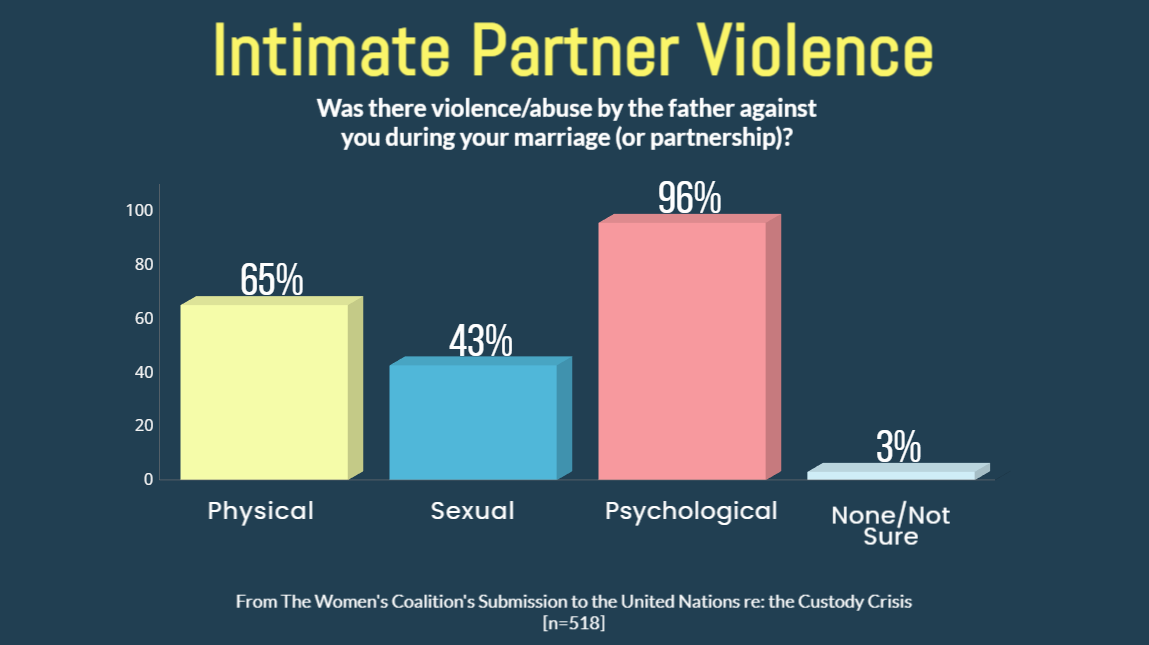
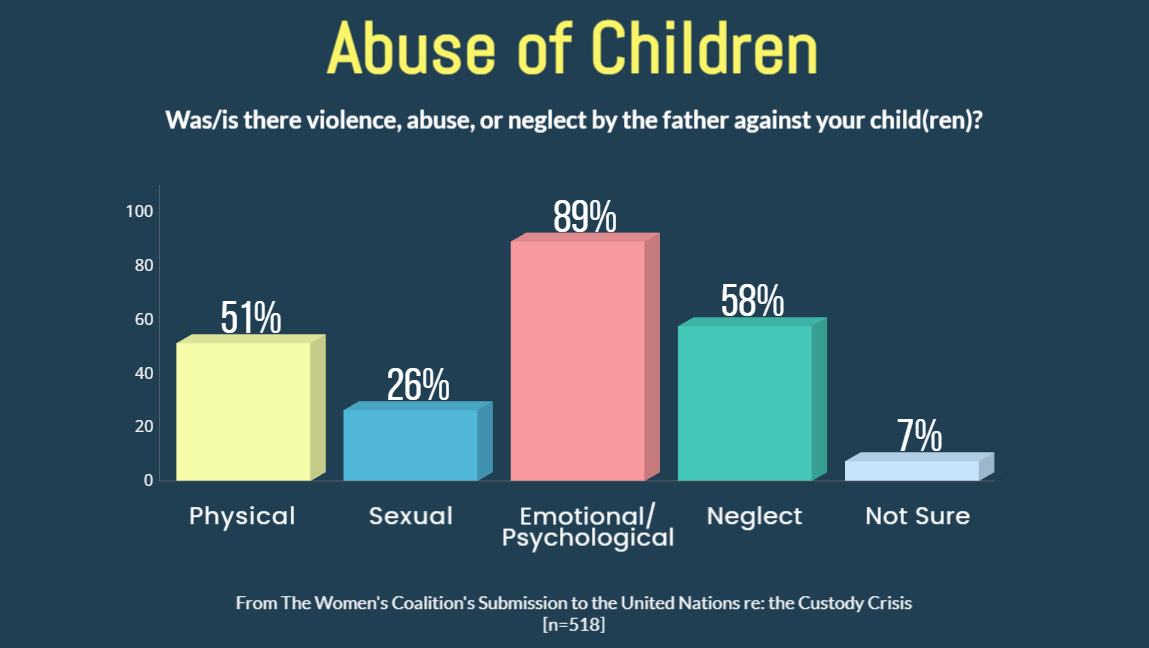
This submission by The Women’s Coalition [hereafter “Coalition”] is in response to the Call for Input by the UN Human Rights Council Special Rapporteur on Violence against Women regarding child custody cases.
Women in countries all over the world are being maltreated in family courts, wrongly deprived of custody, and unable to protect their children. The Special Rapporteur has requested input on many issues surrounding this “custody crisis”, which the Coalition includes in this submission.
However, in the end, it is imperative to put all these issues into the larger context, so the core cause of the crisis becomes clear. It is not just victims of domestic violence who are affected; women are losing custody whether they report abuse or not. Judges often switch custody to fathers who want it, for whatever reason, often to reduce child support or punish their ex for leaving.
This ubiquity supports the core cause of the crisis being systemic male entitlement and the concomitant discrimination against women, rather than the improper handling of women’s reports of violence or abuse. The custody crisis needs to be understood as essentially about power, not abuse—about judges maintaining age-old male entitlement and control in the family, i.e. persisting patriarchy. Only then can an effective solution be identified that gets at the root of the problem. It is the Coalition’s contention that reforms made within the Family Court system will not get to the source of the problem and that a new system is necessary.
SURVEY
The Coalition conducted a last-minute survey after hearing about the Call for Input a few weeks ago. There was no time to translate it into other languages, otherwise there would have been many more participants. Even so, 518 mothers from 21 countries took part: Argentina, Australia, Austria, Canada, Colombia, Denmark, England, France, Germany, Greece, Ireland, Japan, Mexico, New Zealand, Portugal, Scotland, Singapore, South Africa, Sweden, Trinidad and Tobago, and the United States of America.
This survey represents a convenience sample and is not meant to be representative of all family court cases. The survey provides quantitative insights on cases in which mothers have lost custody or have been unable to protect their children. Tens of thousands more cases have been compiled qualitatively by the Coalition and other civic organizations worldwide, attesting to women’s lived experiences.
DISREGARD OF ABUSE
The Special Rapporteur stated the aim of the investigation is to “document the many ways in which family courts ignore the history and existence of domestic and family violence and abuse in the context of custody cases”. “Ignored” is the operative word, as countless mothers report judges are disregarding strong and credible evidence. 95% of mothers surveyed reported that their judge ignored, dismissed, or minimized evidence of violence, abuse, unfitness, or other negative facts about the father.
Judges often issue gag orders or seal cases to keep injustices concealed and disempower mothers. In some jurisdictions, cases are automatically confidential. This is consistent with the patriarchal narrative that abuse is a “private family matter”. It is not. Abuse of women and children is a societal issue.
MISUSE OF PARENTAL ALIENATION
The Special Rapporteur’s Call for Input states there will be special emphasis on “parental alienation and related concepts”. A dictionary definition and common usage of the term is, “Alienation is when one person causes another person to be indifferent, hostile to, or estranged from someone”.
Thus, alienation exists on a spectrum from indifference to complete estrangement. Although it has not been established as a valid scientific construct, it is indisputable that parents sometimes engage in this behavior and that it is harmful.
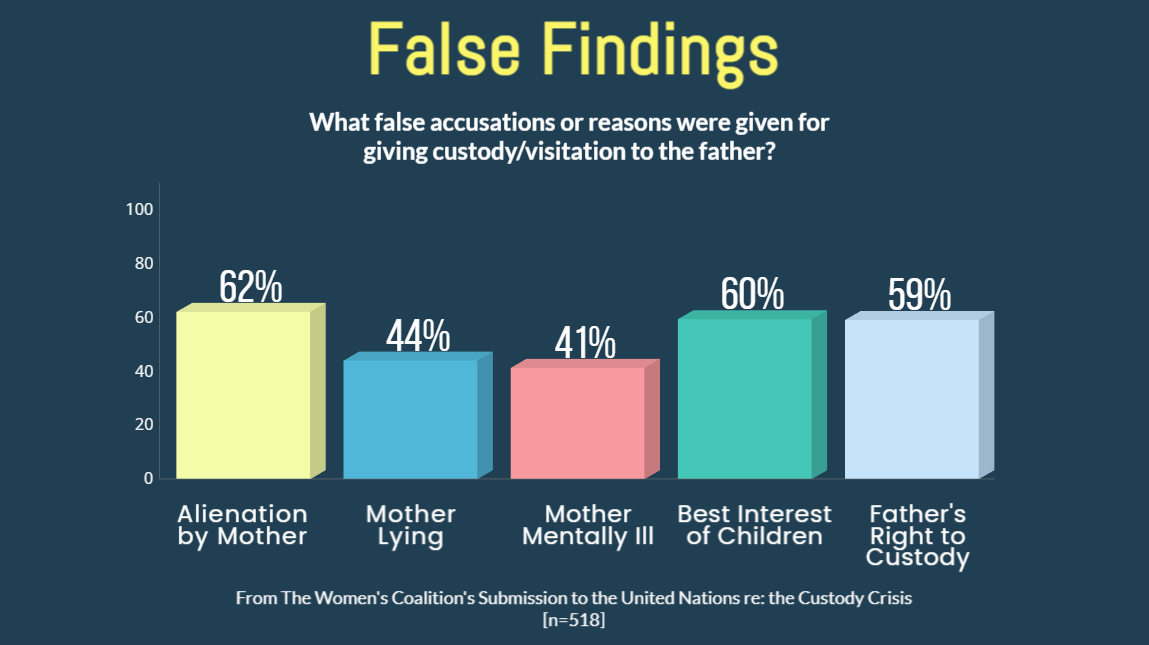
The problem with alienation is not that it is unscientific. It is that judges are falsely finding mothers have alienated their children by coaching or influencing them to say their father abused them. But, as our survey demonstrates, judges often use other false accusations to switch custody, the most common being that mothers are lying or mentally ill. Judges also often claim that being with the father is in the child’s best interest, or that it is a father’s right to be with his child, regardless of abuse.
However, there is an arguably much more serious problem with the discussion around parental alienation that does not get much attention: judges are enabling fathers to truly alienate children from their mothers. The main way judges do this is to severely restrict or eliminate children’s contact with the mother, which can cause them to form a trauma bond with their father.
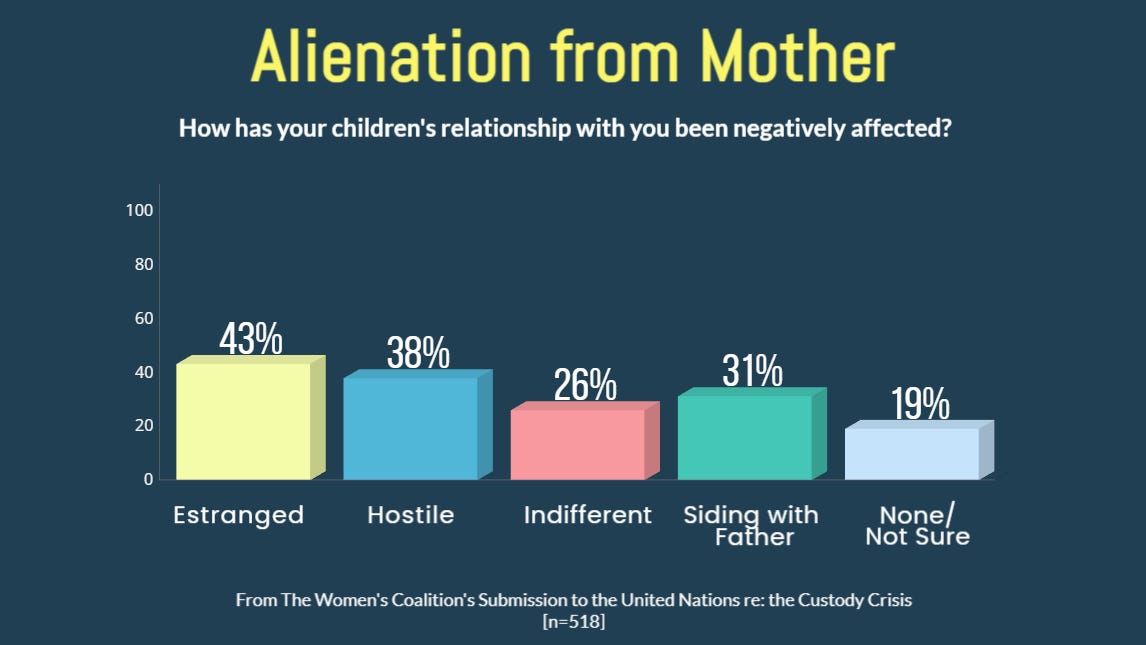
Another way is that judges order children into “reunification therapy”, the problem with that being it is not really therapy children are getting. Judges appoint mental health professionals who will “coercively persuade” (i.e. brainwash) children to recant abuse and comply with living with their father. Judges rarely order reunification with mothers because the goal is to keep the father in control.
Much activism is focused on invalidating and prohibiting the use of parental alienation or reunification therapy in family courts. However, it is neither parental alienation nor reunification therapy that is the problem. The problem is that judges have the power to falsely find mothers to be alienating to justify switching custody and appoint therapists who will help alienate children from mothers.
Prohibiting the use of alienation or reunification therapy, as many organizations and activists are pushing for, will not be effective because, as the survey shows, judges can simply use other terms or something else entirely. So, the Coalition strongly advises the Special Rapporteur not to recommend it be abolished. The Human Rights Council taking that position could do much harm to women who have been truly alienated and to the effort to end the crisis.
Instead, it would be helpful if a statement is made clarifying the real problems with parental alienation and urging women who’ve been falsely accused to unite with women who’ve been truly alienated. Women will have more power fighting together for an effective solution, such as the new system proposed.
COURT-AFFILIATED PROFESSIONALS
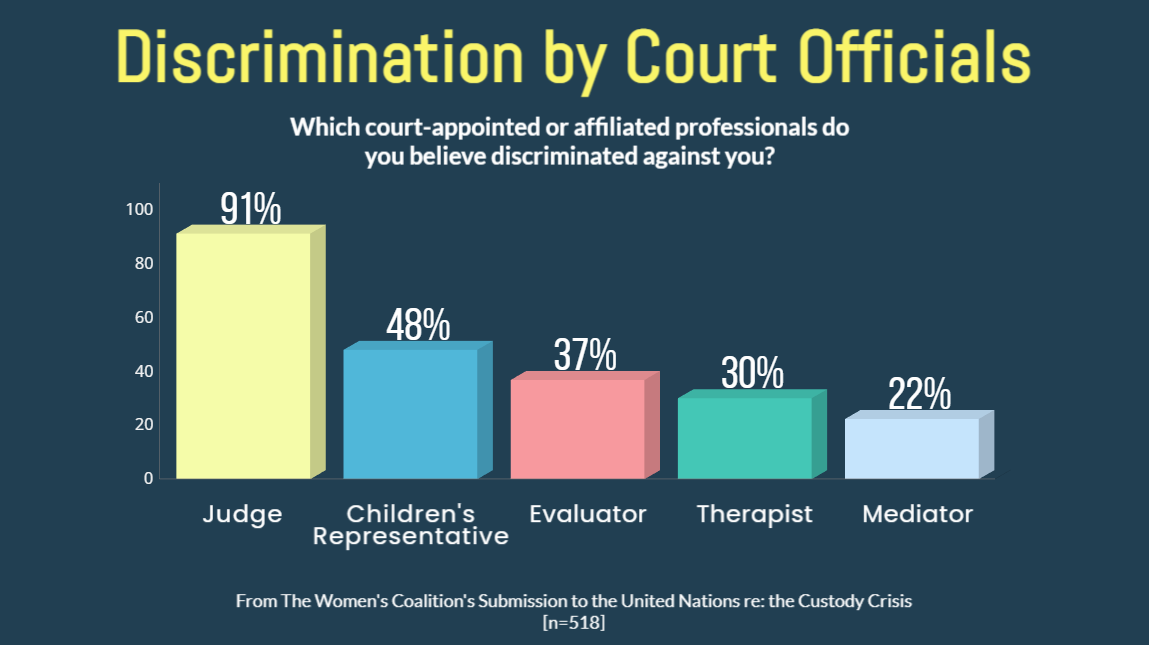
Judges regularly appoint children’s legal representatives, custody evaluators, therapists, mediators, and others, on whom they supposedly rely in making their custody decisions. But they inevitably choose professionals who can be counted on to steer cases to the father.
Although there is activism to require stricter regulation, higher qualification, and more training for court officials, that will not significantly change outcomes, since the actions of the appointees are mere reflections of the judges’ wishes. Also, judges can simply ignore them if they don’t say what is expected.
THREATS AND PUNISHMENT
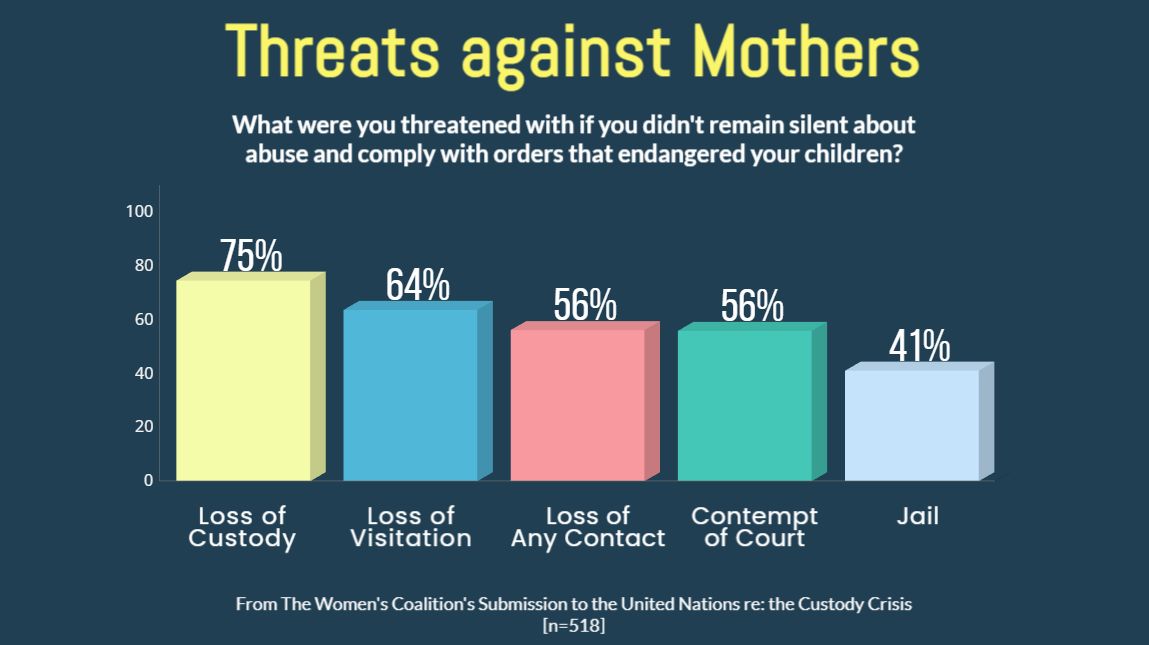
Threats and punishments serve to not only discourage women from continuing their own efforts to protect their children, but also send a message to other women to cease and desist. Judges and other court officials often threaten mothers to get them to comply with orders to make their children visit unsupervised or live with an abusive father, or to stay quiet about abuse.
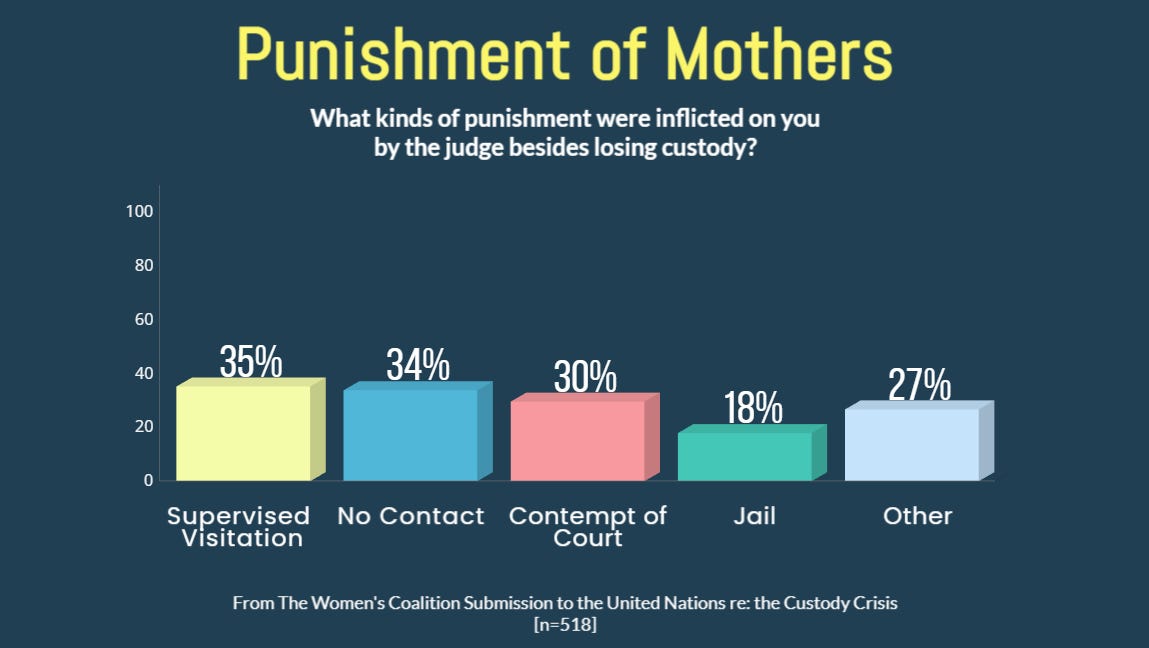
Judges not only threaten mothers, they actually restrict contact with children to punish them for challenging male authority in the family. Mothers are also being criminally indicted after going into hiding to escape abuse. Law enforcement and the criminal justice system often aid and abet family court judges by prosecuting them.
Thus, contact with children is being used by judges as leverage, not in their best interest.
GRAVE CONSEQUENCES
Many women not only suffer psychologically, but are losing their homes and careers and being financially devastated. Some succumb to suicide.
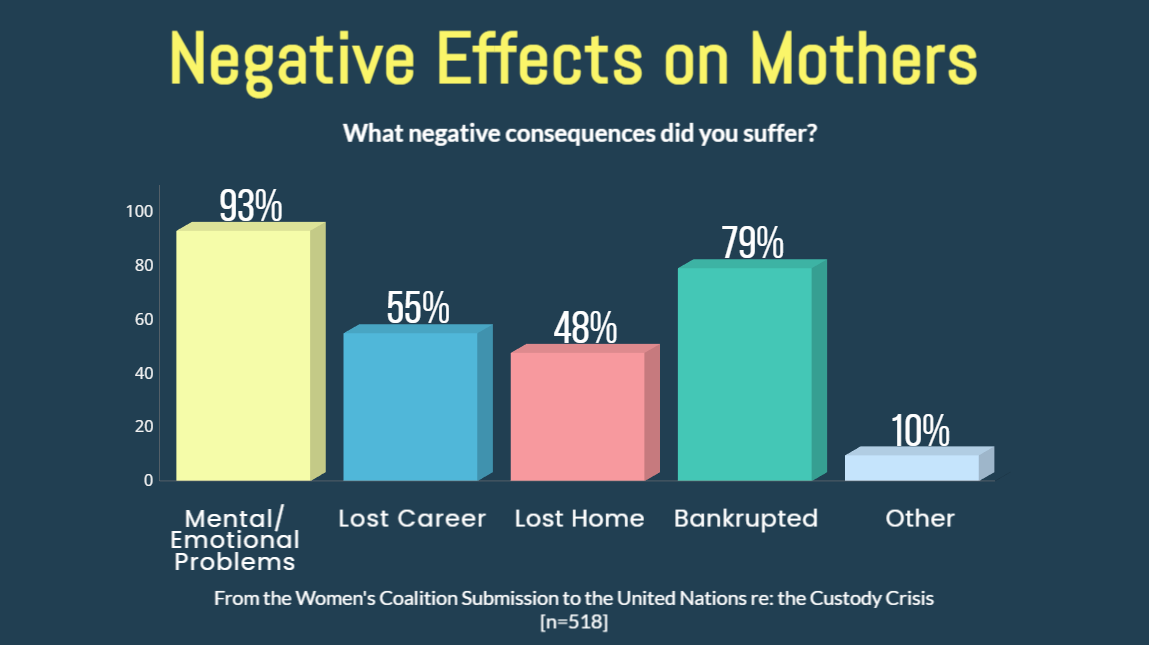
More than half of the mothers in the survey said they considered running with their children, and 15% fled anyway, many of who were imprisoned. The Hague has failed women who run, ordering them back to return children to the abusive father.
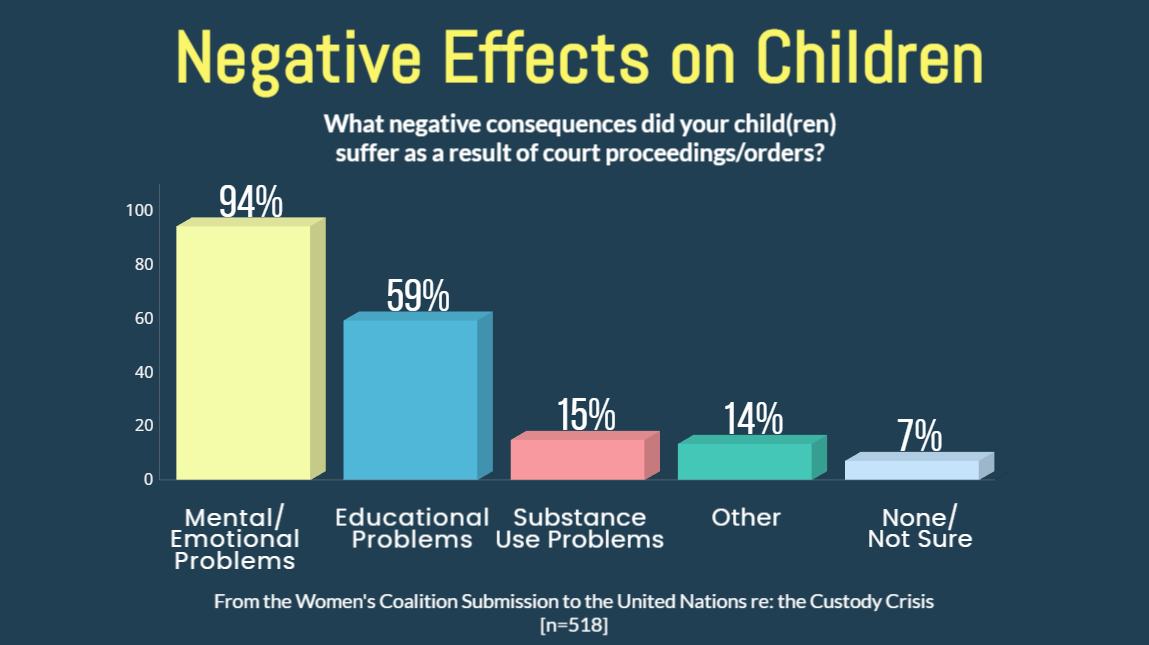
Children almost always suffer from psychological problems and many from educational problems, substance use issues, suicidal ideation, and some children also succumb to suicide. Both mothers and children are being rendered unable to fulfill their human potential.
HUMAN RIGHTS VIOLATIONS
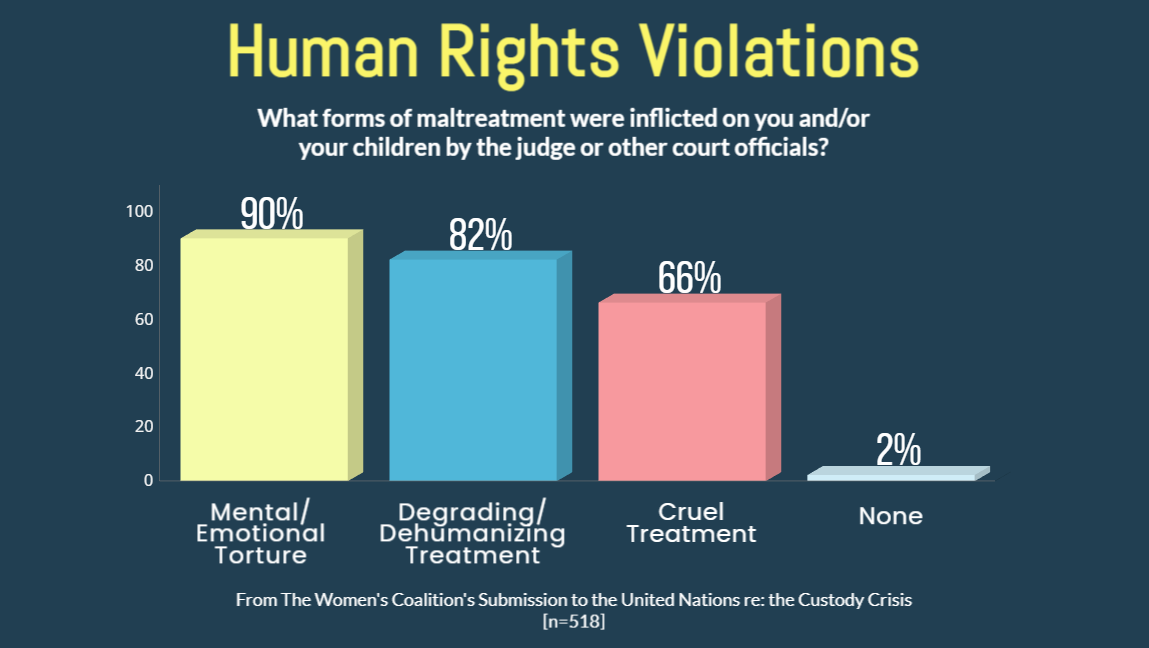
The Universal Declaration of Human Rights enumerates certain inalienable rights guaranteed to all citizens. Equal protection under the law is set out in Article 7. The right to a fair hearing before an impartial tribunal is set out in Article 10. The right to be free of torture and cruel, inhumane and degrading treatment is set out in Article 5.
Articles 7 and 10 establish the right to due process and prohibition of sex discrimination. A whopping 98% of mothers surveyed reported their judge discriminated against them. However, it should be noted that this is not simple discrimination due to unconscious bias or gender stereotyping. It is deep, systemic discrimination executed for the purpose of empowering men in their role as fathers.
Of course, there is no way to prove a judge discriminated against or tortured a mother psychologically, but it is important to credit women’s lived experiences in the courtroom. These human rights violations need to be prevented, not remedied. Judges must be prevented from committing them in the first place.
CONCLUSION
The family court system is greatly harming women and children around the world. Women are being deprived of custody and the ability to protect their children, along with being financially devastated.
It should not be surprising that men created a system that perpetuates their power in the family after women gained financial independence and the ability to divorce. In order for women to regain the power they had to keep and protect their children before patriarchy took hold, a new system is needed which provides them due process and equal protection.
The Coalition has attempted to establish in this submission that the issues of interest to the Special Rapporteur are all means or results of judges making rulings that maintain male power and control in the family. The reason Family Court judges are able to entitle fathers and oppress mothers is because they have, in effect, absolute power, and there is no effective means of oversight or remedy. Besides, unjust rulings need to be prevented, not remedied, as children suffer greatly in the litigation process.
Because of this, reforms within the present system will not make any significant difference. Custody cases must not be heard in family courts.
The Coalition has drafted legislation in which custody cases are removed from family courts and heard in regular, public civil courts with the right to a jury. This will provide for due process and equal protection, while precluding judges from inflicting torturous and degrading treatment on litigants, thus preventing the human rights violations being committed in family courts. The Coalition is willing to work with the Special Rapporteur or others within the Human Rights Council or other UN body to create a framework to be used internationally.
REQUESTS
The Coalition hereby requests the Special Rapporteur make three recommendations in her report to the Human Rights Council:
· First, that the Council should identify the human rights violations identified by the Special Rapporteur are a result of “systemic male entitlement and the concomitant discrimination against women”.
· Second, that the Council should establish that reforms within the present system will not prevent judges from committing human rights violations, hence, the right to a jury trial in a regular civil court must be guaranteed, along with other due process protections.
· Third, that the Council should form a task group that communicates with The Women’s Coalition and other women’s rights organizations to create an international framework for a process that will provide justice and protection in custody cases, and where the Coalition’s proposed Child Custody Act may act as a guide in this process.
Finally, it is The Women’s Coalition’s earnest stance that this approach is the only way women’s human and civil rights will be effectively upheld in custody cases. Non-abusive men who truly want the best for their children will also benefit from this new and just process.
Respectfully submitted to the UN Special Rapporteur this 15th day of December 2022
Cindy Dumas
Founder and Executive Director of The Women’s Coalition
Courts Using Conservatorships to Rob from the Elderly
Thank you to a California Grand Jury for this report about how civil rights are violated against our second most vulnerable community. (If you think the unborn are not human, then you might consider the elderly and feeble minded as the most vulnerable community.)
Court mandated conservatorship is often a euphemism for embezzlement and elder abuse.
I am only 60 years old, but an Arkansas attorney, William Zac White, tried to have me declared incompetent. Even though he appears to get everything he asks for from Judge Susan Weaver and several other judges, I was able to stop him from his plan to transfer control of my assets and my freedom to a conservator. Otherwise, he would undoubtedly nominate himself as conservator and I would live out my days in captivity without freedom to spend time with my husband and offspring.
Please read the report and pray for our elderly who have their homes stolen and are committed to live in an “assisted living” home.
Open Letter Looking for My Soul Mate
A wonderful writer named Shelly Hart wrote an article in CityWatchLA.com describing the corruption against and disdain for pro se litigants by judges perfectly.
I reached out to Ms. Hart through her online news group and hope to publish her work here as a guest author soon.
Here is a copy of the email:
Hi. My name is Laura Lynn Hammett. I was Laura Lynn until 2019.
You may be familiar with the work I did to get the CJP to give a “severe” public admonishment to retired commissioner Alan Friedenthal (deceased).
One of my colleagues forwarded a copy of an article written by Shelly Hart published September 23, 2019.
Bravo!
Arkansas is my new home. Unfortunately, the judiciary here is as bad as in California. It is more frustrating as many of the judges pose as “Christians”, even proclaiming “praise Jesus” on public posts. My response is a little different than when Jesus turned the tables over at the temple. The hypocrisy makes me want to puke.
Please forward this email to Ms. Hart as an introduction. Also, can you give me permission to reprint the article on my blog?
Foreshadowing Doom in the Arkansas Court of Appeals
Just the facts. I don’t want to speculate as to motivation. It is just too depressing to think the Justices at the Arkansas Court of Appeals are as conniving and disingenuous as Circuit Court Judge Susan Kaye Weaver and District Court Judge Charles Clawson.
Susan Weaver used her position of power to transfer my assets that were held in trust to a man who put in writing his intent to defraud me of over $75,000 by convincing me I was paying off the “mortgage” then foreclosing on the property after I gave him “cash”.
I was dismissed from the suit as an individual, but “the trust” was found in default. Judge Weaver said that I could not speak on behalf of the trust.
The reason courts give for forbidding an individual from representing himself as trustee of a trust is that the trustee is a fiduciary to beneficiaries and the settlor of the trust. A person must be authorized to practice law to represent anyone else’s interests.
I was settlor, trustee and sole beneficiary of my trust. My sons were contingent beneficiaries, meaning if I did not terminate the trust before I died, they would become beneficiaries later, at my death.
To be certain that I can represent myself in all my trust capacities, I amended the trust to remove my sons. The purpose of the trust was to transfer property to my sons without paying the high taxes at probate. The government takes about four times as much of an estate that was not transferred through a trust. But Judge Susan Weaver and her friendlies already looted my trust. There was nothing left to give to my sons anyhow.
Now, I am not an attorney. I am inexperienced compared to most attorneys. I made a mistake.
When I filed a notice of appearance with a copy of the amended trust, I came into a glich in the electronic filing system. It would only let someone with a bar number file the entry of appearance. So I used the “motion – other” document type.
Instead of telling me I used the wrong document type, the Court proceeded as if my entry of appearance was a motion. It did not look like a motion. It did not smell like a motion.
But the Justices of the Arkansas Court of Appeal pretended it was a motion and denied my Constitutional right to represent myself, in all my different hats.
Then, the images of the entry of appearance were not posted on the online docket. That alone makes me suspect that the Justices were trying to hide something. But I promised not to speculate. [UPDATE] The Clerk added the images and apologized. She said that the error was made because my case is marked “Under Seal” because 10 pages are supposed to be under seal.
Here are copies of the entry of judgment, the amended trust and my motion filed today that explains the facts recited above to the COA and asks them to strike their “Formal Order” denying my right to self-representation without giving a reason.

