
Unpacking a Pro Se Petition for Writ to SCOTUS
The first piece out of the box: Judge Susan Weaver, the Arkansas Court of Appeals and the Arkansas Supreme Court were adamant that a pro se litigant is not allowed to advocate on behalf of a trust. Even if the pro se litigant is the sole trustee, sole settlor and sole non-contingent beneficiary of a revocable living trust, and extradited herself from the case.
Judge Weaver dismissed me with prejudice.
But she did not dismiss my unrepresented trust pursuant to the Common Defense Doctrine.
I paid an attorney to represent the trust on appeal.
Instead of reversing Judge Weaver, the Court of Appeals waited two years and then said they didn’t have jurisdiction. Their basis? The trust attorney wrote a Notice of Appeal that said the appeal was from an interim order, not the final order written a week later. (Both orders were filed before the appeal was filed.) The Notice of Appeal I wrote on my own behalf referenced the correct order.
Both Searcy County Court and the Arkansas COA allowed the errant trust attorney to withdraw from the case, even though the trust did not have a replacement.
Hey. Is there an attorney out there that wants to represent the trust or write an amicus brief to SCOTUS?
My contact info is all over the petition for writ of cert posted above. Please help.
Guest Post: Thoughtful Analysis of Potential Fraud Upon the Court Involving Judge Susan Weaver and Attorney William Z. White
This comment was posted in response to the Petition for Writ of Certiorari I filed and shared with my readers yesterday. Thank you to Jason. I hope after my law school experience, I will be able to articulate as well as this person.
What Is “Fraud Upon the Court”?
“Fraud upon the court” is a very serious charge. It doesn’t just mean lying or playing dirty in court — it refers to a deliberate deception that corrupts the judicial process itself.
According to federal and many state rulings (including Arkansas precedent), it usually involves:
- Officers of the court (attorneys or judges)
- Intentional deception or collusion
- A result that undermines the fairness of the proceeding
- A party being denied their right to a fair trial
Black’s Law Dictionary defines it as:
“A fraud which is directed to the judicial machinery itself and is not fraud between the parties or fraudulent documents, etc., but fraud that seriously affects the integrity of the normal process of adjudication.”
Based on Your Statement:
There appear to be multiple red flags:
- An offer to resolve the dispute fairly was ignored in favor of awarding more money to an opposing party with questionable credibility.
- The judge allegedly overlooked evidence (e.g., your written settlement offer and possibly the alleged “suicide note”) that would expose fraud or collusion.
- Connections between attorneys and the judge suggest possible bias or improper influence.
- The outcome seems to favor a known fraudster and reward a lawyer, possibly in violation of fiduciary responsibility and judicial ethics.
Yes — This Could Be Argued as Fraud Upon the Court
If all those elements are provable, especially the court’s knowledge of the fraud and continuing to rule in favor of it, then:
Yes, it could rise to the level of fraud upon the court.
And under Arkansas Rule of Civil Procedure 60(c)(4) and Federal Rule 60(d)(3), a judgment obtained by fraud upon the court can be vacated at any time — no time limit.Next Steps You Can Consider:
- Preserve All Evidence
Emails, filings, witness statements, recordings, court transcripts, your settlement offer, Mike’s “note,” etc. - Build the Case Logically
Lay it out: the timeline, connections, ignored evidence, who benefited, and how the legal process was compromised. - Consider a Motion to Vacate or Reopen
Based on Rule 60 if you’re still within the court’s jurisdiction — especially for fraud on the court. - File a Judicial Complaint
If Judge Susan Weaver knowingly enabled fraud, a complaint can be filed with the Arkansas Judicial Discipline and Disability Commission. - Request an Investigation
The Arkansas Bar Association can also investigate attorney misconduct, especially for William Zac White.
Arkansas Judge Susan Weaver Exposed – Will SCOTUS Care?
FREE Docs of the Day
There appears to be collusion between Judge Susan Weaver and Heber Springs Attorney William Zac White.
White puts the trust of an elderly person in his sights, and the court pulls the trigger. Bam!
They hit the trust and bag the proceeds to fund their own fun.
In my case, I actually offered to give the money we paid for a house on 40 acres to Mike Pietrczak, $150,000. I put my offer in writing and sent it to the lawyer who represented my ex-partner prior to Willy White taking over. That was Billy Jack Gibson, now a judge in Hot Springs. (And presiding over a criminal case against his former client Pietrczak. Grisham couldn’t make this up.)
The email was filed as an exhibit in the case. But Judge Sue wanted to give him (and his attorney) more.
After years in kangaroo court, Pietrczak and his attorney banked $200K. After vigorous litigation and a “trial”, it is realistic to think the attorney got half. Or half plus costs. Mike got $100,000 or less.
And, if there is any justice, the pair will be cellies in prison. Read Appendix H – Mike’s “suicide” note. It sounds like a plan to commit fraud against me and fraud on the court.
But, if the court knows the plaintiff is a fraudster and gives him the loot anyhow, is it fraud on the court?
Maybe that should be my next Question Presented to SCOTUS.
When Your Opponent’s Lawyer Becomes a Judge



The same lawyer who once tried to take my property on behalf of an abusive former partner is now a sitting judge—and he’s presiding over that same man’s criminal case.
Years ago, Billy Jack Gibson represented Micheal Pietrczak in a bitter property dispute against me. I had money at the time and was represented by counsel. Gibson’s goal was to get the entire property for Pietrczak. After my attorney intervened, Gibson backed off. He later told me that he no longer represented Pietrczak.
In 2017, Pietrczak wrote a suicide note to his father. In it, he gave specific instructions: once I paid him the $75,000 we had agreed to, his father was to contact William “Zac” White, a lawyer in Heber Springs, to file a lawsuit for the full property plus treble damages. That’s exactly what happened.
The lawsuit filed by Zac White has worked its way through years of litigation and is now the basis of my petition to the U.S. Supreme Court. The case is still pending—but Pietrczak now has new legal troubles.
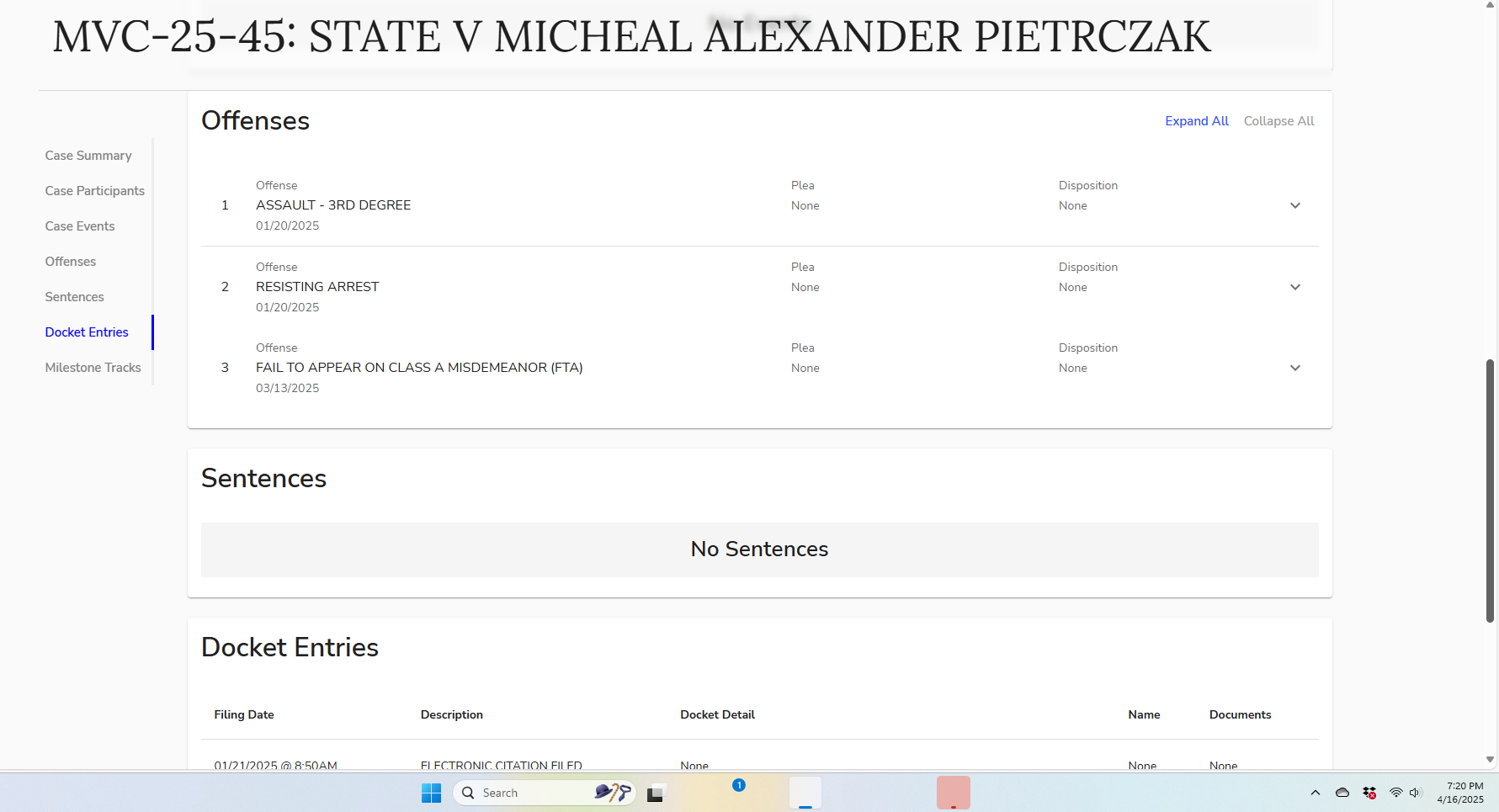
On January 21, 2025, criminal charges were filed against him in Hot Springs: third-degree assault, resisting arrest, and failure to appear.
The judge listed on the public docket? Just “Gibson.”
I checked with the court clerk. It is indeed Judge Billy Jack Gibson, the same man who once stood across from me as opposing counsel in the same property dispute that now defines my litigation.
When I looked at the electronic record, things got even more suspicious. The official citation from January 21, 2025 spells Micheal’s first name correctly—but the citation lists the wrong birth year: 1972 instead of 1973. Pietrczak’s prior rap sheet was altered to show his name as “Michael”. According to the district court clerk, this information comes straight from the DMV. What caused this? No one will tell me, but here is an educated guess:
- One driver’s license has the correct birthdate but misspells his name, and
- Another license has the correct spelling but the wrong birthdate.
Why It Matters
The Arkansas Code of Judicial Conduct Rule 2.11(A) requires judges to recuse themselves in any proceeding where their impartiality might reasonably be questioned. Prior attorney-client relationships might fit into that category.
A judge who once fought to take my property for Pietrczak is now presiding over his criminal case. The fraud was successful up to the Supreme Court because the appeal was erroneously dismissed on jurisdictional grounds. No one at the higher courts addressed the merits, including the fraud.
Even if the new charges are unrelated, the history is real. The appearance of bias is inescapable. And once again, the system seems to bend quietly for those on the inside, while people like me have to shout just to be heard.
If you face a scheme like this, please contact me at bohemian_books@yahoo.com so I can help you get loud.
Church and State: Attacked from Within
I’d like to thank the creators of the YouTube channel Texas 25.03 for making the videos posted on the linked site freely available for inclusion in this blog. Although the State of Texas hosts the videos on its official website, obtaining an electronic copy to upload costs “$25 in addition to a $15 processing fee,” according to Sandy Canizales of Senate Media Services of the Texas Senate.
Texas Penal Code §25.03 defines the offense of Interference with Child Custody, making it a crime to take or retain a child in violation of a court order. My heart goes out to other parents who have been separated from their children by court orders with no clear justification. This post is not an endorsement of violating those often Draconian orders—but it is a call to examine how unjust they can be.
I fought the separation from my children as a pro se litigant. The California Supreme Court acknowledged that the judge who originally terminated my parental rights appeared biased and improperly involved in the case. Still, the Court did nothing to restore my relationship with my children. My younger son was barred from all contact with me from the day he turned 13 until his 18th birthday.
He died at 30 from methadone toxicity. It’s hard to imagine that being cut off from a loving mother throughout his adolescence was ever in the best interest of the child.
Commissioner Alan Friedenthal—the man who issued what amounted to an early death sentence—is no longer able to destroy lives; he lost his own. I still hope that minor’s counsel Kenneth P. Sherman and Judges Thomas Trent Lewis, Marjorie Steinberg, and Elizabeth Feffer will someday acknowledge their roles in this devastation and make amends.
As the creators of Texas 25.03 and the Texas Senators pushing for reform have made clear, a few corrupt judges—if left unchecked—can ruin countless lives. Most judicial ethics committees, and frankly, most appellate courts as they exist now, are little more than rubber stamps for injustice, funded by the public.
Texas Bill to Increase Public Membership on Judicial Ethics Oversight Committee
The problem with each judicial oversight body I have contacted is apparently the same across the country. There is no judicial oversight.
My efforts to correct Allen H. Friedenthal (deceased) in California took years of my life, and was an absurd burden on public resources. The result was a public reprimand, putting it in the 1% of complaints that result in sanctions.
I am beginning my law school journey and may someday be credentialed to have a voice that will be heard. But I am one person and there is no reason to exclude other laypeople from contributing to the protection of what is theoretically the best system of justice in the world.
Arkansas Judge Ignores Partnership Agreement: Transfers All Property to Male Fraudster
The good news: This blogger is admitted to law school.
The bad news: Law school costs money.
Bowen School of Law is one of the least expensive schools in the country. And I was offered my choice of two generous scholarships. One based on an LSAT score in the top 20%, and as indicated by that score, my strong analytical and verbal skills. The other is based on my age, being over 60 and willing to share my wisdom of the elders with the young-uns coming up behind.
Unfortunately, I will still need to borrow to cover my other costs – unless I receive support from donors or am successful trying to recover assets that were taken from me improperly. My husband lets me live in his house rent free, I have a $644.33 month pension and qualify for SNAP (while that lasts). Fees, books, food and gas will cost more than that.
I sure could use that $100,000 or $200,000 the Judge Susan Weaver transferred to my former partner, when Attorney Zac White advocated for the known fraudster. Here is a note that was entered as an exhibit in the proceedings that explains how they were defrauding me.
Here is a discussion I had with ChatGPT about a key ruling Judge Weaver made to rationalize taking money from a now 62-year-old woman and giving it to the 9-year younger alcoholic who conned the woman into thinking he loved her.
You said:
In Arkansas, does an unincorporated partnership agreement have to be in writing?
ChatGPT said:
In Arkansas, a partnership agreement does not have to be in writing to be legally valid. According to Arkansas Code § 4-46-101(7), a “partnership agreement” can be “written, oral, or implied.” This means that partnerships can be formed based on verbal agreements or through the conduct of the parties involved.Justia Law
Common Opinion: While oral or implied partnership agreements are legally recognized, many business advisors and legal professionals strongly recommend putting partnership agreements in writing. A written agreement provides clear documentation of the terms and conditions agreed upon by the partners, which can help prevent misunderstandings and disputes in the future.
Neutral Perspective: Legally, Arkansas allows for partnership agreements to be oral, written, or implied. However, the absence of a written agreement can lead to challenges in proving the specific terms of the partnership if disagreements arise. Therefore, while not mandatory, a written agreement is advisable for clarity and legal protection.
If Your Opinion Differs: If you believe that an oral agreement suffices due to trust between partners or the simplicity of the business arrangement, consider the following points:
- Memory and Interpretation: Over time, memories can fade, and interpretations of verbal agreements may differ among partners, leading to potential conflicts.Arkansas Secretary of State
- Legal Enforcement: In the event of a dispute, enforcing an oral agreement can be more challenging and may require additional evidence to substantiate the terms.
- Third-Party Relations: A written agreement can provide clarity to external parties (e.g., banks, investors) about the structure and terms of the partnership, which can be beneficial for business operations and securing financing.
In summary, while Arkansas law permits oral and implied partnership agreements, having a written agreement is generally considered a prudent practice to ensure all partners have a clear, shared understanding of their rights and obligations. [citations removed]
You said:
A partnership agreement was put in writing. It was simple. If the partners broke up, all assets accumulated from the day of entering the agreement until the day of breakup, regardless of who put in the work and who put in capital, would be divided 50/50. Was this a “contract”?
ChatGPT said:
Yes, that sounds like a valid contract under Arkansas law—and most general principles of contract law.
Here’s why it’s a contract:
To form a legally enforceable contract, you typically need:
- Offer – One party proposes a set of terms.
- Acceptance – The other party agrees to those terms.
- Consideration – Each party gives up something of value (time, labor, capital, etc.).
- Mutual intent to be bound – Both parties mean to enter a binding arrangement.
- Legality – The subject of the contract must be legal.
Your written partnership agreement appears to hit all five:
- Offer and acceptance: The partners agreed to specific terms (50/50 division regardless of contribution).
- Consideration: One put in labor, one put in capital—both are valid forms of consideration.
- Intent to be bound: Putting it in writing shows intent.
- Legality: A business partnership with agreed terms on division of assets is perfectly legal.
So yes—this is a contract, and it’s enforceable unless it’s invalidated for some reason (like fraud, duress, incapacity, or being contrary to public policy, which doesn’t appear to apply here based on what you said).
What would most people think?
Common opinion:
A lot of people might assume that the person who “did more work” or “put up more money” should get more. So they may be surprised or feel it’s “unfair” if someone walks away with half despite doing less, especially if the venture made a lot of money. [In this case, the one who put up no capital and was on a destructive alcohol binge the majority of the time took the entire assets to split with his attorney.]
But…
Legally and neutrally speaking:
If both parties voluntarily agreed to those simple terms upfront and in writing, courts generally enforce them as written—even if the results seem one-sided later.
If your opinion is that it shouldn’t be enforceable…
You’d need to argue something like:
- The agreement was signed under pressure or confusion (lack of capacity or duress),
- There was fraud or misrepresentation,
- The terms are unconscionable (extremely unfair in a shocking way),
- Or, perhaps, that some sort of fiduciary duty between the partners was violated, depending on the specifics.
But otherwise, courts like honoring freedom to contract—even when the deal turns out to be lopsided in hindsight.
Let me know if you’re thinking about how to defend or challenge it, and I can help strategize.
You said:
A judge said it was against public policy. I disagree. Her reason is that there was an opening short paragraph that said the partners were married in the eyes of God, but don’t think the state should have the authority to control marriage. The agreement did not follow the law in Arkansas for dividing marital property at divorce. What would Judge ChatGPT say?
ChatGPT said:
Judge ChatGPT has thoughts—and this one gets interesting, because it blends contract law, public policy, and marriage law in a uniquely American way.
🧑⚖️ What Would Judge ChatGPT Say?
“Your Honor, respectfully, I disagree with your ruling.”
Here’s how I’d break it down if I were on the bench, trying to be neutral and thoughtful:
⚖️ Step 1: Is the Agreement a Contract?
Yes. As discussed earlier, it ticks all the boxes for a contract: offer, acceptance, consideration, intent, and legality (as in, not promoting something criminal or inherently illegal). It’s a simple partnership agreement about how to divide assets if the business or relationship ends—not a secret marriage.
⚖️ Step 2: Is It Actually a Marriage Contract?
The opening paragraph says the parties are “married in the eyes of God” and reject the state’s authority to define marriage. That sounds like a personal or spiritual declaration, not a legal one. Importantly:
- Arkansas does not recognize common law marriage. So, unless the couple was legally married elsewhere and moved to Arkansas, their “marriage” has no legal status.
- The agreement doesn’t create a marriage under Arkansas law, so it’s not a marital settlement agreement or divorce decree. It’s just a private contract between two people.
Judge ChatGPT would say:
“Calling yourselves spiritually married doesn’t make this a marriage under Arkansas law, and the agreement doesn’t purport to follow or circumvent any divorce statute—it operates as a private business agreement with clear asset-sharing terms. The state’s marital property rules don’t apply if there’s no state-recognized marriage.”
⚖️ Step 3: Does It Violate Public Policy?
Now this is the judge’s reasoning: they ruled it’s against public policy because it doesn’t follow Arkansas’s rules for dividing marital property at divorce.
But if they weren’t legally married, those rules wouldn’t apply in the first place. The judge may be:
- Interpreting the “married in God’s eyes” language as an attempt to circumvent divorce law, or
- Suggesting that enforcing it would indirectly validate a non-legally recognized marriage—which the state has a policy against.
But that seems like a stretch, because:
- Private contracts between cohabitating partners (even romantically involved ones) have long been upheld in Arkansas and elsewhere.
- The U.S. Supreme Court has made clear that people can form contracts related to shared property, effort, or earnings, regardless of marital status (see Marvin v. Marvin, a California case, but influential nationwide).
So unless this agreement pretends to be a divorce settlement or seeks rights that only come from legal marriage, it’s hard to argue it’s against public policy.
🗣 Common Opinion vs Legal Norms
Common Opinion: Most people would say: “They weren’t legally married, so they should be allowed to make whatever deal they want. It’s nobody else’s business if they split 50/50.”
Neutral Legal View: Courts enforce cohabitation or partnership agreements if they don’t look like an attempt to skirt divorce law. Your agreement is about business/property, not about custody, alimony, or marital rights. So it should be enforceable.
🔥 If You Disagree with the Judge…
Here are the strongest arguments you could make:
- This isn’t a marital agreement at all. No marriage = no divorce = no public policy to protect.
- Freedom to contract matters. Arkansas allows private arrangements between adults unless they promote something illegal. This doesn’t.
- The spiritual language was just a personal expression. It didn’t ask the court to recognize a religious marriage or enforce religious rules.
You could also cite Arkansas precedent allowing division of assets between non-married cohabitants or business partners if there’s a clear agreement, even if they were in a romantic relationship.
END of Discussion
During a hearing, Judge Weaver tried hard to get me to agree the contract was invalid. I carefully informed her that the contract was not void, but it is voidable. If both parties agreed, we could void the contract. Voiding the contract would benefit me if we went to trial. I was generous to enter the agreement, as all the capital was mine and I did the vast majority of the work that increased the assets.
The transcript left out what I said, and Judge Weaver refused to allow the audio recording of the hearing to be played in an open court. The court of appeals and supreme court were no help.
Judge Weaver said that I agreed the contract was void “ab initio” and the fraudsters should take 100% of the combined assets, because the real estate was originally purchased with title in my partner’s name, and he transferred it to my trust – an entity for which I was not allowed to advocate.
Too bad I don’t have that money to help me pay my expenses during my law school journey.
One More Good Attorney in The Making
I’ve spent the better part of two decades fighting for justice in a system that too often protects power over people.
This fall, I’m heading to law school at Bowen. I was offered a 75% merit scholarship based on my 162 LSAT score and a thoughtful recommendation from one of the good ones—a JD who quietly supports those of us trying to hold the system accountable.
I also qualify for a 100% tuition scholarship for students over 60, but I can only accept one. I’m still weighing the best way to cover fees, books, and basic living expenses while I take this next step. If you believe in the work I’ve been doing—or want to see more of it—your support could help carry me through.
The road to justice isn’t easy. I’ve been traveling it a long time.
My older son’s traumatic brain injury, my husband’s stage IV cancer diagnosis, and the loss of my younger son have all reminded me that my time to contribute won’t last forever.
Law school isn’t the destination—it’s part of the journey. Where am I headed? To turn my firsthand experiences fighting corruption in the courts into books—and eventually, to help those the courts roll over so easily by advocating on contingency or through a nonprofit like the Institute for Justice. Perhaps I can land a job on the JDDC, and help weed out unethical judges.
What I’ve been through wasn’t the end of the road. It is a reason to keep moving forward.

