Motion to Ban this Blog: Rose Law Firm Fibs About Service
- Attorneys from Rose Law Firm and Troutman & Pepper waited 11 days to file an “emergency” motion for sanctions.
- David Mitchell certified that the motion was handed to me and mailed to me on December 20th.
- There was neither kind of service made until December 23rd.
- Judge Lee P. Rudofsky ordered me to file my response in the clerk’s office by close of business on the 27th.
- I’d rather be organizing my laundry room and pantry before Christmas, but working on this response will point me to some interesting evidence to share with you, my dear readers.
- Enjoy the video.
- May your Christmas be filled with peace and joy.
Sunday Funday: Comedian Josh Johnson on the Grounds of a Brewing Revolution
I am not and never have advocated for violence. Josh Johnson is not, either. We both are commentators to what we see happening in this country. Sticking our heads in the sand will not change what is happening up above.
An oligarchy of corporate kings and their puppet politicians and judges tried, and some say succeeded at enslaving the masses. There is no justice for the everyday person.
One example: Walmart and major credit card companies partner to create million entry portfolios of account numbers. If one of the accounts appears to be in default and the person associated with that account refuses to pay, whether for a legitimate reason or not, the account may be written off for a tax break to the corporations, then sold to a debt buyer like Portfolio Recovery Associates LLC.
An account associated with my name before I married, Laura Lynn, was one of the default accounts on a list generated by Capital One. (There is no indication that the Capital One account was a Walmart branded account. I mention Walmart, because the judge who was supposed to deliver justice on the matter, Lee P. Rudofsky, was general counsel to Walmart before his lifetime appointment to the federal bench.)
There was also an account sold to PRA that was associated with Laura Lyman. After I filed a lawsuit against Portfolio Recovery Asociates, LLC for violating the Fair Debt Consumer Protection Act (FDCPA) and my privacy, PRA sent a letter to Laura Lynn that said it completed the investigation into Laura Lyman’s dispute and set the balance of Laura Lyman’s account number to zero.
When pressed, PRA sent a letter to Laura Lynn saying her account was closed. When pressed again, the debt company sent a letter with the same language as the Laura Lyman letter, only with “Laura Lynn” and the account number associated with Laura Lynn. PRA and Judge Rudofsky maintain to this day that Laura Lynn owed $2,297.63 and admitted she owed the money. Total bullshit.
Judge Rudofsky and Portfolio Recovery kept me in court for years. Rudofsky lied about what I said. He lied by implication about the evidence that he allowed PRA to file under seal. The judge refused to allow a jury to hear and see the evidence.
Finally, PRA asked Judge Rudofsky to tax the costs of the goliath credit collector’s defense to me. In protest, I gave a copy of my tax return for the latest year and swore under penalty of perjury that my income is a pension that is under $650 per month. I said I qualify for Medicaid.
Judge Lee P. Rudofsky grumbled that I gave two different amounts, $630 and $639 off the top of my head, for my pension. (I didn’t realize I got a cost-of-living increase on the part of my pension that came from a QUADRO in a divorce filed in 1996.) He complained that I only gave one year of taxes. (President Trump, who nominated Rudofsky, wouldn’t show any of his tax returns to the public.)
The judge said something like “let her eat cake” and rubber stamped the order for costs to the company that buys debt from his past employer.
Josh Johnson got it right. It is looking like Versailles.
Commoner’s Commentary on Lawyers Proofread by Blogger Laura Lynn Hammett
This is a fictional work. But it resonates with many people. Most people are not capable to or comfortable fighting their own legal battles. Yet, legal services are too expensive for the working class (slaves), and the stars must align perfectly for a lawyer to take a case on contingency.
Our legal system is the giant thumb of the oligarchy keeping us down.
Sean Lynn priced this book high. If he ever becomes famous, it is the unedited version and will be collectable. I’ll post links to a couple of his other books, including the one he co-authored with me before his fall. Some are cheaper, especially as Kindle offerings.
More Shocking News of Power Elite Corrupting Our Legal System: Joe Biden commutes sentence of convicted judge Michael Conahan
Monsters who use our courts to make big bucks on the backs of the commoner should rot in jail the rest of their lives. If they have a jailhouse conversion, they should be content to spread the word to their fellow inmates.
Pardons should go to the now adult children who were sold into confinement for infractions that were nearly harmless. For example, posthumously to the boy who killed himself after spending eight months imprisoned for drinking while under aged. Not to the evil child abusers like Michael Conahan or now deceased Commissioner Alan Friedenthal.
I don’t advocate physical violence. I am smart enough to know that there will be an escalation of protest against the domination of a few over the masses. These pardons and commutations by the Biden Crime Family Boss might be the catapult.
Expose Court Corruption: Help the Commoner Enter the Halls of Justice.
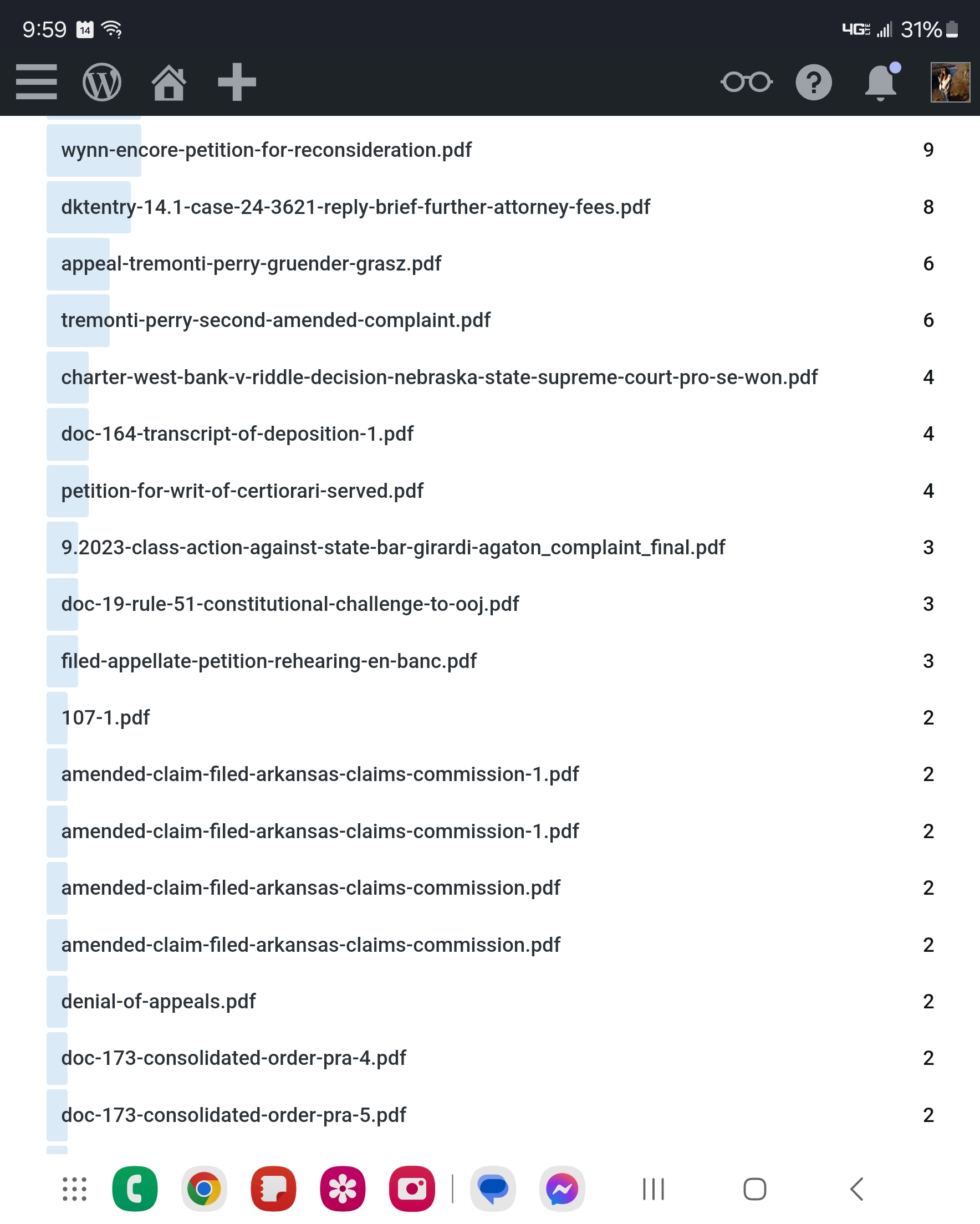
It was a good week for FREE Doc of the Day downloads.



Interviews are welcome. Contingent representation also. Bohemian_books@yahoo.com
Please repost and quote to your heart’s content (with attribution)

I am not a lawyer. I have been writing about the legal system for about 15 years. Mostly, I expose corrupt judges and attorneys.
In all this time, no one has sued me for copyright infringement for posting legal documents they generated. This makes me think reposting legal documents is fair game.
My blog is not monetized. It is useful in other ways. Feel free to repost and share my stories in any way you want. I just ask that you give attribution, and if you make changes, don’t represent the edited version as mine. Don’t be a Rudofsky and truncate sentences while keeping them in quotation marks.
When I checked my stats this morning, on my phone, there were 26 downloads of my filed appeal reply brief against Portfolio Recovery Associates, LLC. (By the time I walked upstairs to my computer, that number increased.) It struck me that a few days ago, maybe even weeks, there were exactly 26 downloads of a document.
That would be cool with me, if some law school professor was using my documents as a tool. I don’t care if it is to ridicule the pro se litigant or because the professor thinks the document is well written. It is my purpose to improve our world. If sharing my documents helps, get them out there.
Thank you.
Go, Steve Lehto, Go! Exposing the idiocy of our judges.
It seems like most of us commoners are losing or lost our faith in the legal system.
Hey, please send Mr. Lehto my posts about the Portfolio Recovery Associates case that is at the Supreme Court. He might get a kick out of how “textualist” Lee Rudofsky truncated a sentence to completely change the meaning and then based his decision to deny a jury trial on that miscomprehension.
Falsified Record at the U.S. Supreme Court?
The jury is still out.
My Pro Se Petition for Writ of Certiorari has about a .00000000001 % chance of being granted. It is almost unheard of for SCOTUS to review cases brought by pro se litigants.
There was a moment on December 9, 2024 when my heart raced and I shook and spoke like the men on the hunting videos my husband watches, right after they kill a buck. I thought I might have a heart attack. My docket had the words “motion granted”.
That was just a motion, not the petition for writ of certiorari.
Having the motion I filed granted was a big deal standing alone. It felt the same as seeing my 162 on the LSAT this past August. My motion asked for documents the lower courts kept sealed to be seen by you, the Public. Those documents were posted on this blog immediately.
Then the let down. Someone from the Supreme Court called me back to verify that it was the motion that was granted. She said that only the part of the motion asking for the documents to be filed under seal initially, to be in compliance with the lower court orders, was granted. She said that the justices understood that I was asking to unseal those documents and they were keeping them sealed at the Supreme Court.
There was no explanation of why the docket failed to mention my motion to unseal, and why there was no copy of my motion filed on the docket. There was no indication that there was a motion to unseal, even to say the motion itself was filed under seal.
There is a mechanism for me to purchase a certified copy of the motion filed. I will do that.
In the meantime, I checked the appendix to see what was made available to the public. The clerk scanned all the documents I filed, other than the four under seal. The guidance given by the Supreme Court says that only orders and required appendices will be scanned. “The Court’s practice is to scan and make available on its website most filings submitted by litigants representing themselves. The Court scans petitions, motions to proceed in forma pauperis, proofs of service, and the portion of an appendix that includes relevant lower court opinions and rulings. While the Court does not scan other portions of an appendix from a pro se litigant, the entire appendix is fully a part of the Court’s record and is available to the Justices.” Motions to seal are typically not available as links on their dockets. But other motions, like extensions of time, are. I have not found any other motion to unseal yet.
The appendix as scanned by the Supreme Court clerk is posted below for you to download. The clerk added an order that I did not include. It starts at electronic page 302. It is the order concerning my motion to settle the record, claiming the transcript of a hearing was falsified.
That this order was added to the appendix is promising for one reason. Obviously, someone looked carefully at my filing. The question of the accuracy or inaccuracy of the record is notable to the highest court.
So, why make their own record inaccurate? Why not mention that my motion also asked to unseal? Why not post the motion and write “denied in part”? Or write that the motion to unseal will be considered separately? At this point, it feels a little like reading the transcript that left out a lecture by Judge Rudofsky. I’m positive I don’t hallucinate. Why try to gaslight me? Hopefully the motion to unseal (and the motion to settle the record) will be revisited upon grant of certiorari. Hope and prayers.

