Judge Susan Weaver Claims Expressing Intent to Appeal is a Criminal Threat on the Judge
This is unbelievable. But true. I’ve heard recordings that clearly substantiate the claims of pro se litigant and fellow Judge Weaver victim, Betty Figueroa.
Betty was terrorized. She says she was going to participate in a luncheon event given by the Arkansas Bar Association on Friday. Judge Weaver was slated to speak there.
According to the pro se litigant, Judge Weaver conveyed a message through the police department, that if Betty Figueroa attends the shindig, she will be arrested. Her alleged crime. Threatening the judge.
I heard a recording of Betty speaking to Judge Weaver’s clerk, Emma.
Betty: “She [Judge Susan Weaver] filed a report on me.”
Emma: “…the last few times I’ve talked to you you’ve said that if [Judge Weaver] doesn’t file a response [to a petition for writ of mandate Betty Figueroa filed in the circuit court] you’re going to take it to the Supreme Court, and that is a threat.”
Really? Inquiring if the petition for writ of mandamus to compel Judge Weaver to do her job at the circuit court needs to be filed in a higher court, or if Judge Weaver intends to agree to the requested conduct on her own is considered a “threat”? A threat worthy of arresting Mrs. Figueroa for, but only if she participates in a Bar Association event?
Yes, later in the conversation, Emma repeated quite clearly: “You threatening to file stuff against Judge Weaver is a threat.”
The ones who seem to be making criminal threats are Judge Susan Weaver and her goon patrol.
It gets more frustrating!
Mrs. Figueroa claims she reported the judge’s threats to the JDDC. Someone at the JDDC told her to report it to the prosecutor, according to Mrs. Figueroa. I heard the recording of Betty and the prosecutor’s discussion. The prosecutor told the alleged victim to report the threat to the police; the same police office that conveyed the threat for Judge Weaver.
I went to three different police departments to report Judge Weaver for colluding to fictionalize transcripts of hearings she presided over. I went to Searcy County, Faulkner County and Malvern. Each department refused to investigate. The Malvern officer told me that judges can do whatever they want, even lie in court.
Is there no one in the government who will stand up against this tyranny? Are there no lawyers willing to challenge Judge Weaver on appeal for her unethical and allegedly illegal conduct against pro se litigants?
What about you? What will you do?
Improved Questions for SCOTUS: Pro Se Fights Against the Lack of Transparency in Court
The lead case for this challenge to a common problem is Laura Lynn Hammett v. Portfolio Recovery Associates, LLC, et al.
Questions presented for review:
- Whether transparency, equal access to technology, and guarding the integrity of evidence in court proceedings is required to protect the due process rights of a class of people who are often denied equal protection because of their socio-economic class; Pro Se Litigants.
- Whether the regulatory opinions resulting from civil investigations by the Consumer Financial Protection Bureau are authoritative and may be used as evidence of the respondents’ practices.
If court personnel, including clerks and judges, altered the record in a case in which you were an unrepresented litigant, you were denied permission to file electronically, or the judge ignored obvious incongruities in the represented parties’ evidence and you were self-represented, please post your case name, number and jurisdiction in the comments or contact me anonymously at bohemian_books@yahoo.com.
Your case may be included in a collection for an appendix to this petition for writ of certiorari to the Supreme Court of the United States and if denied, the Office of the High Commissioner of the United Nations.
Advocate Lucinda. Go ahead and preach.
Write In Candidate for President, Betty Figueroa, May Be Our Best Option
My readers know the angst the upcoming presidential election brings me.
RFK hits the nail on the head when he defines the problems with our current system and options. But does he provide an option that is different? I think not.
My personal standard of living has decreased during Biden’s reign. Court corruption has increased and there is little meaningful enforcement for anti-corruption laws that are already in place. (The Trump verdicts are encouraging; but we need to bring criminal charges against judges who violate individuals’ rights and hide behind judicial immunity to evade civil liability.) Still I was thinking of voting for Biden because none of his appointed judges have hit my radar for court corruption yet.
There is a new candidate that is my probable choice now. Yes, it is a “wasted” vote, because the chance she will win approaches zero. She does say exactly what I want to hear. We have met in person a couple times and she strikes me as authentic. What you see is what you get when you see Betty Figueroa.
Here is her campaign statement that she wrote with the help of the AI application Goodparty.org.
AI Campaign Plan
Your personalized plan powered by GoodParty.org GPT and our team of campaign experts.
Campaign Slogans:
1. “Real Change, Real Results”
2. “Transparency for All”
3. “From Struggle to Strength”
Personal Credentials:
I’m Betty Figueroa, an Independent candidate for President of the United States. While I don’t have a conventional occupation, I am always helping people and taking on new challenges. I enjoy fishing, music, and learning new things.
Motivation for running:
Having never been rich or handed anything, I understand what it means to be overlooked, not heard, and walked over. I can relate to the everyday struggles of the people and believe our system needs fixing. My experience as an advocate for people’s rights has shown me the importance of transparency and accountability in government.
Government ethics and anti-corruption measures: I am committed to promoting transparency in government decision-making to ensure it serves everyone, not just those with an agenda.
Police Accountability: I advocate for mandatory body cameras for all officers as a part of their uniform. These cameras should protect everyone, and any officer who tampers with them should face immediate termination and charges.
Differentiating Factors: Standing Apart in the Race
We’ve been lied to enough by presidents who have no firsthand experience with poverty or struggle. It’s time for a leader who knows what needs to be done and has the drive to get it done. I’ve had people released from jail and fought tirelessly for others’ rights. I bring a unique perspective and a genuine commitment to making meaningful changes.
Bio
### About Me: Hello, I’m Betty Figueroa, and I’m running for President of the United States as an Independent, non-partisan candidate. My journey to this point has been deeply rooted in my commitment to addressing critical issues that impact everyday Americans. My primary focus lies on government ethics, anti-corruption measures, and police accountability.
**Government Ethics and Anti-Corruption Measures** Transparency in government decision-making is essential. It should serve everyone’s interests, not just those of a privileged few. We are supposed to have a say in everything, yet often, we’re expected to follow orders without any input, especially the less fortunate among us. If you’re wealthy, you might not see this disparity, but it’s a reality for many. It’s time for a change where everyone’s voice is heard, and our freedoms are preserved.
**Police Accountability** Police accountability is another cornerstone of my campaign. I firmly believe that mandatory body cameras should be a part of every police officer’s uniform. These cameras protect everyone—both civilians and officers. An officer should not have the ability to turn it off, cover it, or block it in any way. Any violation of this should result in immediate termination and legal consequences. This measure is crucial for building trust and ensuring justice.
**A Voice for the Struggling** Our country has been lied to enough by politicians who seek votes without understanding the struggles of ordinary people. Many of them have been handed everything on a silver platter and have no idea what it means to be broke or overlooked. I know what it’s like to struggle in everyday life because I have lived it. My career has been enriched by my skills and achievements, like advocating for people’s rights and having individuals released from jail. I can relate to the people, and I believe our system needs fixing by someone who understands these challenges firsthand.
**Personal Touch**
On a personal note, I am always eager to help people, and I enjoy fishing, music, and learning new things. I’m always up for a challenge, which reflects my personality and commitment to our community’s betterment. Together, let’s make a change. It’s that simple. Thank you for considering me, Betty Figueroa, for President of the United States.
My Policies
Betty Figueroa for President
Independent / Non-partisan Candidate
Government Ethics and Anti-Corruption Measures
Promoting transparency in government decision-making
Ensure all government decisions and processes are transparent and accessible to the public.
Implement strict regulations to prevent conflicts of interest among government officials.
Develop a public online portal for real-time tracking of government spending and activities.
Police Accountability
Mandatory body cameras
Require all police officers to wear body cameras as part of their uniform.
Prohibit officers from turning off or obstructing body cameras, with immediate termination and legal consequences for violations.
Establish an independent oversight committee to review body camera footage and ensure accountability.
Addressing Poverty and Broken Systems
Real struggle in our State
Implement policies that address income inequality and provide support for low-income families.
Focus on educational reforms that offer equal opportunities for all, regardless of socio-economic background.
Develop community-based programs that offer job training, healthcare, and housing assistance to those in need.
It’s time for a change. It’s time for a person who has first-hand knowledge of what needs to be done and get it done. Betty Figueroa has the experience and vision to lead our nation towards a more transparent, accountable, and equitable future.
What I Will Say About Myself
As a dedicated advocate for government ethics and anti-corruption measures, my priority is promoting transparency in government decision-making. The transparency in government decision making should help everyone, not just serve agendas that take more of our freedoms. We are supposed to have a say in everything. The current system expects us to do what we’re told without a say, especially the poor. If you’re rich, you most likely won’t see these issues.
Police Accountability is another key issue. I support mandatory body cameras for all officers as a mandatory part of the uniform to protect everyone. Officers should not be able to turn these off. Any officer who covers, turns off, or blocks the camera should be terminated immediately and charged.
Transparency, accountability, broken systems, poverty, and real struggle in our State are my focus areas. We have been lied to enough by presidents just for a vote. People who don’t know a thing about being broke and have been hand-fed with a silver spoon can’t relate to the real struggles. It’s time for a change, for someone who has first-hand knowledge of what needs to be done to take over and get it done. It’s that simple.
Leveraging my experience in various skills, I have never been rich and was not handed anything. I know what it is like to be overlooked, not heard, and walked over. I can relate to the people. I also believe that our system needs fixing. A person who knows first-hand what it’s like to struggle in everyday life is essential. I have had people released from jail and have been an advocate for people’s rights.
What I Will Say About My Opponent
Unlike Joe Biden and Donald Trump, my approach to government ethics and anti-corruption measures is grounded in promoting transparency in government decision-making. The current system’s transparency should help everyone, not just serve specific agendas that take more of our freedoms. We need to ensure everyone has a say, not just the wealthy.
On the issue of Police Accountability, I support mandatory body cameras as a mandatory part of the uniform to protect everyone. Officers should not be able to turn these off, and any officer who covers, turns off, or blocks the camera should be terminated immediately and charged. This ensures transparency and accountability, which are lacking in the current system.
Joe Biden and Donald Trump’s approaches are often rooted in traditional politics, which have failed to address these critical issues effectively. My hands-on experience in dealing with real struggles ensures practical and realistic solutions for our community.
What My Opponent Will Say About Me
Joe Biden and Donald Trump may argue that my unconventional background and approach do not align with traditional political strategies. They might claim that my lack of a longstanding political career is a disadvantage. However, I believe that innovative solutions are what our community needs. My experience in advocating for people’s rights, having people released from jail, and understanding the struggles of everyday life make me uniquely qualified to bring about the change we need.
What My Opponent Will Say About Themselves
Joe Biden and Donald Trump will likely emphasize their longstanding political careers, positioning themselves as traditional choices for President of the United States. They will highlight their experience in handling national and international issues, portraying themselves as seasoned leaders capable of maintaining stability and continuity. However, it’s time for a change, for someone who has a fresh perspective and a deep understanding of the real struggles faced by ordinary people.
About the Candidate and Race
In this exciting race for President of the United States, Betty Figueroa’s unique background as an advocate for people’s rights and her personal flair, shown in her passion for helping people, fishing, music, and learning new things, stand against the campaigns of Joe Biden and Donald Trump. The election on November 11, 2024, will be a pivotal moment for our nation, offering a choice between traditional political approaches and a fresh perspective grounded in real-life experience and practical solutions.
***********************
If you don’t see any option for real change, consider writing in “Betty Figueroa” for president.
Do I really think Betty Figueroa is the best person in this country for the position? NO! This is parody. I thought it was a joke also when I heard Donald Trump was running.
Why I Can’t vote for a walking douche-bag instead of a turd sandwich for President: Their record on judicial appointments
My enthusiasm for the Other Candidate RFK waned when his campaign failed to heed my requests to stop receiving text requests for donations. It was also troubling that Mr. Kennedy was offering to meet personally with donors who were able to give $6,000 to his campaign. Not exactly a populist practice.
Other Candidate Cornel West is a genius and authentic. But he is a little too “green” for me and, while I could overlook our different leanings, he has no chance of winning.
UPDATE:
If I thought our country doomed under the rule of Joseph Biden and Donald Trump equally, I might waste my vote and check off the Libertarian candidate, Chase Oliver. But there is one issue in which Biden stands out against Trump. Trump chooses pro-big business, anti-individual judges. Worse, Trump judges like Lee P. Rudofsky are corrupt and Trump appointed circuit judges like Ralph Erickson and David Stras turn a blind eye to the corruption.
I have run into corrupt judges who were appointed by Democrat presidents, also, but never one appointed by Biden. Maybe that is because I am in a Republican state and circuit. I do have a lingering case in Dem run California and of the numerous judges involved, none are Biden appointees.
Biden nominated corrupt judge Linda Lopez to her position as a federal district court judge. Alas, I think our nation is doomed.
I might need to waste my vote on the Libertarian candidate or write in a random person. I thought it clever for one Libertarian delegate to vote for Stormy Daniels.
Republican Appointed Eighth Circuit Approves of Star Chamber Shenanigans
An appeal of orders that benefitted debt collector Goliath Portfolio Recovery Associates was shot down by the Republican appointed Eighth Circuit Court of Appeals today.
Circuit Judges Raymond W. Gruender, appointed by G.W. Bush, Ralph R. Erickson, appointed by Donald Trump, and David Stras, appointed by Donald Trump, gave a unanimous, though unsupported opinion. The most troubling point from a Constitutional perspective, was that the company business records about the account were inaccurate on their face and both District and Circuit court agreed the records should be kept under seal.
Here is a conversation I had with ChatGPT about the 8th circuit judges unsupported opinion:
Is a federal circuit court of appeals required to give reasons in an opinion, or are the circuit judges allowed to give a blanket reason such as “the appellant was wrong about all her arguments”?
ChatGPT
In the U.S. judicial system, federal circuit courts of appeals are generally expected to provide reasons for their decisions in written opinions. The requirement for reasons is rooted in the principles of transparency, accountability, and fairness in the judicial process. Here are some key points:
Common Practice
- Detailed Opinions: Federal circuit courts typically issue written opinions that explain the legal reasoning behind their decisions. These opinions provide a detailed analysis of the arguments, applicable law, and how the law applies to the facts of the case.
- Per Curiam Opinions: In some cases, the court may issue a brief, unsigned opinion known as a “per curiam” opinion. These opinions are often used in cases that do not involve new or complex legal issues and can be brief, but they still usually provide some reasoning.
Legal Requirements
- Judicial Transparency: The requirement for reasons is not explicitly stated in the Constitution or in any statute, but it is implied by the need for judicial transparency and the appellate process. Detailed opinions help ensure that the parties understand the basis for the court’s decision and provide a basis for further appeal, if necessary.
- Judicial Precedent: Detailed opinions contribute to the development of case law, which is essential for consistency and predictability in the law. Future courts and litigants rely on the reasoning in these opinions to understand and apply the law.
Blanket Rejections
- Not Typical: A blanket statement such as “the appellant was wrong about all her arguments” without any further explanation would be highly unusual and generally not acceptable. It would likely be seen as insufficient to meet the standards of judicial reasoning and could be challenged as lacking in due process.
- Potential Repercussions: If a court were to issue such a statement without providing reasons, it could undermine the legitimacy of the decision and might lead to further legal challenges. The appellate process relies on reasoned decisions to ensure fairness and accountability.
Conclusion
Federal circuit courts of appeals are expected to provide reasoned opinions when deciding cases. While there is some flexibility in how detailed the reasoning must be, a blanket dismissal of arguments without explanation would not meet the standards typically upheld by the judiciary. If you ever find yourself dealing with a case where the court has not provided sufficient reasoning, it may be grounds for seeking further review or appeal.
I will ask for review and then appeal. Any contributions of legal expertise and money to cover filing and printing fees will be appreciated. Contact me at bohemian_books@yahoo.com if you can help.
Here is my appellate brief.
What You Can Do to Counter Court Corruption
Empowerment.
If you found this blog, chances are you have experienced court corruption, or unfortunately, are the corrupt.
My personal first experience as the victim of systemic corruption was when I was subjected to the anti-family court in California. I decided to divorce an abusive man in my early 30s. When Commissioners Robert Zakon and Alan Friedenthal got involved, I was like a deer in the headlights. My protectors were worse abusers than my ex could be. They got me in their sights and opened up on me.
I was unequipped to protect myself or my children.
A question I ask often: How do African Americans handle the kind of injustice that is prevalent in our legal system?
I love the YouTube video posted above. Empower yourself. I think every person should be taught law, just like we profess to teach each person to read. Anyone who is willing to expend the time should leave school able to take and pass the bar, without being saddled with student loans. Each person who is able to pass the bar should be required to log a significant number of hours of pro-bono representation.
When lawyers are as numerous as plumbers and teachers, hourly rates for lawyers will come down.
Perhaps some of the hours giving back for the free education should be spent reviewing cases that never made it to appeal. Suspect situations should be brought to the attention of the relevant judicial ethics commission.
We must stop accepting corrupt conduct from officers of the court. We must provide justice for all.
Empower the people.
Evil Witch (Judge) Susan Weaver Makes Case Disappear with a Wave of Her Wand (Gavel)?
This is the online docket caption of an appellate case challenging Arkansas Judge Susan Weaver that has been briefed on appeal for 18 months:

Here is the corresponding Circuit Court docket caption:
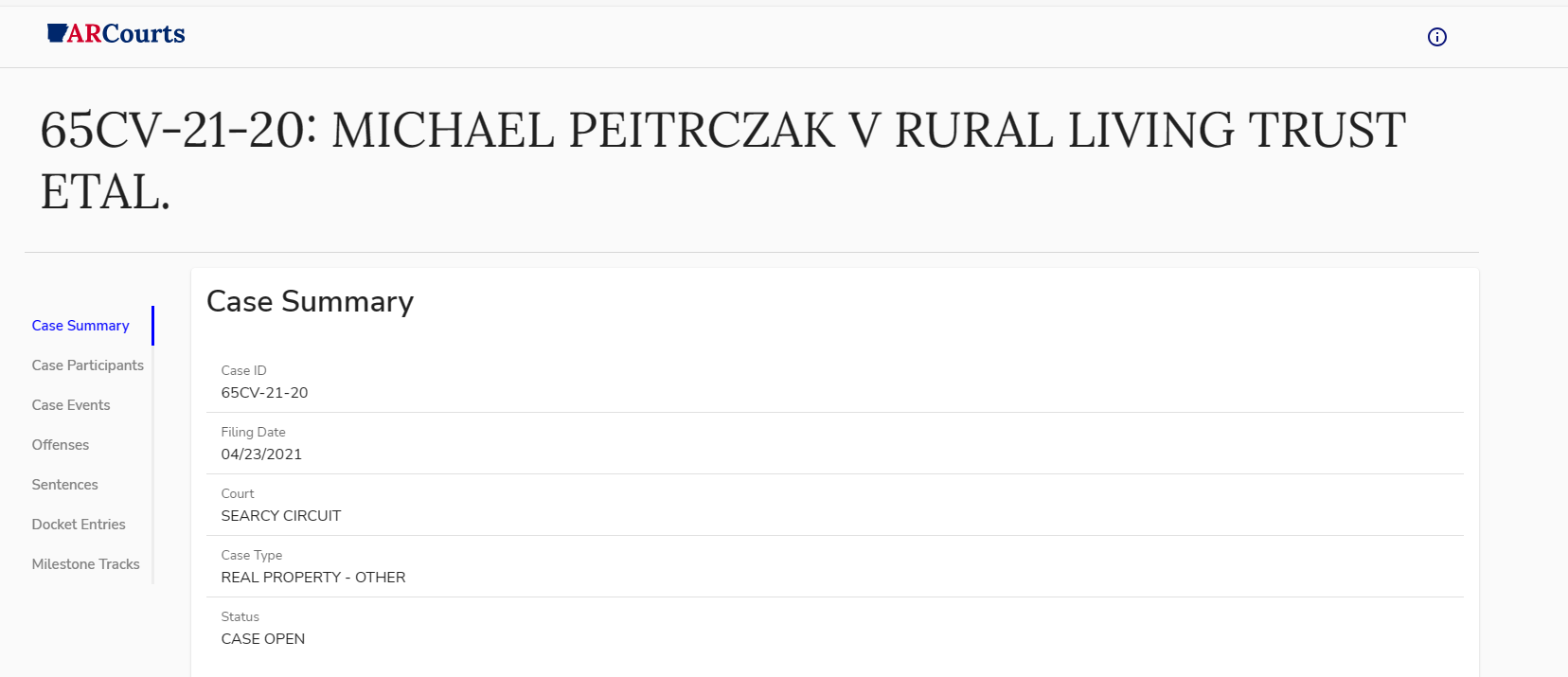
Ok. People make mistakes. But court clerks have one purpose in life; to keep an accurate record.
The clerk supervised by Judge Susan Weaver managed to change “Micheal” (a German name) to “Michael”, and “Pietrczak” (a Polish name) to “Peitrczak. The trust involved in the case is named the “Rural Revival Living Trust”. Close enough to “Rural Living Trust” for government work.
Now, while we all wait with bated breath for an opinion from the COA, Weaver’s Witchling is threatening to “dismiss” the case.
Here is the application showing good cause to keep the case on the docket that I asked the clerk to file late last night. I may be away from my desk through the weekend and will try to switch to the file stamped copy next week. Assuming it is approved for filing. I notice that I made two errors, myself. Paragraph 2 should say, “The Court filed a final judgment on April 7, 2022.” And I misspelled the misspelling of “Peitrczak”, using the correct spelling “Pietrczak”, on footnote 1. There is some irony in that.
Guest Post: Corruption Alleged in Case Against Minor’s Counsel William Spiller, Jr.
Thank you to the Post Modern Justice Media Project. Click on the link.

