Supreme Court’s Betrayal of Public Trust by Silence
Supreme Court Declines to Hear Parents’ Case Against Child Protective Services Investigator for Retaliation Against Their Family
Court leaves open the question of whether retaliatory investigations by government officials, even when they lack probable cause, are unconstitutional
J. Justin Wilson · January 10, 2023 (Reposted by permission of Institute for Justice.)

IJ is a public interest law firm. We represent clients free of charge in cutting-edge litigation defending vital constitutional rights. You can join us by supporting our work here: ij.org/support
Yesterday, the United States Supreme Court declined to hear a case against a child protective services (CPS) official who abusively investigated a Missouri family. The result of the Court’s decision will serve to embolden CPS and other government officials nationwide to wield retaliatory investigations against average people as punishment for standing up for their rights.
This case started with a tragic incident involving a sexual assault of a minor boy by a sheriff’s deputy for Scott County, Missouri. The incident happened while the officer was on duty, so the parents (who are going by their initials in this case to maintain their son’s privacy) threatened to take legal action against the sheriff’s department. After all, it was known to the department that the deputy had been disciplined in previous law enforcement jobs. In response, the local child protective services investigator—who has worked with the department—opened a retaliatory investigation into the parents for child neglect. She claimed that the parents were the ones to blame for letting their son be sexually abused.
What followed was a nightmare for the family, involving multiple interviews of the already traumatized boy, a referral to a clinic for an inspection of the boy’s genitals and rectum, and a threat to take away the father’s law-enforcement license. The investigator only backed off from harassing the family after the family found pro bono lawyers to help them defend their rights. These lawyers helped the family appeal the investigator’s findings of child neglect, which were quickly overturned by the review board based on the lack of evidence.
Once the parents cleared their names, they sued the investigator for violating their First Amendment rights. The district court agreed with their claim and denied the investigator her defense of qualified immunity. The 8th U.S. Circuit Court of Appeals disagreed, however, writing that “[e]ven assuming that the facts in the complaint are true,” there is no such thing as retaliatory investigation claims in the Eighth Circuit. In other words, the court gave a blank check to government officials to punish individuals by investigating them.
By refusing to grant the parents’ petition for certiorari, the Supreme Court allowed this decision to stand.
“Government investigations are reputation-damaging, stressful and costly,” said Anya Bidwell, an attorney for the Institute for Justice, which represented the parents in their appeal to the Supreme Court. “No one should be the victim of retaliation through a governmental investigation just because they seek to vindicate their rights. This is government intimidation and abuse of power at its worst. The Court should have taken the parents’ case and made it clear to all government officials that retaliatory investigations are unconstitutional.”
Department of Health and Human Services statistics indicate that CPS case workers investigate the home lives of roughly 3.5 million children every year. And CPS investigations represent just a fraction of governmental investigations launched each year against citizens. “The Institute for Justice is committed to the idea that government officials do not have carte blanche to make citizens’ lives miserable and bully them into silence through investigations,” said Patrick Jaicomo, IJ’s senior attorney and a co-counsel in the case. “Officials can’t be allowed to weaponize their investigative powers. We will not rest until the Supreme Court says so.”
Women’s Coalition Offer Input to United Nations: Find Judges Encourage Patriarchal Power Structure
You can read the submission here. Posted by permission implicit in that all submissions will be included in a public document.
This submission by The Women’s Coalition [hereafter “Coalition”] is in response to the Call for Input by the UN Human Rights Council Special Rapporteur on Violence against Women regarding child custody cases.
Women in countries all over the world are being maltreated in family courts, wrongly deprived of custody, and unable to protect their children. The Special Rapporteur has requested input on many issues surrounding this “custody crisis”, which the Coalition includes in this submission.
However, in the end, it is imperative to put all these issues into the larger context, so the core cause of the crisis becomes clear. It is not just victims of domestic violence who are affected; women are losing custody whether they report abuse or not. Judges often switch custody to fathers who want it, for whatever reason, often to reduce child support or punish their ex for leaving.
This ubiquity supports the core cause of the crisis being systemic male entitlement and the concomitant discrimination against women, rather than the improper handling of women’s reports of violence or abuse. The custody crisis needs to be understood as essentially about power, not abuse—about judges maintaining age-old male entitlement and control in the family, i.e. persisting patriarchy. Only then can an effective solution be identified that gets at the root of the problem. It is the Coalition’s contention that reforms made within the Family Court system will not get to the source of the problem and that a new system is necessary.
SURVEY
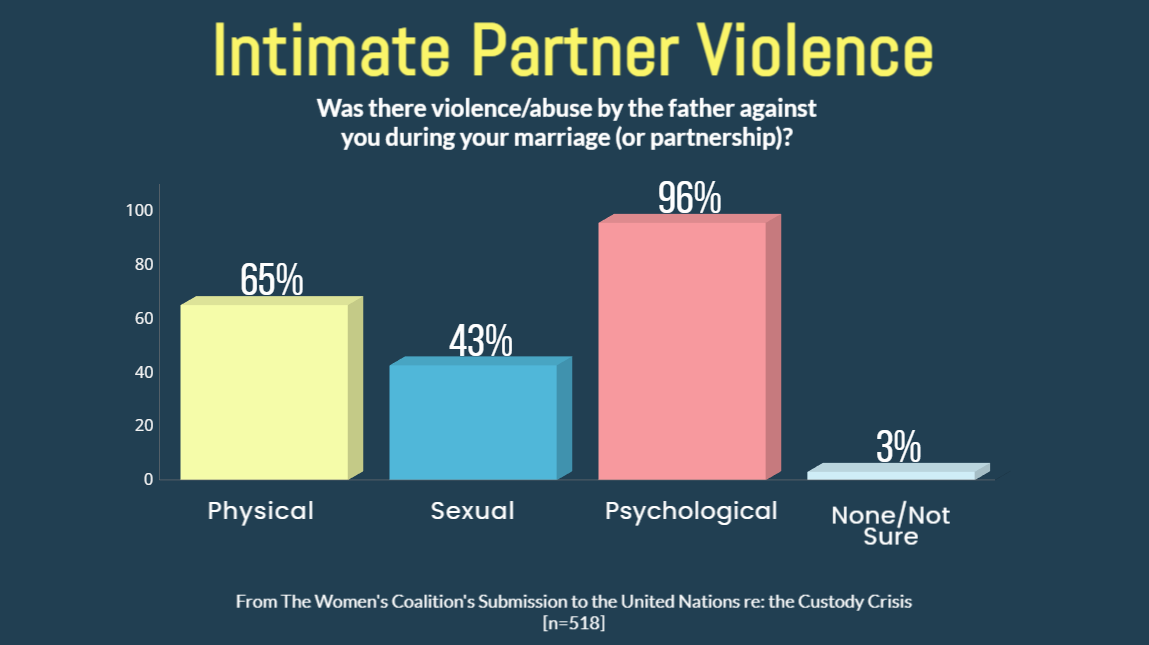
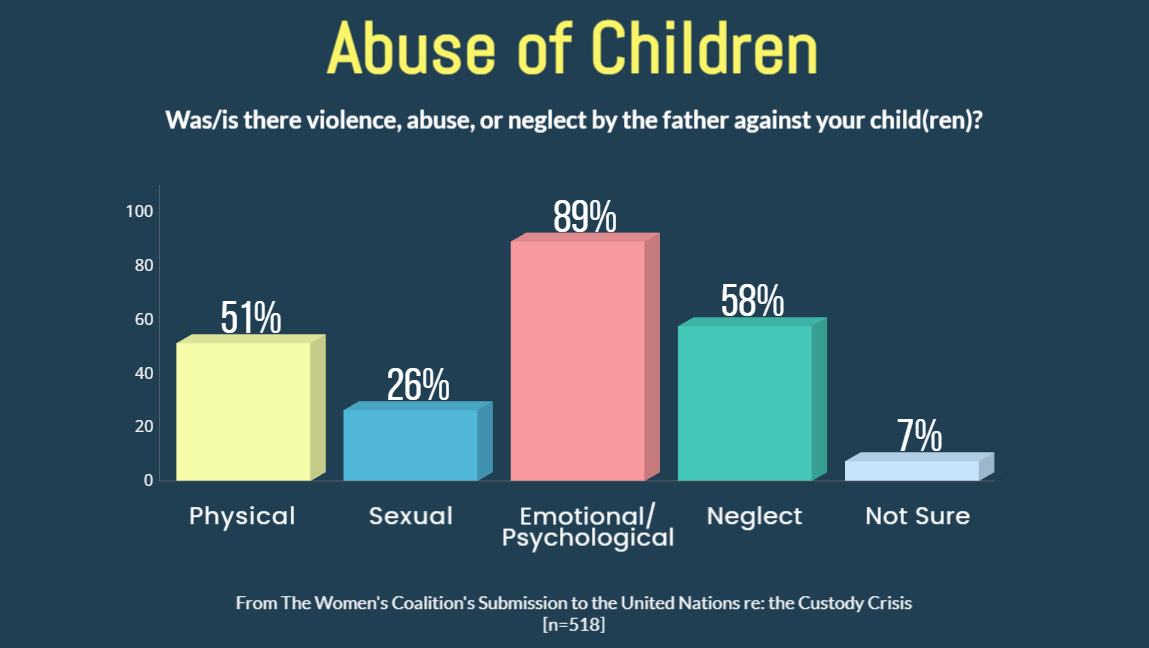
The Coalition conducted a last-minute survey after hearing about the Call for Input a few weeks ago. There was no time to translate it into other languages, otherwise there would have been many more participants. Even so, 518 mothers from 21 countries took part: Argentina, Australia, Austria, Canada, Colombia, Denmark, England, France, Germany, Greece, Ireland, Japan, Mexico, New Zealand, Portugal, Scotland, Singapore, South Africa, Sweden, Trinidad and Tobago, and the United States of America.
This survey represents a convenience sample and is not meant to be representative of all family court cases. The survey provides quantitative insights on cases in which mothers have lost custody or have been unable to protect their children. Tens of thousands more cases have been compiled qualitatively by the Coalition and other civic organizations worldwide, attesting to women’s lived experiences.
DISREGARD OF ABUSE
The Special Rapporteur stated the aim of the investigation is to “document the many ways in which family courts ignore the history and existence of domestic and family violence and abuse in the context of custody cases”. “Ignored” is the operative word, as countless mothers report judges are disregarding strong and credible evidence. 95% of mothers surveyed reported that their judge ignored, dismissed, or minimized evidence of violence, abuse, unfitness, or other negative facts about the father.
Judges often issue gag orders or seal cases to keep injustices concealed and disempower mothers. In some jurisdictions, cases are automatically confidential. This is consistent with the patriarchal narrative that abuse is a “private family matter”. It is not. Abuse of women and children is a societal issue.
MISUSE OF PARENTAL ALIENATION
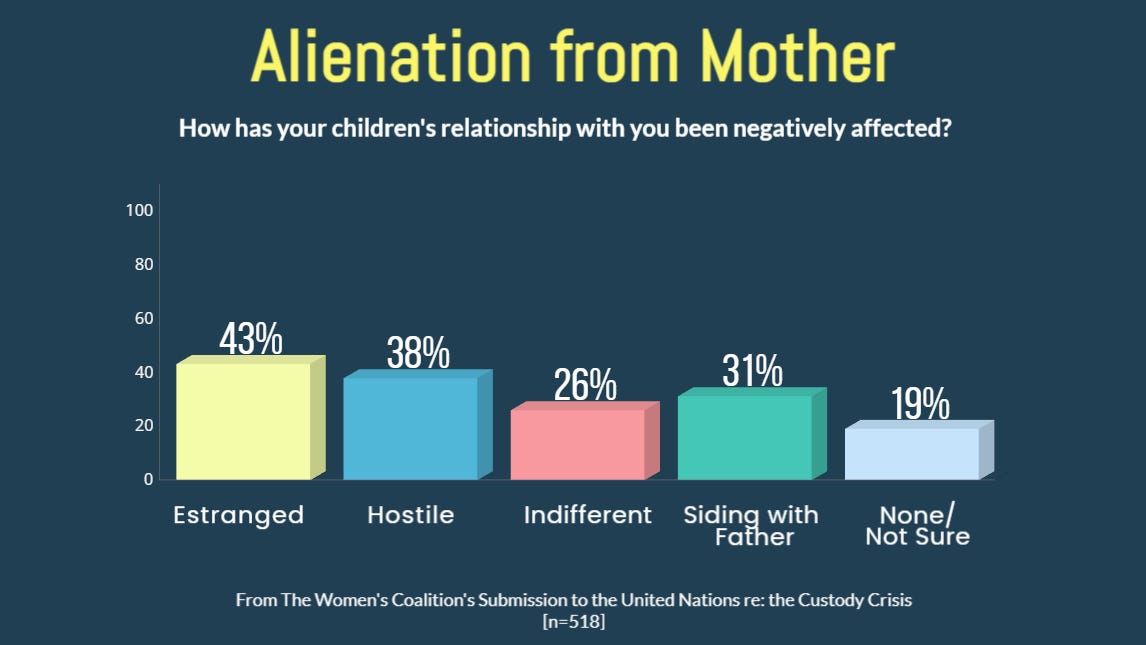
The Special Rapporteur’s Call for Input states there will be special emphasis on “parental alienation and related concepts”. A dictionary definition and common usage of the term is, “Alienation is when one person causes another person to be indifferent, hostile to, or estranged from someone”.
Thus, alienation exists on a spectrum from indifference to complete estrangement. Although it has not been established as a valid scientific construct, it is indisputable that parents sometimes engage in this behavior and that it is harmful.
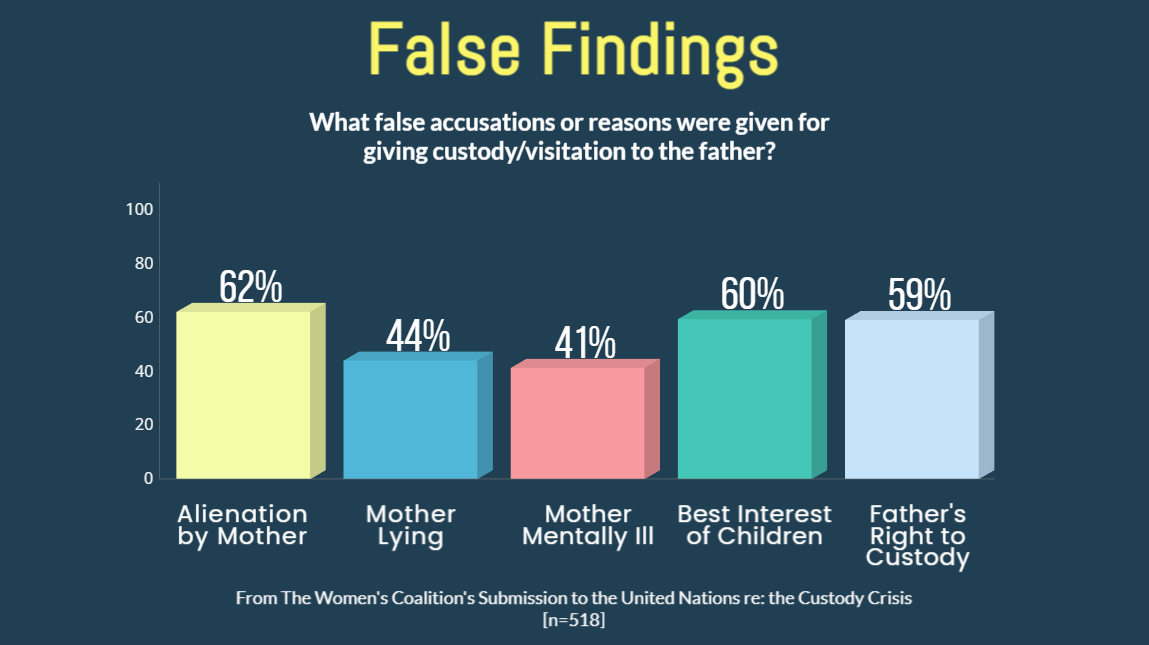
The problem with alienation is not that it is unscientific. It is that judges are falsely finding mothers have alienated their children by coaching or influencing them to say their father abused them. But, as our survey demonstrates, judges often use other false accusations to switch custody, the most common being that mothers are lying or mentally ill. Judges also often claim that being with the father is in the child’s best interest, or that it is a father’s right to be with his child, regardless of abuse.
However, there is an arguably much more serious problem with the discussion around parental alienation that does not get much attention: judges are enabling fathers to truly alienate children from their mothers. The main way judges do this is to severely restrict or eliminate children’s contact with the mother, which can cause them to form a trauma bond with their father.
Another way is that judges order children into “reunification therapy”, the problem with that being it is not really therapy children are getting. Judges appoint mental health professionals who will “coercively persuade” (i.e. brainwash) children to recant abuse and comply with living with their father. Judges rarely order reunification with mothers because the goal is to keep the father in control.
Much activism is focused on invalidating and prohibiting the use of parental alienation or reunification therapy in family courts. However, it is neither parental alienation nor reunification therapy that is the problem. The problem is that judges have the power to falsely find mothers to be alienating to justify switching custody and appoint therapists who will help alienate children from mothers.
Prohibiting the use of alienation or reunification therapy, as many organizations and activists are pushing for, will not be effective because, as the survey shows, judges can simply use other terms or something else entirely. So, the Coalition strongly advises the Special Rapporteur not to recommend it be abolished. The Human Rights Council taking that position could do much harm to women who have been truly alienated and to the effort to end the crisis.
Instead, it would be helpful if a statement is made clarifying the real problems with parental alienation and urging women who’ve been falsely accused to unite with women who’ve been truly alienated. Women will have more power fighting together for an effective solution, such as the new system proposed.
COURT-AFFILIATED PROFESSIONALS
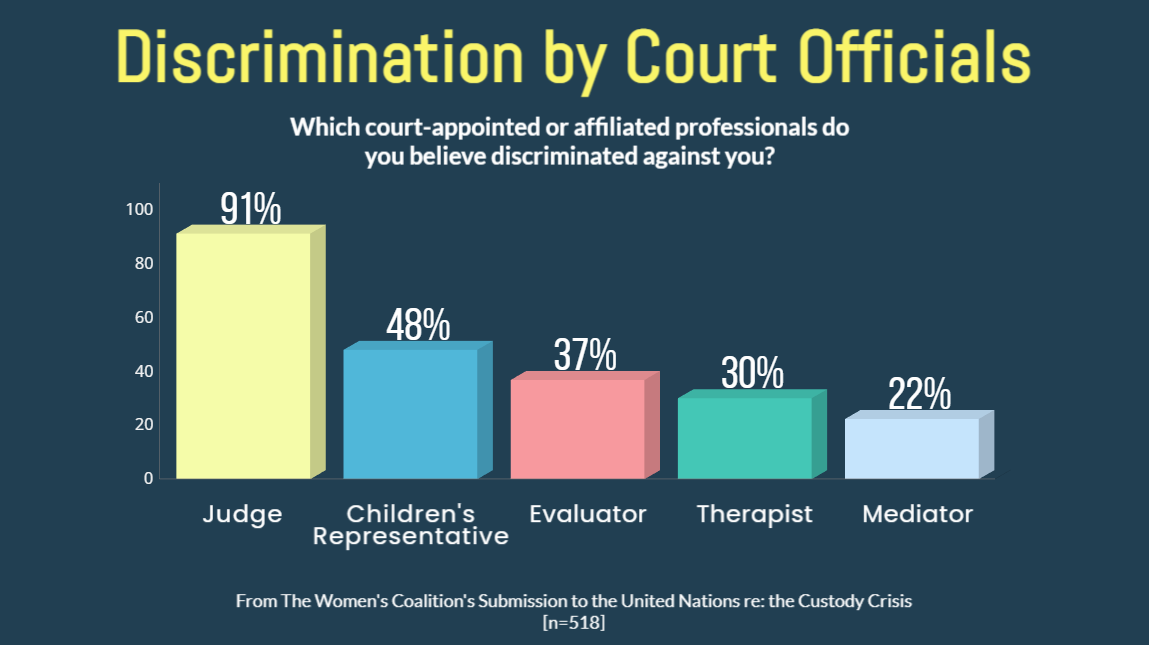
Judges regularly appoint children’s legal representatives, custody evaluators, therapists, mediators, and others, on whom they supposedly rely in making their custody decisions. But they inevitably choose professionals who can be counted on to steer cases to the father.
Although there is activism to require stricter regulation, higher qualification, and more training for court officials, that will not significantly change outcomes, since the actions of the appointees are mere reflections of the judges’ wishes. Also, judges can simply ignore them if they don’t say what is expected.
THREATS AND PUNISHMENT
Threats and punishments serve to not only discourage women from continuing their own efforts to protect their children, but also send a message to other women to cease and desist. Judges and other court officials often threaten mothers to get them to comply with orders to make their children visit unsupervised or live with an abusive father, or to stay quiet about abuse.
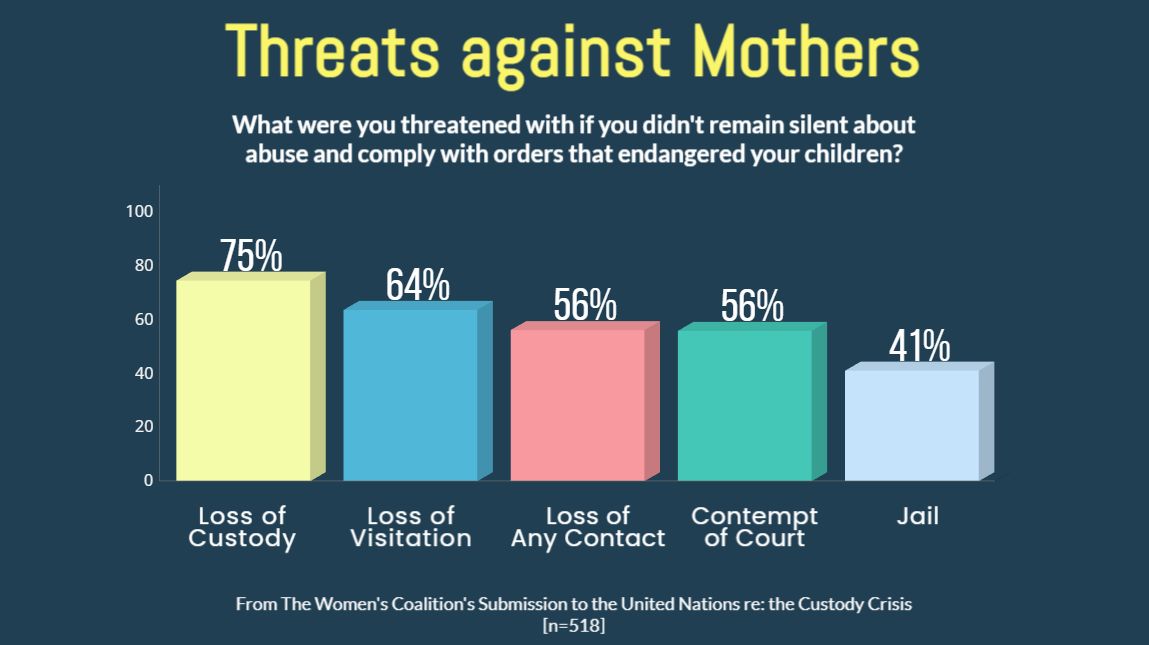
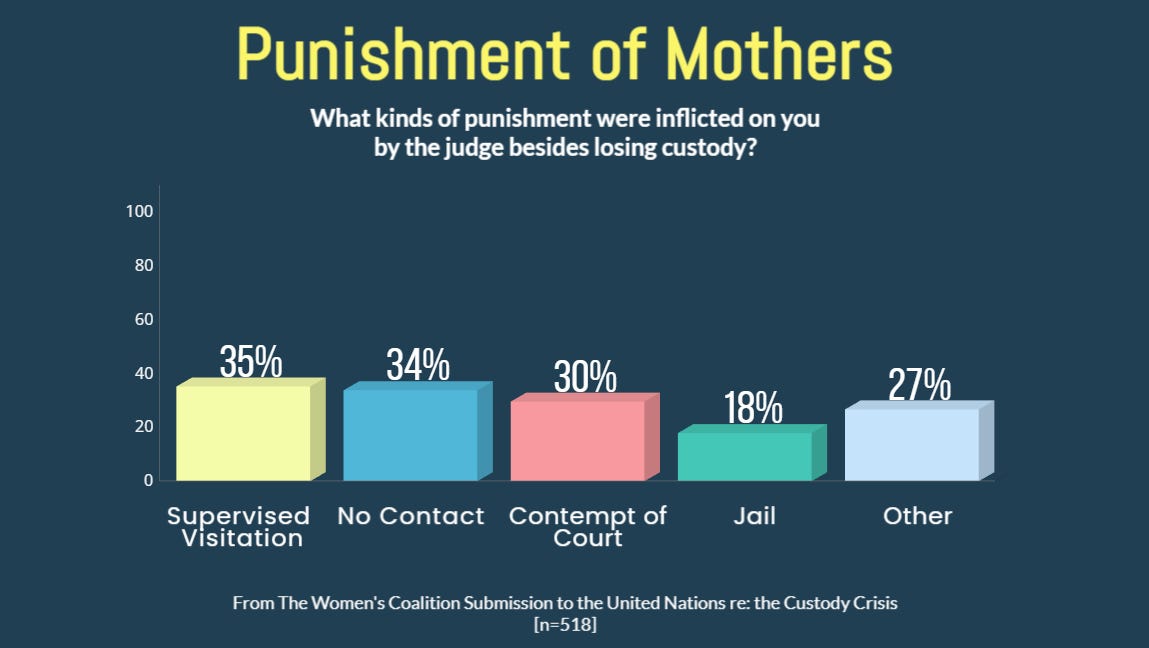
Judges not only threaten mothers, they actually restrict contact with children to punish them for challenging male authority in the family. Mothers are also being criminally indicted after going into hiding to escape abuse. Law enforcement and the criminal justice system often aid and abet family court judges by prosecuting them.
Thus, contact with children is being used by judges as leverage, not in their best interest.
GRAVE CONSEQUENCES
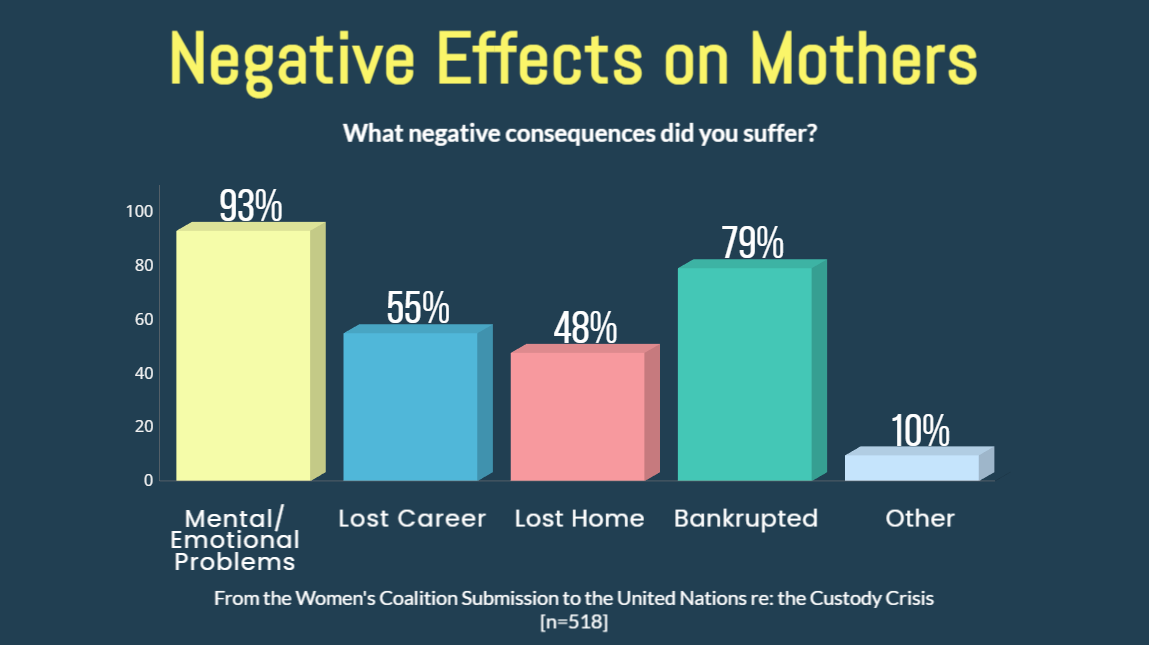
Many women not only suffer psychologically, but are losing their homes and careers and being financially devastated. Some succumb to suicide.
More than half of the mothers in the survey said they considered running with their children, and 15% fled anyway, many of who were imprisoned. The Hague has failed women who run, ordering them back to return children to the abusive father.
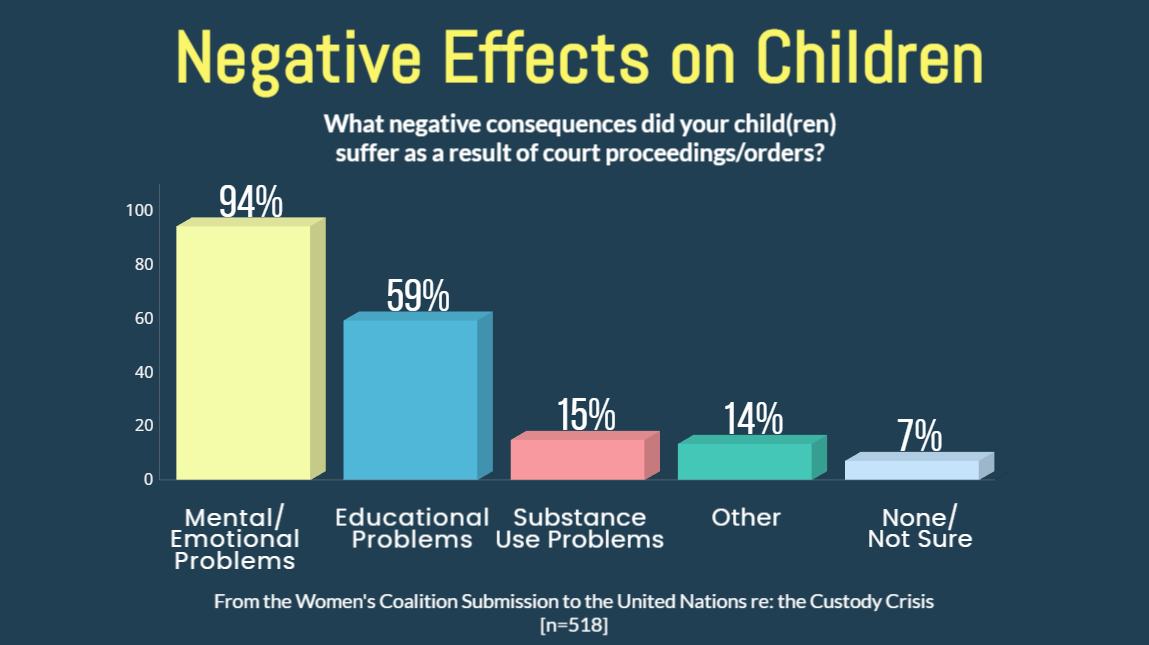
Children almost always suffer from psychological problems and many from educational problems, substance use issues, suicidal ideation, and some children also succumb to suicide. Both mothers and children are being rendered unable to fulfill their human potential.
HUMAN RIGHTS VIOLATIONS
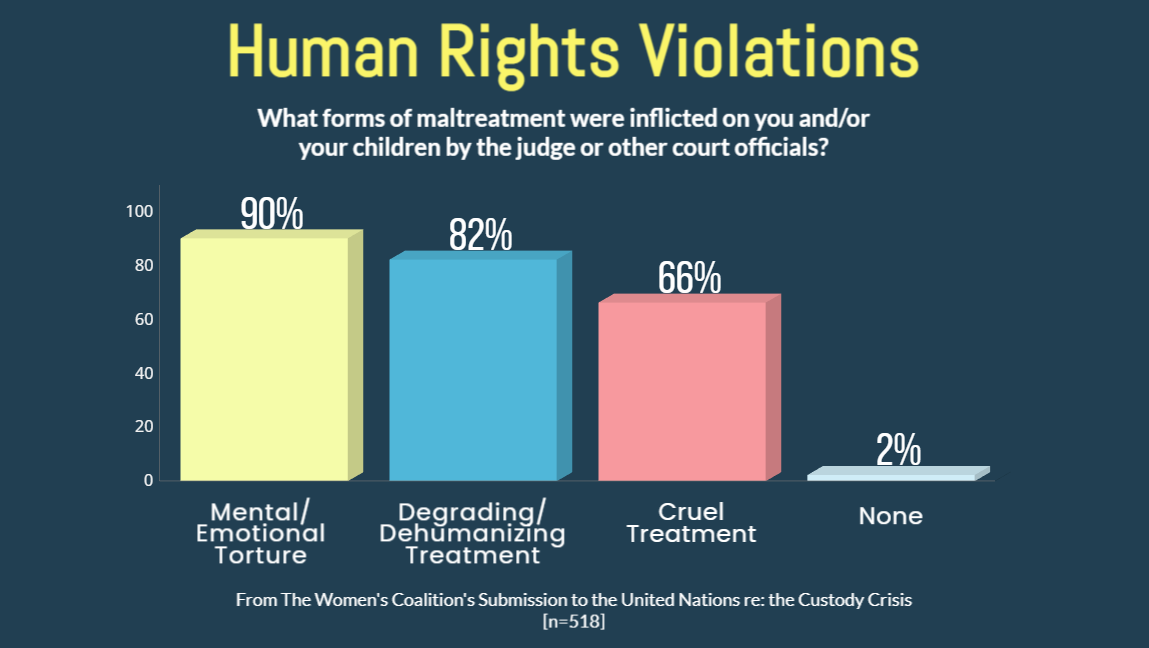
The Universal Declaration of Human Rights enumerates certain inalienable rights guaranteed to all citizens. Equal protection under the law is set out in Article 7. The right to a fair hearing before an impartial tribunal is set out in Article 10. The right to be free of torture and cruel, inhumane and degrading treatment is set out in Article 5.
Articles 7 and 10 establish the right to due process and prohibition of sex discrimination. A whopping 98% of mothers surveyed reported their judge discriminated against them. However, it should be noted that this is not simple discrimination due to unconscious bias or gender stereotyping. It is deep, systemic discrimination executed for the purpose of empowering men in their role as fathers.
Of course, there is no way to prove a judge discriminated against or tortured a mother psychologically, but it is important to credit women’s lived experiences in the courtroom. These human rights violations need to be prevented, not remedied. Judges must be prevented from committing them in the first place.
CONCLUSION
The family court system is greatly harming women and children around the world. Women are being deprived of custody and the ability to protect their children, along with being financially devastated.
It should not be surprising that men created a system that perpetuates their power in the family after women gained financial independence and the ability to divorce. In order for women to regain the power they had to keep and protect their children before patriarchy took hold, a new system is needed which provides them due process and equal protection.
The Coalition has attempted to establish in this submission that the issues of interest to the Special Rapporteur are all means or results of judges making rulings that maintain male power and control in the family. The reason Family Court judges are able to entitle fathers and oppress mothers is because they have, in effect, absolute power, and there is no effective means of oversight or remedy. Besides, unjust rulings need to be prevented, not remedied, as children suffer greatly in the litigation process.
Because of this, reforms within the present system will not make any significant difference. Custody cases must not be heard in family courts.
The Coalition has drafted legislation in which custody cases are removed from family courts and heard in regular, public civil courts with the right to a jury. This will provide for due process and equal protection, while precluding judges from inflicting torturous and degrading treatment on litigants, thus preventing the human rights violations being committed in family courts. The Coalition is willing to work with the Special Rapporteur or others within the Human Rights Council or other UN body to create a framework to be used internationally.
REQUESTS
The Coalition hereby requests the Special Rapporteur make three recommendations in her report to the Human Rights Council:
· First, that the Council should identify the human rights violations identified by the Special Rapporteur are a result of “systemic male entitlement and the concomitant discrimination against women”.
· Second, that the Council should establish that reforms within the present system will not prevent judges from committing human rights violations, hence, the right to a jury trial in a regular civil court must be guaranteed, along with other due process protections.
· Third, that the Council should form a task group that communicates with The Women’s Coalition and other women’s rights organizations to create an international framework for a process that will provide justice and protection in custody cases, and where the Coalition’s proposed Child Custody Act may act as a guide in this process.
Finally, it is The Women’s Coalition’s earnest stance that this approach is the only way women’s human and civil rights will be effectively upheld in custody cases. Non-abusive men who truly want the best for their children will also benefit from this new and just process.
Respectfully submitted to the UN Special Rapporteur this 15th day of December 2022
Cindy Dumas
Founder and Executive Director of The Women’s Coalition
Courts Using Conservatorships to Rob from the Elderly
Thank you to a California Grand Jury for this report about how civil rights are violated against our second most vulnerable community. (If you think the unborn are not human, then you might consider the elderly and feeble minded as the most vulnerable community.)
Court mandated conservatorship is often a euphemism for embezzlement and elder abuse.
I am only 60 years old, but an Arkansas attorney, William Zac White, tried to have me declared incompetent. Even though he appears to get everything he asks for from Judge Susan Weaver and several other judges, I was able to stop him from his plan to transfer control of my assets and my freedom to a conservator. Otherwise, he would undoubtedly nominate himself as conservator and I would live out my days in captivity without freedom to spend time with my husband and offspring.
Please read the report and pray for our elderly who have their homes stolen and are committed to live in an “assisted living” home.
Open Letter Looking for My Soul Mate
A wonderful writer named Shelly Hart wrote an article in CityWatchLA.com describing the corruption against and disdain for pro se litigants by judges perfectly.
I reached out to Ms. Hart through her online news group and hope to publish her work here as a guest author soon.
Here is a copy of the email:
Hi. My name is Laura Lynn Hammett. I was Laura Lynn until 2019.
You may be familiar with the work I did to get the CJP to give a “severe” public admonishment to retired commissioner Alan Friedenthal (deceased).
One of my colleagues forwarded a copy of an article written by Shelly Hart published September 23, 2019.
Bravo!
Arkansas is my new home. Unfortunately, the judiciary here is as bad as in California. It is more frustrating as many of the judges pose as “Christians”, even proclaiming “praise Jesus” on public posts. My response is a little different than when Jesus turned the tables over at the temple. The hypocrisy makes me want to puke.
Please forward this email to Ms. Hart as an introduction. Also, can you give me permission to reprint the article on my blog?
Waking from A Court Induced Nightmare
This is a letter of Input for the United Nations Human Rights Office of the High Commissioner’s report on violence against women and children in custody cases.
Laura Lynn Hammett
The litigation in my custody case culminated in my complaint sent to the United Nations Human Rights Office of the High Commissioner almost a decade ago.
It was like waking from a nightmare to see the call for input to inform the Special Rapporteur on this issue concerning violence against women and children. My thanks to God and the United Nations for focusing a light on the devastating practice of our courts in the United States of America of giving no respect to the women and children who report abuse, beg for relief and are retaliated against by the judges who are supposed to protect them.
My struggle against the Court devoured 16 years of my life. There were several corrupt judges who presided, including Commissioner Alan H. Friedenthal (retired and deceased), Judge Elizabeth R. Feffer (retired), and Judge Marjorie S. Steinberg (retired). Mr. Friedenthal was a lifetime friend of an enemy to me, and I believe that, besides being an abusive man himself, he severed my parental rights as a political favor.
Fox news did a story about Commissioner Alan Friedenthal called “Lost in the System: Imbalanced Justice” that can still be found on YouTube. My work writing about the court corruption was featured in the piece.
These dishonorable people severed my parental rights completely. They then added insult to injury by charging me hundreds of thousands of U.S. dollars for “child support”. I was gifted over $400,000 of non-liquid assets by my parents in 2009. Judge Feffer said this was my “income” and used the figure as an annual income to calculate child support. Eventually I was able to liquidate the property and had to give $279,000 to my former abuser, to reward him for separating my children and me completely.
The California State Court of Appeals, California Supreme Court and the United States Supreme Court did nothing to help us.
“Luckily” my oldest son had behavioral problems that subjected him to juvenile court. We were blessed to have a good judge there who placed my then 17-year-old son with me 100% of the time. I was told that he would probably need to be institutionalized his entire life. Instead, he earned a college degree and is a wonderful father himself now. But he fell far below his potential for being a productive member of society. Before he was ripped away from me, he tested at the top of the charts for academic ability. Because of the lack of justice in our courts, he went to community college instead of MIT.
My younger son and I had no communication for five years, from the time he was 13 until three days before his 18th birthday. I am surprised I was not arrested and incarcerated when I violated the custody order those three days.
My younger son, who is brilliant and has a sweet soul, has not finished community college. He wanted to be a doctor like my father or to write computer programs, but instead he delivers pizza and does light construction. He has earned a real estate license but cannot afford to support himself through the initial months before earning a commission. He has PTSD and struggles with feelings of abandonment.
The worst damage is that we missed so much time together and my sons were taught that I abandoned them. No matter how illogical that is, considering that I took my fight for custody to the Supreme Court, twice, it is a permanent scar on their psyche.
My older son also has a permanent physical scar above his eye from when his father punched him in the face. (He was tried on criminal charges, and found not guilty. Still he retained 100% custody of my younger son.)
Eventually I was able to have the Committee on Judicial Performance convince the California Supreme Court to give a public admonishment against Commissioner Alan Friedenthal for the appearance of bias on my case. But the Draconian orders he and Judge Feffer made were left in place.
Several other judges have recused themselves from cases where I was a litigant since then. Unfortunately, some not so honest judges refused to recuse and instead use their position of power to punish me further for speaking out against the politically connected judicial officer.
Years have passed, but I am being tormented by Judge Janis L. Sammartino, Judge Todd W. Robinson and Judge Linda Lopez in a simple civil case in Federal District Court in the Southern District of California. I think it is retaliation for exposing the commissioner who was disciplined on my child custody case. I can think of no other reason three intelligent judges would ignore my most basic rights on the civil case.
I am diagnosed with PTSD, in large part caused by the trauma of losing my children to an abusive man and being let down so terribly by the people who are tasked with serving justice.
Thank you to the United Nations for any wake-up call it issues to the world. We need to stop these monsters from destroying the lives of our children and their loving mothers.
One Small Win for Laura Lynn; One Big Step for Justice
The United Nations is taking up a fight against injustice that I brought to their attention almost a decade ago.
About 2006, I started commenting on chat boards about corrupt court systems. Then I got hired by a now defunct online paper called Examiner.com, covering the family court in Southern California. Then I started this blog. About 2013, my computer was stolen, and thousands of posts were deleted by the thief. When they say to back up your work, believe them. When I get some spare time (to go with my spare change) I will repost a few of the stories that were gifted to me by a friend who saved hard copies.
My interest in the topic grew out of my own experiences, losing most of my parental rights to a man who I divorced after (I allege) he became physically abusive with me and our children. I don’t talk about that abuse much, but it is important to this story.
The family law courts in my case were presided over by Alan H. Friedenthal and Judge Elizabeth Feffer predominantly.
I appealed their orders and lost.
I went to the California Supreme Court and was denied review.
I went to the United States Supreme Court and was denied review.
My last step was applying to the United Nation’s Office of the High Commissioner. That was around 2013.
This morning I read some great news! Thank you to one of the women who helped in the fight to correct the horrible injustice being done in our family courts who sent the link to me.
Here is the press release. The formatting won’t work, but you can download the original at the bottom.
I can’t say it was my complaint that caused the UN to take action. I am sure it helped. To be able to have the Commissioner read a complaint, the complainant must first exhaust her remedies in her country, meaning a U.S. citizen must first file a petition for writ of certiorari to the United States Supreme Court. I did.
Never give up.
Get loud.
Call for inputs – Custody cases, violence against women and violence against children
ISSUED BY
Special Rapporteur on violence against women and girls, its causes and consequences
DEADLINE
15 December 2022
Purpose To inform the Special Rapporteur on violence against women and girls’ report on the nexus between custody and guardianship cases, violence against women and violence against children, with a focus on the abuse of the concept of “parental alienation” and related or similar concepts.
Background
Globally, 1 in 3 women has experienced violence in their lives – most of it taking place within the home or family. The COVID-19 pandemic considerably increased domestic violence in many countries, which implemented lockdown and confinement measures that also reduced women’s ability to report or seek assistance and protection. While many measures are adopted to tackle this silent pandemic, both at the national and the international levels, not enough attention is given to the interconnections between domestic violence and abuse and issues of child custody and parental relations.
In 2019, the Platform of independent expert mechanisms on the elimination of discrimination and violence against women (EDVAW platform), of which the Special Rapporteur is a member, voiced its concern over patterns across various jurisdictions of the world that ignore intimate partner violence against women in determining child custody cases. Since then, the Special Rapporteur on violence against women and girls has received reports and cases from different countries all over the world, in which such violence has been ignored and mothers have been penalized for making allegations by law enforcement and/or the judiciary responsible for determining custody cases.
The tendency to dismiss the history of domestic violence and abuse in custody cases extends to cases where mothers or children have brought forward credible allegations of child physical or sexual abuse. In several countries, family courts tend to judge such allegations as deliberate efforts by the mothers to manipulate their child and pull them away from their father. This supposed effort by a parent alleging abuse is often termed “parental alienation.” The term generally refers to the presumption that a child’s fear or rejection of one parent, typically the noncustodial parent, stems from the malevolent influence of the preferred, typically the custodial parent.
Although these concepts lack a universal clinical or scientific definition, emerging patterns across various jurisdictions of the world indicate courts worldwide are using the concept of “parental alienation” or similar concepts explicitly or are allowing for its instrumentalization. The vast majority of those accused of ‘alienating’ their child while alleging abuse are women. Consequently, many women victims of violence and abuse face double victimization as they are punished for alleging abuse, including by losing custody or at times being imprisoned. Children who are victims of violence and abuse by a parent (in many cases the father) often continue to be subjected to such violence and abuse, against themselves and/or the other parent (in most cases the mother) post-separation, through imposed contact with the abusive parent. These dynamics often allow parents to be intimidated, coerced or forced by their abusive ex-partners and pressured by the courts to withdraw their allegations of abuse or to agree to a specific custody arrangement. In many instances, when given the risk of losing contact with their children and the high impunity the violence committed by their partner, women end up withdrawing their allegations or not reporting at all. According to experts, in many cases, the perpetrators of violence have deliberately inflicted violence on their children as a continuation of the violence inflicted on their partner who is the parent of their children and therefore a continuation of the attempt and process of controlling the target (i.e. the mother).
Several reasons account for the regular and widespread dismissal of intimate partner violence history and incidents by family courts when examining custody cases. These include harmful gender stereotypes and discriminatory gender bias among family law judges. Often, gender stereotypes are aided and abetted by discriminatory status laws in some countries, many of which are motivated by cultural, religious and social grounds. A very powerful bias, shared by many welfare and judicial systems, is that the right of a father to maintain contact with his children should override any other consideration. This is often justified with reference to the “the best interest of the child”, so that it is argued that the child’s best interest is to maintain contact with their father under all circumstances, even if the father has been abusive towards the mother or the child.
In its General Recommendation No. 33 of 2015 on women’s access to justice, the Committee on the Elimination of Discrimination Against Women recognized that stereotypes and gender prejudices in the judicial system impede access to justice and may particularly affect women, victims and survivors of violence. The Committee further recognized that such stereotyping could cause judges to misrepresent or misapply the law and can result in perpetrators of violence not being held legally accountable for violations of women’s rights, thereby upholding a culture of impunity.
Under international law, States have a responsibility to take all measures necessary to prevent violence against women and children. According to article 5 of the Convention on the Elimination of All Forms of Discrimination Against Women, States have an obligation to ensure that gender stereotyping is addressed and dealt with adequately. Furthermore, article 19 of the Convention on the Rights of the Child provides that the right for the child should be protected from all forms of physical or mental violence, injury, abuse, or maltreatment, including sexual abuse, while in the care of parents. Where it occurs, the failure to address intimate partner violence and violence against children in custody rights and visitation decisions is a form of violence against women and their children and a violation of the human rights to life and security that could amount to torture. It also violates the best interest of the child legal standard.
In 2014, the CEDAW Committee recommended that any history of domestic violence and abuse must be considered when determining visitation schedules to ensure that these do not endanger women or children. In the case Gonzalez Carreño versus Spain (2014), where an abusive father murdered his daughter and then took his own life during an unsupervised visit, the Committee found that, by ordering unsupervised visits without giving sufficient consideration to the background of domestic violence, Spanish authorities had failed to fulfil their due diligence obligations under the Convention (para. 9.7). Since then, the CEDAW Committee has issued a number of Concluding Observations in which it directed States Parties to abolish the use of the concept of parental alienation in court cases, and conduct compulsory judicial training on domestic violence, including on the effect that exposure to domestic violence has on children. Regional monitoring bodies such as GREVIO, which monitors the Istanbul Convention, and MESECVI, which follows up on the implementation of the Belem do Paro Convention, have also made similar requests.
Despite a strong indication that the parental alienation concept has become a tool for denial of domestic and child abuse, leading to further discrimination and harm to women and children, data on the treatment of the history of intimate partner violence and other forms of domestic violence and abuse when family courts assess custody cases continues to be limited. Data is also limited regarding the degree to which family courts use a gender analysis in their decisions.
Given the correlation between the resort to the concept of parental alienation and the persistence of gender-based violence against women, the topic requires urgent attention. A holistic and coordinated approach based on the existing international and regional standards is required in such cases at the national level, not only to uphold the principle of the best interest of the child but also the principle of non-discrimination against women and equality between women and men. This approach is confirmed by jurisprudence of various international courts, UN treaty bodies and other relevant mechanisms.
Objectives
The aim of this report is to examine the ways in which family courts in different world regions refer to parental alienation, or similar concepts, in custody cases and how this may lead to double victimisation of victims of domestic violence of abuse. It also aims to document the many ways in which family courts ignore the history and existence of domestic and family violence and abuse in the context of custody cases, as well as their grave consequences on mothers and their children. It hopes to draw attention to the scale and manifestation in many countries, spanning all regions of the World. The report will also offer recommendations for States and other stakeholders to address the situation.
The Special Rapporteur kindly seeks the support of States, National Human Rights Institutions, civil society actors, international organizations, academics, and other stakeholders to provide updated information on:
- The different manifestations or specific types of domestic and intimate partner violence experienced by women and children, including the use of “parental alienation” and related concepts in child custody and access cases. Please also include a description of the different forms of violence that may be experienced by the mother and child as well as fundamental human rights violations, where relevant.
- The factors behind the increased number of allegations of parental alienation cases in custody battles and/or disputes involving allegations of domestic violence and abuse against women, and its differentiated impact on specific groups of women and children.
- The way in which different groups of women and children experience this phenomenon differently based on any intersecting elements such as age, sex, gender, race, ethnicity, legal residence, religious or political belief or other considerations and the factors that contribute to these situations.
- The role that professionals play, including welfare workers, child protection services, guardian ad-litem, psychologists, psychiatrists, and how they are regulated in any way as expert witnesses.
- The consequences of the disregard for the history of domestic violence and abuse and intimate partner violence or the penalising of such allegations in custody cases on the human rights of both the mother and the child, and the interrelationship between these rights.
- The challenges in collecting disaggregated data on courts’ practices concerning custody cases, the areas/sectors for which data is particularly lacking and the reasons for such challenges.
- The good practices, strategies adopted by different organs of the State or other non-State actors, at local, national, regional, or international level to improve the due consideration of domestic and family violence, including intimate partner violence against women and abuse of children in determining child custody, as well as in providing remedies and redress for victims/survivors.
- Recommendations for preventing the inadequate consideration of a history of domestic violence and abuse and gender stereotyping in custody cases to restore the human rights of mothers and their children, as well as ensure that survivors/victims are effectively protected and assisted.
- Any other issue of relevance that are vital for consideration but that may not have been mentioned in this call for inputs.
Whenever possible and available, inputs should provide updated quantitative and disaggregated data on the issues presented.
All submissions will be published on the mandate webpage on the OHCHR website, unless otherwise indicated in your submission.
Next Steps
Inputs should be sent by e-mail by 15 December 2022
E-mail address:
hrc-sr-vaw@un.org
E-mail subject line:
Input for SR VAWG’s report on violence against women and children in custody cases
Word limit:
2,000 words
File formats:
Word, PDF
Accepted languages:
Arabic, English, French, Spanish
Is Judge Linda Lopez Any Better Than A Mafia Thug? No.
I filed the following opposition yesterday, setting up for an appeal of a punitive fee shifting judgment in Federal District Court for the Southern District of California.
The format doesn’t transfer well, and I am up against another big deadline on a different case. Sorry.
The pdf is posted at the bottom with a pdf you can download of the accompanying brief.
Judges decide what the legislature meant when it authorizes an award of “reasonable attorney fees”. Precedence is to use a supply and demand standard and call it the “prevailing rate”. The judges decide that lawyers can charge $460 per hour and still drum up enough business to keep all lawyers busy.
Of course, this is a fallacy. No one would hire the lawyers if the judges didn’t force them to. Most lawyers would be out of work if it was up to We the People.
TO: THE COURT AND ALL PARTIES OF RECORD:
I, Laura Lynn Hammett (“Plaintiff”), for this Plaintiff’s Opposition to Defendants
Ellis Roy Stern, Alan G. Goldberg and Stern & Goldberg’s (together “S & G”) Combined
Motion for Attorney’ Fees (ECF No. 271) state:
The Court issued an order (ECF No. 284) on my ex parte motion to strike S & G’s
motion for attorney fees (ECF No. 282).
The Court’s opinion, inter alia: “This Court’s prior orders already determined that the
S&G Defendants and MKZ Defendants were prevailing parties, based on the Court’s
analysis under Coltrain v. Shewalter, 66 Cal. App. 4th 94 (1998), and awarded fees to the
Attorney Defendants for expenses incurred up to the Court’s initial order granting fees.
See ECF Nos. 111 at 48; 266 at 9-10. In other words, the substance of the present fee
motions is not whether Plaintiff’s claims against the Attorney Defendants was barred by
the anti-SLAPP statute or whether an award of fees is mandatory under that statute, but
whether the fees sought by the Attorney Defendants is reasonable.”
The Court is wrong again. The “law of the case” is not controlling where it is a clear
error, such as here. The law of the case is not controlling where the judge who wrote it
appeared to have a bias and should have recused. The law of the case is not controlling
before it is affirmed by the Court of Appeals.
Therefore, I am reasserting my previous arguments against awarding any attorney fees
pursuant to Cal. Code Civ. Proc. Sec. 425.16(C)(1) in order to preserve the arguments for
appeal.
My repeated arguments:
- The Court appeared to have a bias and retaliated against me for complaining about
clerk “JPP” altering the docket, then altering it back without indication on the
docket after I told him I had a copy of the unaltered version. Until she was recused,
which never happened, the proceedings were tainted. - The derivative cause of action for legal malpractice arising from S & G’s dual
representation of Silver Strand Plaza, LLC (“SSP”) and individual members of SSP
and all proceedings based on it that cause of action are null and void because I filed
on behalf of a limited liability company. - Neither cause of action against S & G was Strategic Litigation Against Public
Participation (“SLAPP”), therefore failing the first prong of the anti-SLAPP test. - The “voluntary dismissal” was mandated. That is why I dismissed the causes and
there can therefore be no presumption that S & G was the prevailing party. - The denial of leave to hire an attorney on limited scope made equal protection for
me impossible because I am not a net-worth-elite person. The Southern District of
California is split from other districts in the Circuit and throughout the country.
The result of having no mechanism to retain limited scope representation is to
render the “anti-SLAPP” statute, Cal. Code Civ. Proc. Sec. 425.16(C)(1)
unconstitutional as applied in the Southern District of California. (A notice
pursuant to FRCP 5.1 will be filed and served with a copy of these papers promptly
on the Attorney General of the State of California by certified mail or
electronically.)
I am adding argument pursuant to intervening-change-in-law that was issued October
20, 2022, Wakefield v. ViSalus, Inc., 2022 WL 11530386 United States Court of Appeals,
Ninth Circuit, that questions the constitutionality of awarding an oppressive award, even
if mandated by statute.
The aggregate attorney fee awards against me are unreasonable, oppressive and
violate my Constitutional rights, and therefore, if not reversed should be reduced
drastically.
I am asking this Court to deny any further attorney fees to S & G and will ask the
Ninth Circuit Court of Appeals to reverse the prior orders which were based on clear
error.
This opposition is based on this Plaintiff’s Opposition to Defendants Ellis Roy Stern,
Alan G. Goldberg and Stern & Goldberg’s Combined Motion for Attorney’ Fees, the
accompanying Brief Memorandum of Points and Authorities, the Affidavit of Laura Lynn
Hammett, as well as the pleadings and papers filed herein, and any oral argument
presented at the time of hearing, should the Court desire oral argument.
Respectfully submitted,
Is it Real or is it Parody? I Couldn’t Make This Shit Up.

The following post is a press release from a fantastic outfit called Institute for Justice. They take up legal issues involving judicial corruption and legislation that denies our constitutional rights.
I wish I had more time to look for gems on their site, but I’m on a five-day countdown to filing my own appellate brief about what I believe was an illegal taking of my real property.
So here is a link for you. https://ij.org/about-us/
And here is a story about government officials trying to shut down a fun Facebook page that parodied police.
A handful of people called the police station to ask if the stories were true.
Just so you know, my own stories posted on this blog are true to the best of my knowledge and belief. But then, Judge Lee P. Rudofsky would point out that a “belief is not a fact”. Uh, Judge R., did you take third grade math? Sets and numbers. All sports are not baseball, but baseball is a sport. All boys are not Bobby, but Bobby is a boy. All my jokes are funny, but not all funny jokes are mine.
Okay, it was a long day. Enjoy the read.
*****************
The Babylon Bee, a right-leaning satirical news site, joined The Onion in calling on the U.S. Supreme Court to take up Novak v. Parma and clearly protect the right of parody under the First Amendment. Anthony Novak was arrested and prosecuted for a felony after he made an obviously fake Facebook page mocking his local Parma Police Department. Anthony’s lawsuit for the violation of his civil rights was thrown out after the officers were granted qualified immunity.
“Parody is fundamental to free speech and the broad support for Anthony demonstrates why the Supreme Court needs to take up his case and affirm his First Amendment rights,” said IJ Senior Attorney Patrick Jaicomo. “No one should be arrested for making jokes online and no one feels that more than people who do it for a living. We thank both The Babylon Bee and The Onion for stepping up to defend free speech.”
At the same time the Babylon Bee filed their brief with the Court, it also released its own parody brief on its website claiming: “We Have Filed an Amicus Brief Arguing That Parody Is Dangerous.” The humorous brief, formatted just like a real brief, purports to support the Parma Police Department and city of Parma while the actual brief filed with the Court clearly supports Anthony Novak’s suit against the two.
As with The Onion’s brief, The Babylon Bee argues strongly against the notion that the police should receive qualified immunity from Anthony’s suit because he did not include a disclaimer on his Facebook page saying it was parody. Both sites point to numerous examples of their “fake news” being taken seriously by some individuals.
In addition to the amicus briefs from the two parody sites, the Cato Institute, the Foundation for Individual Rights and Expression (FIRE) and the Rutherford Institute offered their support for the Court taking up the case.
The Cato brief asks the Court to clarify that the First Amendment protects social media. Additionally, the brief points out that Anthony’s parody was speech, not conduct. Anthony was prosecuted for “impeding police operations” even though his parody only resulted in a handful of people calling the police non-emergency line and was only online for 12 hours.
The FIRE brief points out the absurdity of qualified immunity’s requirement that plaintiffs point to another case with similar facts before their own lawsuit can move forward. This led the 6th U.S. Circuit Court of Appeals to initially deny qualified immunity in the suit and then later grant it when more facts had been established in the case, but still the case went before a jury.
The Rutherford Institute brief focuses on how the 6th Circuit distorted the standard for probable cause in order to grant qualified immunity. The brief also maintains that all of the acts that prompted the arrest are clearly established protected speech.
“These amicus briefs show that people across the political spectrum agree that what happened to Anthony was wrong, and that the Supreme Court should take his case to ensure that the officers who arrested him will be held accountable for their unconstitutional actions.” said IJ Attorney Caroline Grace Brothers.
The (Lack of) Integrity in the Courts
“That is why there is an investigation sir. Any time there is an allegation that the integrity of this judicial process has been compromised, especially with a juror I take it incredibly seriously, which is why I’ve turned it over to the Sheriff’s Department.” – Judge Jennifer Darow, presiding over the Darrell Brooks Christmas Parade Murder Trial.
Arkansas Court of Appeals District 2 Judges Mike Murphy and Bart Viden do not seem to have the same sensibility as Judge Darow.
I made the credible claim that at least two transcripts from proceedings that I was present for were purposefully falsified by the court reporter to benefit the opposition. It is important to note that after seven months of forcing me to litigate, I was dismissed with prejudice. But my rights were still seized from me and property that should have gone to my children after I passed was given to the man who maliciously prosecuted me.
I filed a motion to “settle the record” in the COA, and it was denied without reason given. The opposing party had not filed a response.
The Arkansas Supreme Court has now denied my petition for writ of mandate to play the recording of the hearings and correct the transcripts before my appellate brief on the case is due. (See the order below. I originally wrote this post before reading my emails and incorrectly said the Ark. Sup. Ct. did not rule as of today.) The opposing party did not file a brief in opposition. The Supreme Court justices did not give any reason for the denial.
The prosecutors in the Darrell Brooks trial were allowed to play the video of the harrowing assault. We were not told that a transcript is “the official record” of what happened that tragic day, and that we should trust the version typed out by a court reporter.
Why are layers of court personnel and the Sheriff in Searcy County Arkansas allowed to bury the evidence of their own wrongdoing? Why did the trial court judge, Susan Weaver, the appellate court judges, Mike Murphy and Bart Viden, and the Arkansas supreme court justices refuse to allow the recordings to be heard by the public?
There is no integrity in the Courts. At least not in this neck of the woods.
 A Higher Law