Guest Post: Thoughtful Analysis of Potential Fraud Upon the Court Involving Judge Susan Weaver and Attorney William Z. White
This comment was posted in response to the Petition for Writ of Certiorari I filed and shared with my readers yesterday. Thank you to Jason. I hope after my law school experience, I will be able to articulate as well as this person.
What Is “Fraud Upon the Court”?
“Fraud upon the court” is a very serious charge. It doesn’t just mean lying or playing dirty in court — it refers to a deliberate deception that corrupts the judicial process itself.
According to federal and many state rulings (including Arkansas precedent), it usually involves:
- Officers of the court (attorneys or judges)
- Intentional deception or collusion
- A result that undermines the fairness of the proceeding
- A party being denied their right to a fair trial
Black’s Law Dictionary defines it as:
“A fraud which is directed to the judicial machinery itself and is not fraud between the parties or fraudulent documents, etc., but fraud that seriously affects the integrity of the normal process of adjudication.”
Based on Your Statement:
There appear to be multiple red flags:
- An offer to resolve the dispute fairly was ignored in favor of awarding more money to an opposing party with questionable credibility.
- The judge allegedly overlooked evidence (e.g., your written settlement offer and possibly the alleged “suicide note”) that would expose fraud or collusion.
- Connections between attorneys and the judge suggest possible bias or improper influence.
- The outcome seems to favor a known fraudster and reward a lawyer, possibly in violation of fiduciary responsibility and judicial ethics.
Yes — This Could Be Argued as Fraud Upon the Court
If all those elements are provable, especially the court’s knowledge of the fraud and continuing to rule in favor of it, then:
Yes, it could rise to the level of fraud upon the court.
And under Arkansas Rule of Civil Procedure 60(c)(4) and Federal Rule 60(d)(3), a judgment obtained by fraud upon the court can be vacated at any time — no time limit.Next Steps You Can Consider:
- Preserve All Evidence
Emails, filings, witness statements, recordings, court transcripts, your settlement offer, Mike’s “note,” etc. - Build the Case Logically
Lay it out: the timeline, connections, ignored evidence, who benefited, and how the legal process was compromised. - Consider a Motion to Vacate or Reopen
Based on Rule 60 if you’re still within the court’s jurisdiction — especially for fraud on the court. - File a Judicial Complaint
If Judge Susan Weaver knowingly enabled fraud, a complaint can be filed with the Arkansas Judicial Discipline and Disability Commission. - Request an Investigation
The Arkansas Bar Association can also investigate attorney misconduct, especially for William Zac White.
Arkansas Judge Susan Weaver Exposed – Will SCOTUS Care?
FREE Docs of the Day
There appears to be collusion between Judge Susan Weaver and Heber Springs Attorney William Zac White.
White puts the trust of an elderly person in his sights, and the court pulls the trigger. Bam!
They hit the trust and bag the proceeds to fund their own fun.
In my case, I actually offered to give the money we paid for a house on 40 acres to Mike Pietrczak, $150,000. I put my offer in writing and sent it to the lawyer who represented my ex-partner prior to Willy White taking over. That was Billy Jack Gibson, now a judge in Hot Springs. (And presiding over a criminal case against his former client Pietrczak. Grisham couldn’t make this up.)
The email was filed as an exhibit in the case. But Judge Sue wanted to give him (and his attorney) more.
After years in kangaroo court, Pietrczak and his attorney banked $200K. After vigorous litigation and a “trial”, it is realistic to think the attorney got half. Or half plus costs. Mike got $100,000 or less.
And, if there is any justice, the pair will be cellies in prison. Read Appendix H – Mike’s “suicide” note. It sounds like a plan to commit fraud against me and fraud on the court.
But, if the court knows the plaintiff is a fraudster and gives him the loot anyhow, is it fraud on the court?
Maybe that should be my next Question Presented to SCOTUS.
When Your Opponent’s Lawyer Becomes a Judge


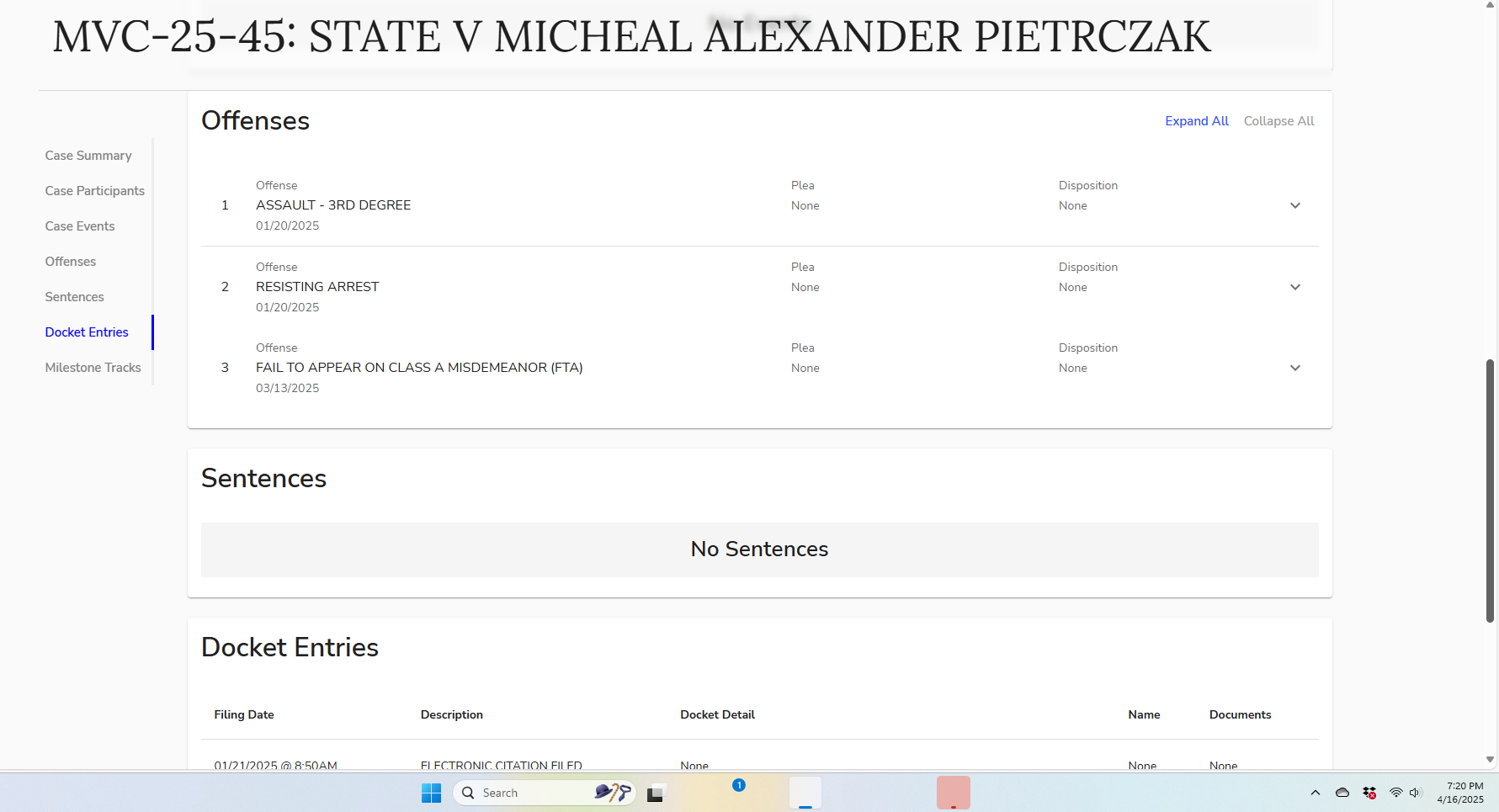

The same lawyer who once tried to take my property on behalf of an abusive former partner is now a sitting judge—and he’s presiding over that same man’s criminal case.
Years ago, Billy Jack Gibson represented Micheal Pietrczak in a bitter property dispute against me. I had money at the time and was represented by counsel. Gibson’s goal was to get the entire property for Pietrczak. After my attorney intervened, Gibson backed off. He later told me that he no longer represented Pietrczak.
In 2017, Pietrczak wrote a suicide note to his father. In it, he gave specific instructions: once I paid him the $75,000 we had agreed to, his father was to contact William “Zac” White, a lawyer in Heber Springs, to file a lawsuit for the full property plus treble damages. That’s exactly what happened.
The lawsuit filed by Zac White has worked its way through years of litigation and is now the basis of my petition to the U.S. Supreme Court. The case is still pending—but Pietrczak now has new legal troubles.
On January 21, 2025, criminal charges were filed against him in Hot Springs: third-degree assault, resisting arrest, and failure to appear.
The judge listed on the public docket? Just “Gibson.”
I checked with the court clerk. It is indeed Judge Billy Jack Gibson, the same man who once stood across from me as opposing counsel in the same property dispute that now defines my litigation.
When I looked at the electronic record, things got even more suspicious. The official citation from January 21, 2025 spells Micheal’s first name correctly—but the citation lists the wrong birth year: 1972 instead of 1973. Pietrczak’s prior rap sheet was altered to show his name as “Michael”. According to the district court clerk, this information comes straight from the DMV. What caused this? No one will tell me, but here is an educated guess:
- One driver’s license has the correct birthdate but misspells his name, and
- Another license has the correct spelling but the wrong birthdate.
Why It Matters
The Arkansas Code of Judicial Conduct Rule 2.11(A) requires judges to recuse themselves in any proceeding where their impartiality might reasonably be questioned. Prior attorney-client relationships might fit into that category.
A judge who once fought to take my property for Pietrczak is now presiding over his criminal case. The fraud was successful up to the Supreme Court because the appeal was erroneously dismissed on jurisdictional grounds. No one at the higher courts addressed the merits, including the fraud.
Even if the new charges are unrelated, the history is real. The appearance of bias is inescapable. And once again, the system seems to bend quietly for those on the inside, while people like me have to shout just to be heard.
If you face a scheme like this, please contact me at bohemian_books@yahoo.com so I can help you get loud.
Texas Bill to Increase Public Membership on Judicial Ethics Oversight Committee
The problem with each judicial oversight body I have contacted is apparently the same across the country. There is no judicial oversight.
My efforts to correct Allen H. Friedenthal (deceased) in California took years of my life, and was an absurd burden on public resources. The result was a public reprimand, putting it in the 1% of complaints that result in sanctions.
I am beginning my law school journey and may someday be credentialed to have a voice that will be heard. But I am one person and there is no reason to exclude other laypeople from contributing to the protection of what is theoretically the best system of justice in the world.
Are Courts Zooming Away the Public’s Right to Access?
There is some constructive criticism that might help this YouTube creator. But the general themes of his message are important issues. Are our rights to access to judicial proceedings eroding? Are judges using Zoom to slam the door on court watchers?
In Arkansas, Judge Weaver used Zoom to improve her chance to get away with causing the court reporter to fictionalize transcripts. She also denied use of Zoom when the opposing party wanted to personally serve documents on me, and I lived over an hour drive away.
There should be uniformity and logic in the use of virtual court proceedings. Unfortunately, instead technology is abused by some judges who would rather not have open courts.
A Document Portfolio Recovery Associates Did Not Want You To See
In going through the record, looking for documents that the federal district court in Arkansas and the Eighth Circuit Court of Appeals ordered me to destroy, I found one for which secrecy was denied. Praise the Lord!
Maybe reading it will give you ideas about how to approach your own suit against PRA for making annoying and harassing phone calls to you. I am not an attorney and I lost my case, but sometimes we learn more from other people’s mistakes and we can prepare for the expected attack by the defense.
I will go into detail after my mandatory assignments are complete. For now, even reading the first few pages, it is clear that Judge Lee P. Rudofsky lied when he said that I agreed that I owed the debt.
“No reasonable juror can conclude there was a debt from Hammett to PRA.” – Paragraph 11
“PRA still produced no account level documentation for the alleged debt and I have no record of my Capital One account opened in 2001 other than the unsupported conclusion of PRA.” – paragraph 14
Feel free to contact me in the comments, or by email to bohemian_books@yahoo.com. Enjoy the FREE Doc of the Day:
Eighth Circuit Accepts Documentation Supplied By Untrustworthy Company
I tried to use that order in my case against Portfolio Recovery Associates. District Court Judge Rudofsky said it was not relevant. Just because PRA violated hundreds of thousands of other consumers and agreed to pay $24,000,000 in restitution and fines didn’t mean the documents they produced in my case were inaccurate, according to the big business puppet judge.
Judge Rudofsky forbid me from taking the case to a jury. The Eighth Circuit affirmed his orders.
Judge Rudofsky said I cannot disclose what is in any of the “evidence” presented by the debt collector. I can tell you it was not accurate.
Judge Rudofsky said the debt collector did not need a copy of a credit card agreement between the original creditor and me. He said there was no need for the alleged account to be referenced on a bill of sale or any other documentation. There was no credit card agreement. There was no link between a purchase made by PRA and the account associated with me.
How do you know I am telling the truth?
If I committed perjury when I made these same claims all the way up to the Supreme Court, you better believe there would be perjury charges filed against me.
Since our judges are essentially tyrants, there is a chance one will collude with a prosecutor and kangaroo court me into jail. But it would be a lot harder than what was done to me in civil court. I would be entitled to counsel, instead of representing myself. The sealed documents would be exculpatory evidence and it would be awkward for a judge to deny me the right to show the public the evidence. It would look even worse than the Star Chamber in which Judge Rudofsky ordered me to pay a full year of my pension to the billion dollar company to reimburse for the cost of their defense.
Hopefully, you have an honest judge in your case. The Arizona lawyer in the video above should be right. You should be able to use the stipulated order against Portfolio Recovery Associates to beat prosecution by them and to win an FDCPA or invasion of privacy case against them.
Do me a favor please. Don’t settle for $5,000. One jury on a similar case to mine decided PRA should pay $82,000,000 in punitive damages. And even that didn’t slow them down.
Judge Gets Off With 6 Month Suspension
Judges granted themselves absolute judicial immunity. That means when Judge Susan Weaver transfers property from an older woman to a man who put his intent to defraud the lady in writing, it is nearly impossible for the victim to receive restitution from the judge.
Government workers show a brick wall resistance to filing criminal charges on a sitting judge.
Judicial ethics commissions are a huge waste of taxpayer dollars. They are paper tigers. Lazy paper tigers that lay around all day licking their paws. They act as if the judge is going to throw them their next slab of meat, not acknowledging it is the taxpayers providing for them.
Concerned citizens, like I am, are often retaliated against for challenging the corrupt judges.
The system is designed to work beautifully. It is the people inside perverting it.
So you can verify, here is a copy of the hand written fraud letter mentioned above. It was entered as an exhibit in a motion for contempt against Attorney William Zac White that Judge Weaver denied inexplicably.
On my to do list, the court records about the fraudster, whose name is spelled as in this letter, “Micheal”, have most or all been changed to “Michael” by the various court clerks. This appears to be a way to help Micheal Pietrczak, a felon for using false documents at the border, to deter people from learning the truth about him. One must ask why there was an orchestrated effort by court personnel to do this dirty deed.
The Court and Big Business Billionaire Defendant Allowed to Discuss Sealed Documents on Public Record: Mums the Word for Pro Se Plaintiff
In a case against the most annoying and offensive debt collector, Portfolio Recovery Associates, Judge Lee P. Rudofsky made it clear that the pro se plaintiff, me, was not allowed to discuss sealed documents on the public record.
After Judge Rudofsky finally recused himself, the fresh judge reiterated the threat of sanctions for disclosure of sealed evidence.
But Judge Rudofsky and Portfolio Recovery Associates repeatedly violated their own call for the cone of silence.
Here is a copy (that you can download for free) of plaintiff’s deposition redacted by Portfolio Recovery Associates. They were supposed to redact mentions of the sealed documents – but they didn’t.
For example, look at page 77, line 7. PRA attorney James Trefil of huge defense firm Troutman Pepper starts discussing Exhibits 9, 10 and 11. PRA marked those “CONFIDENTIAL” and filed under seal. There is one short redacted section, then Mr. Trefil asks about the specific data from Exhibit 9.
That is not keeping sealed documents confidential.
Worse, Portfolio Recovery disclosed what was supposedly on a document I designated as “CONFIDENTIAL”. On page 116, line 17. Mr. Trefil: “For the record, this is a confidential document.
This is plaintiff’s credit report. Are you familiar with this document?” His next sentence: “Do you see where says it Midland Credit [?]”
Wow! That is not keeping it confidential. And without seeing the entire document, it is misleading. But Mr. Trefil on behalf of Portfolio Recovery Associates did not stop at just insinuating there were debts showing on my credit report.
“So what debt of yours does Midland Credit Management hold?”
“None [!]”
“It’s showing up on your credit report.”
Liar! “It says, ‘The listing of a company’s inquiry in this section means that they obtained information from your credit file in connection with an account review or other business transaction with you. These inquiries are not seen by anyone but you. They will not be used in scoring your credit file except insurance companies may have access,’ blah, blah, blah about the insurance companies. So I don’t know why they made a soft inquiry, but Portfolio Recovery also made a soft inquiry and it’s on the same report, isn’t it?”
“I don’t see Portfolio on this report. I might just be missing it.”
“Did I give you both? I got two — I contacted all three credit agencies, but I only got two reports back and I don’t think this is the one that has Portfolio Recovery on it. I think it’s the other one. Yeah, Portfolio Recovery made a soft inquiry on November 1, 2019. So Midland just is like Portfolio, a –“
“My question is what debt of yours does Midland hold?”
“None that I’m aware of.”
“All right. But you acknowledge they are showing up on your credit report?”
“As a soft inquiry.”
“Understood.”
“They’re allowed to — anybody can look me up. In fact, that might be the way that companies like Portfolio Recovery find their marks is they go in and they look at people’s credit reports and then they contact them and say, hey, you owe us $2,297.63. How do you want to pay for that? And they have — because they have access to these credit reports, they have a whole mess of information about you, so they’re –“
Trefil interrupted my lecture. “What about Enhanced Recovery Company?”
“Same thing. I have no clue who they are. I don’t have any debt, and so they could look.”
“So it’s your sworn testimony here today under oath that you currently have no delinquent debt?”
“I am not aware of any delinquent debt. I have found out –” Another interesting topic comes up from this statement, which will be discussed in a later post. For now it segues into more of the defense divulging what was in its own confidential documents.
“You sound an awful lot like the Capital One representative who wasn’t aware of any mistakes.”
“That what?”
“In the affidavit of sale, [Exhibit 11] you were complaining that the Capital One representative was saying he wasn’t aware of any mistakes in the records that they were giving.”
So here, PRA is telling the public what was said in the “CONFIDENTIAL” affidavit of sale.
In a bigger picture, Judge Rudofsky told the public what was supposedly said in the confidential, sealed documents. He represented that I agreed to owing the debt. He represented that there was accurate records that showed PRA did not call an annoying or harassing number of times. He said that the evidence under seal was so strong, no reasonable juror could disagree with him.
If we were playing poker, I would say PRA bluffed, then Judge Rudofsky as the casino forced me to fold my hand for a manufactured reason, allowing PRA to avoid showing its hand.
The Eighth Circuit upheld that dishonest service and the United States Supreme Court denied my petition for writ of cert and did not mention my motion to unseal the documents on the docket. 24M44.
Here is the motion that was labeled a motion to seal and was “granted”. Despite the record appearing to grant the motion in full, SCOTUS did not unseal the documents. The highest court in the country behaved as if the motion did not request unsealing and ignored the request.
 A Higher Law