Courts Help Portfolio Recovery Associates: Here is help for You
Portfolio Recovery Associates is not slowing down.
Even as the stock of parent company PRA Group, Inc. plummets, the debt buyer is dialing for dollars.
It took me filing a lawsuit for violation of the FDCPA and intrusion on seclusion for me to convince Portfolio to quit their incessant calling.
It didn’t end well for me. Judge Rudofsky said no reasonable juror could think that the debt collector’s calls were too annoying. PRA got a judgment for over $8,000 to reimburse their costs of defending themselves. Judge Rudofsky said that even though that is more than my annual income, I didn’t list my expenses, so it wasn’t unjust to make me pay the equivalent of a year’s pension to the billion-dollar company. Easy for him to say, living off a six-figure government job.
But, don’t give up. In a different jurisdiction, for similar conduct, PRA was hit with an $82 million jury verdict. Other pro se litigants are making leeway. And Portfolio Recovery did make a $5,000 Offer of Judgment to me – I just went all in and the dealer pulled PRA’s card off the bottom of the deck.
I hope this document showing a Portfolio Recovery Associates call log, charge off data compiled and contact log will help you convince your judge not to let the defendant cover-up similar documents in your case.
Open Response to Email By Someone Interested in Joining a Class Action Against Debt Collectors in New York
Hi. I already filed a lawsuit on my own and lost. Lost on appeal. Was denied discretionary review at the Supreme Court.
I am not an attorney. I scored 162 on the LSAT (Ivy League score) and am accepted tuition free to law school. So, it is over three years before I can help anyone else in court.
I have uploaded many of my filings and filings that won on my website. http://www.court-corruption.com. Also some videos on my YouTube @StopBigBusinessBillionaires
Where did you find me?
The most important advice I can give you in a nutshell, record and document every call. The collector in my case claimed the first hundred calls to my cell phone in 2020 were not made. I hadn’t recorded them and all the numbers I called that were on my phone bill (including the ones they said they called from) they had disconnected.
If a person owed the debts and the statute of limitations expired, the person still owes the money. But the creditor can’t collect in court. They can still call or write to ask the debtor to pay, but are supposed to stop if asked in the same way they contact the person. Regulation F. The calls to me happened before Regulation F went into effect. I was required to put my Cease and Desist in writing. It was a violation for them to try to collect after the C+D. The judge on my case said the interrogatories and affidavit of identity theft or fraud they tried to get me to fill out was not an attempt to collect a debt.
If one of the collectors is Portfolio Recovery Associates, look at the 2015 consent order and the 2023 stipulated judgment for violating that restraint order. Those documents and documents of a winning case with an $82 million jury verdict called Mejia v. Portfolio Recovery Associates, LLC are on my blog and you can download them for free.
If you write your own lawsuit, based on a winning lawsuit or one that was settled as a template, they may throw a little money at you. I had an offer of judgment for $5,000. I think a jury would find damages to be significantly higher, but the judge in Arkansas was not letting it go to trial if I had a video of the debt collector handing him a briefcase full of cash.
Thank you for writing. I almost didn’t open your email because the name of the sender sounded like scam. I’m glad I did open it and hope you find someone who will represent you.
Laura
Stop Laughing! There is nothing funny about Judge Rudofsky ordering us to give scam callers our personal info.
This video is a scam caller who called me back to ask what my YouTube channel is called.
He and his partner in crime called earlier to try to trick me into divulging information about myself, such as where I bank and approximately how much money I have in my accounts.
Portfolio Recovery Associates, a debt buyer and collection company owned by PRA Group, Inc., also made calls trying to gain information about me, even after I told them I have no debt and to quit calling me.
Instead of messing with them like I did with this caller, I sued for violations of the FDCPA and invasion of privacy.
PRA got the last laugh (so far) on that one. Trump appointed judge Lee Rudofsky threw my case out on summary judgment, meaning I did not get a jury trial. The Harvard educated judge also ordered me to pay over $8,000 of the scam caller’s costs. He even lied – flat out – that I said I owed the debt.
The Eighth Circuit justices said they agreed completely with Judge Rudofsky, but failed to elaborate at all on the reasons they disagreed with my full-length appellate brief and reply.
By this order and failure to reverse on appeal, the courts are ordering us to answer questions from scammers or expect the scammers to call us again until we comply with their demands for information.
A good question that was not addressed in Hammett v. Portfolio Recovery Associates: If a person lies to a scam caller on a recorded line, can that lie be used against the recipient of the call in a court of law to prove the recipient is somehow less than honest?
Here are the aforementioned briefs and the Eighth Circuit Order affirming Rudofsky’s B.S. summary dismissal.
Judge’s Pet, PRA Group (PRAA), Owner of Unethical Debt Collector, Stock is Stuck!
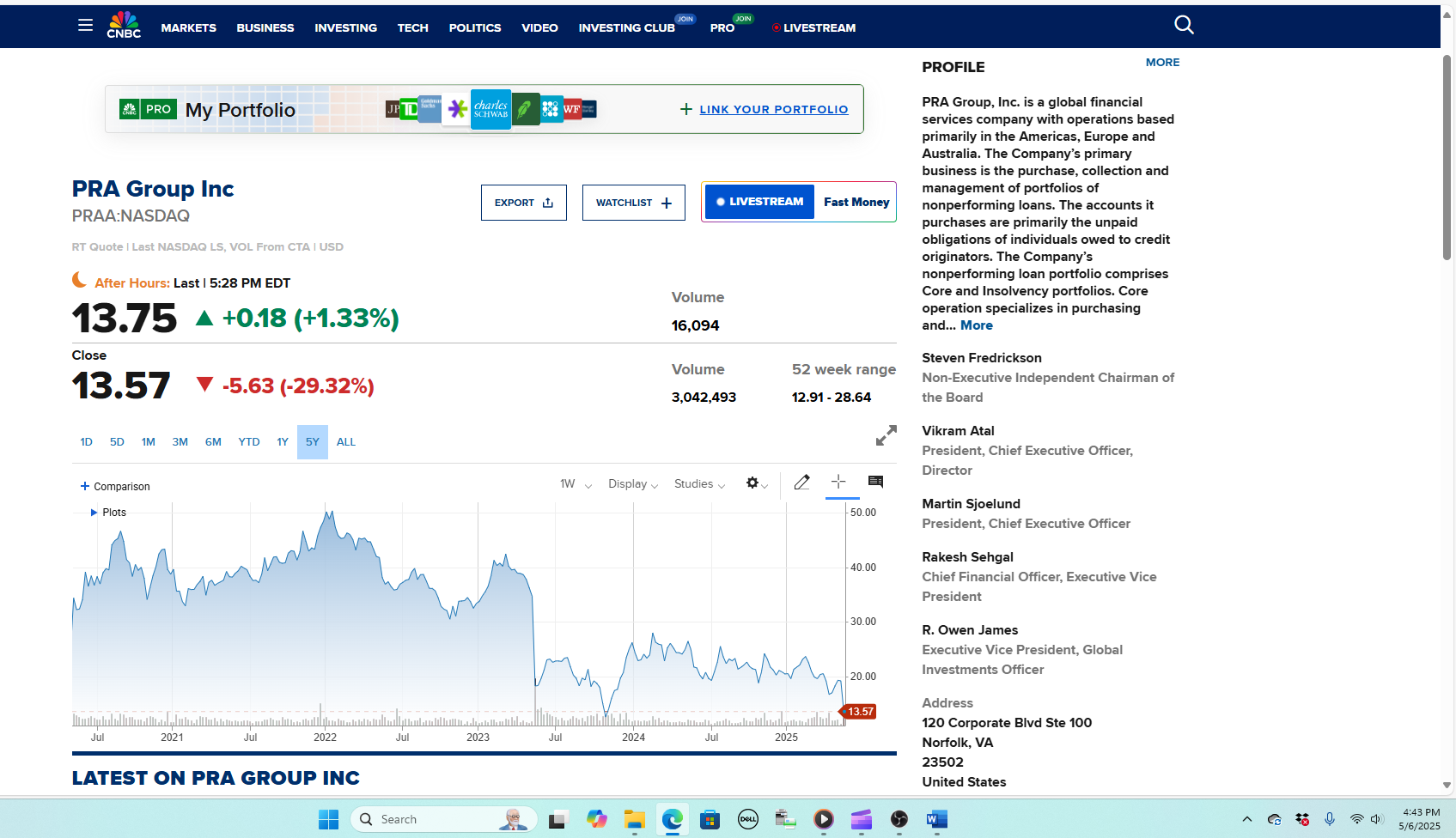

When I filed my lawsuit against Portfolio Recovery Associates in 2021, its parent company PRA Group, Inc’s stock was selling around $20 per share. Today it sold for $13 plus change.
I don’t mean to be a schadenfreudist, but watching PRAA’s stock nosedive genuinely made my day. Maybe true schadenfreude is about undeserved suffering — and this isn’t that. This is earned misery. PRAA is a pet litigant of Federalist Society cabalist Judge Lee Rudofsky, and if justice exists, this is just the beginning of their bad news.
Attorney Knows Better Than to Confirm Info — Even When Caller Has Accurate Private Details. But According to Judge Rudofsky and the Eighth Circuit, You’re Supposed to Cooperate Anyway
Portfolio Recovery Associates, the Nation’s second largest debt buyer, made 100s of phone calls to me before I agreed to confirm (or deny) my identity, birthdate and address. After I confirmed my name and birthdate and denied the address they had was one I was familiar with, they told me that I owed $2,297.63 but not by whom, on what, where, or when the account they purportedly purchased was used.
I sued PRA.
The CFPB had already obtained a consent agreement against the debt collector against making phone calls exactly like this one. A couple years after I filed my suit, Portfolio Recovery stipulated to an order to pay another $24 million for continuing to make the harassing collections.
Judge Lee P. Rudofsky threw my suit out on summary judgment. He said it was not more than an acceptable annoyance for a debt collector to make repeated calls if the recipient refused to confirm personal information about themselves on a recorded line. The Eighth Circuit confirmed. SCOTUS denied writ of certiorari to review the orders. (Steve Lehto, at 5:20 of the YouTube video said, “so I said, ‘just so you know, I find this entire phone call annoying’, and I hung up on her.”)
The courts also allowed the supposed evidence that their decision was based on to be kept under seal. I can tell you that the evidence provided did not show that I owed PRA any money and did not show that my estimate of the number of calls made was inaccurate. This begs the question, why would PRA want to keep the records of my account confidential if I begged to have the records made public?
I can’t answer Steve Lehto’s question, but agree with him whole-heartedly that a caller has no right to demand confirmation of identity or anything else. (At 10:10, Mr. Lehto said, “in fact, I didn’t even confirm some of the things that she asked me.”
I pointed out to Judge Rudofsky that the Fourth Amendment of that pesky Constitution forbids demands for identification. The judge said the 4th amendment only applies to government intrusion. By that reasoning, there is separation of church and state, but it is perfectly fine for an individual to tie you to a rock and force you to profess faith in Jesus Christ as your Lord and Savior before the tide comes in. – Well, that is hyperbole. A more literal analogy is that Portfolio Recovery Associates can call you as often as they want if you let the calls go to voicemail and once every three days for answered calls, indefinitely, until you state on a recorded line that Jesus Christ is your Lord and Savior. (For me, that is a true statement, but I don’t think I should have to confirm my faith on a recorded line, nor wear a Star of David on my sleeve.)
And isn’t it interesting, when I said that I could not confirm the address they had on file, PRA went ahead and discussed the alleged debt with me anyhow?
Judges Having Ex Parte Communications: The New Normal?
This blogger Laura Lynn Hammett
Michigan Attorney Steve Lehto discussing communications a judge partakes in that are not ethical.
A Document Portfolio Recovery Associates Did Not Want You To See
In going through the record, looking for documents that the federal district court in Arkansas and the Eighth Circuit Court of Appeals ordered me to destroy, I found one for which secrecy was denied. Praise the Lord!
Maybe reading it will give you ideas about how to approach your own suit against PRA for making annoying and harassing phone calls to you. I am not an attorney and I lost my case, but sometimes we learn more from other people’s mistakes and we can prepare for the expected attack by the defense.
I will go into detail after my mandatory assignments are complete. For now, even reading the first few pages, it is clear that Judge Lee P. Rudofsky lied when he said that I agreed that I owed the debt.
“No reasonable juror can conclude there was a debt from Hammett to PRA.” – Paragraph 11
“PRA still produced no account level documentation for the alleged debt and I have no record of my Capital One account opened in 2001 other than the unsupported conclusion of PRA.” – paragraph 14
Feel free to contact me in the comments, or by email to bohemian_books@yahoo.com. Enjoy the FREE Doc of the Day:
Eighth Circuit Accepts Documentation Supplied By Untrustworthy Company
I tried to use that order in my case against Portfolio Recovery Associates. District Court Judge Rudofsky said it was not relevant. Just because PRA violated hundreds of thousands of other consumers and agreed to pay $24,000,000 in restitution and fines didn’t mean the documents they produced in my case were inaccurate, according to the big business puppet judge.
Judge Rudofsky forbid me from taking the case to a jury. The Eighth Circuit affirmed his orders.
Judge Rudofsky said I cannot disclose what is in any of the “evidence” presented by the debt collector. I can tell you it was not accurate.
Judge Rudofsky said the debt collector did not need a copy of a credit card agreement between the original creditor and me. He said there was no need for the alleged account to be referenced on a bill of sale or any other documentation. There was no credit card agreement. There was no link between a purchase made by PRA and the account associated with me.
How do you know I am telling the truth?
If I committed perjury when I made these same claims all the way up to the Supreme Court, you better believe there would be perjury charges filed against me.
Since our judges are essentially tyrants, there is a chance one will collude with a prosecutor and kangaroo court me into jail. But it would be a lot harder than what was done to me in civil court. I would be entitled to counsel, instead of representing myself. The sealed documents would be exculpatory evidence and it would be awkward for a judge to deny me the right to show the public the evidence. It would look even worse than the Star Chamber in which Judge Rudofsky ordered me to pay a full year of my pension to the billion dollar company to reimburse for the cost of their defense.
Hopefully, you have an honest judge in your case. The Arizona lawyer in the video above should be right. You should be able to use the stipulated order against Portfolio Recovery Associates to beat prosecution by them and to win an FDCPA or invasion of privacy case against them.
Do me a favor please. Don’t settle for $5,000. One jury on a similar case to mine decided PRA should pay $82,000,000 in punitive damages. And even that didn’t slow them down.
 A Higher Law