Red Alert! Subscribers, Do Not Open Appendices in December 9th Post. Motion was Denied in Part, According to Verbal Instruction from SCOTUS Staff
I filed a motion to seal and then unseal documents in the Portfolio Recovery Associates case that is at the United States Supreme Court on Writ of Certiorari.
The motion was docketed only as a motion to seal.
The motion was granted.
The motion was not available on the SCOTUS website. Here it is.
I called the clerk to confirm that “motion granted” referred only to the motion here, not my petition for writ of certiorari. The next day a woman called. I was cooking lunch and did not write down what she said. My memory is that the court decided to seal the documents in the Supreme Court, they understood that I was asking to unseal, and they did not grant that part of the motion. She did not know why, she said, that they did not say “denied in part” or mention the request to unseal. She agreed to send me a letter putting this in writing, which I have not received yet.
I hope they intend to address the unsealing issue later. For now, according to the woman who called me from the court’s phone, the appendices attached to the December 9, 2024 post you received by email are still sealed. You should treat them as such. Thank you.
UPDATE: The email notification of my post was not showing up on my account earlier today. Since no emails were coming in, I checked my settings and realized I had the wrong tab open. I checked my email of the post with the sealed appendices and the appendices opened. A copy I forwarded to my secondary email also allowed me to open the appendices.
There is still nothing in writing that says my motion was denied in part. It is not contemptuous of me to have interpreted “motion granted” to mean “motion granted in full”. Somehow, I know I will be thrown in the Gulag for my insubordination though. How sad a world in which we live.
Pro Se Motion to SCOTUS Granted: UPDATE: Staff Member Told Me the Motion was Granted In Part
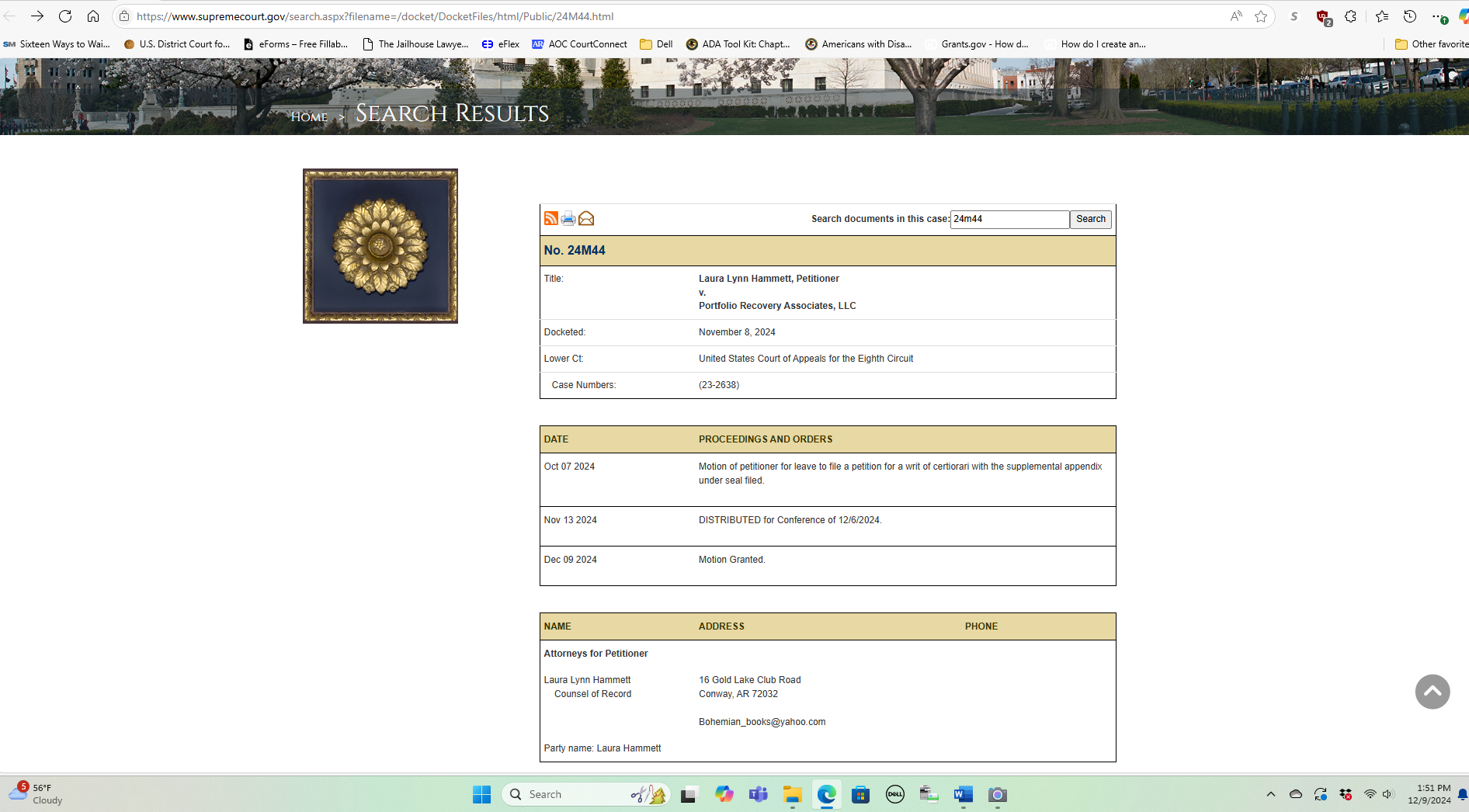
The Motion docketed on October 7, 2024 was titled “Hammett’s Motion to Filed Sealed Documents, Unseal Those Documents and All Lower Court Documents Referred to by the Court in Its Decision”
Hammett gave abundant caselaw supporting the public’s right to access to evidence that was used by the court when deciding to grant Portfolio Recovery Associates’ motion for summary dismissal.
The conclusion of Hammett’s Motion:
“For the reasons stated above, Hammett respectfully requests that the Court grant her motion for public access to the sealed judicial records, unseal Appendices aa, bb, cc, and dd, and require PRA to provide specific justification for maintaining under seal any documents referenced by the district court in its orders granting summary judgment to PRA and denying partial summary judgment to Hammett.
Transparency and fairness in the judicial process demand no less.”
UPDATE: The following four appendices were posted here on December 9, 2024.
Appendix aa
Appendix bb
Appendix cc
Appendix dd
These documents were ordered to be sealed by Federal District Judge Lee P. Rudofsky. The Eighth Circuit affirmed the order.
The United States Supreme Court made a docket entry that did not mention Hammett’s request to unseal the documents. The motion was not available on the SCOTUS website.
Because the Supreme Court Clerk wrote only “motion granted” on the docket on December 9th, Hammett made the reasonable assumption that the motion was granted in full. It is common practice in all other courts for the orders to specify “denied in part” if they are denied in part.
Here is the backstory:
Portfolio Recovery Associates, LLC buys questionable debt from originators for pennies on the dollar. Some of the debt purchased was generated on Walmart branded credit cards. Judge Rudofsky was counsel to Walmart before his lifetime appointment to the bench. He appears to be a puppet for the oligarchy of Big Business.
Portfolio Recovery Associates lied in the proceedings I brought against them, understating the number of times they called me, and making the false claim that they did not call my cell phone in the months leading up to when I recorded a conversation. Purportedly, I turn on my computer, open the camera and record the conversation every time I get a call.
Judge Rudofsky pretended that I had no evidence of PRA’s spoliation of evidence. UPDATE: here is where appendix aa, bb, and dd prove that PRA spoiled evidence by keeping inaccurate, incomplete records of contacts.
Appendix cc proves that PRA and Judge Rudofsky came up with a cockamamie rationalization that failing to issue a 1099-C to me was not proof that the debt was not legitimate. I did not receive one of these forms, but PRA said they “waived” my alleged debt after I filed the lawsuit against them. Judge Rudofsky and the Eighth Circuit pretended that they believed PRA, that I owed the debt and PRA waived the debt without a settlement agreement.
First, why would a script be confidential? This is something PRA representatives repeated to numerous alleged debtors. The reason PRA and their stooge judges wanted it covered up is because it didn’t jibe with PRA’s lie.
Countless debtors have asked: “Why did I receive a 1099-C?” The PRA representative says: “The IRS requires us to file 1099c’s because you either settled your debt, or PRA determined the debt was not collectable and stopped collection efforts.” PRA attorney James Trefil of Troutman Pepper stood in open court and said that the reason PRA did not make a 1099-C against me was that PRA determined the debt was not collectable and stopped collection efforts “in light of the ongoing litigation”. That is the exact reason PRA would be required to file a 1099-C. The reason they did not file the 1099-C is because they knew the debt was not legitimate, and lying to the IRS might get them in trouble. (No such worry existed when lying to Judge Rudofsky and the Eighth.)
The debt buyer is required to file a 1099-C even for disputed legitimate debt. Then the debtor can file for an exemption based on hardship or that they dispute the debt. This is what the IRS says in their instruction booklet.
UPDATE: Whether my petition for writ of certiorari is granted or not, you the public should be able to see with your own eyes that the Federal Courts failed to provide justice, allowed for a Star-Chamber and appear to favor Big Business over individual citizens. Thus far, the Supreme Court is not going to let you, either.
I posted the documents and had numerous downloads. Is there a way to unring that bell?
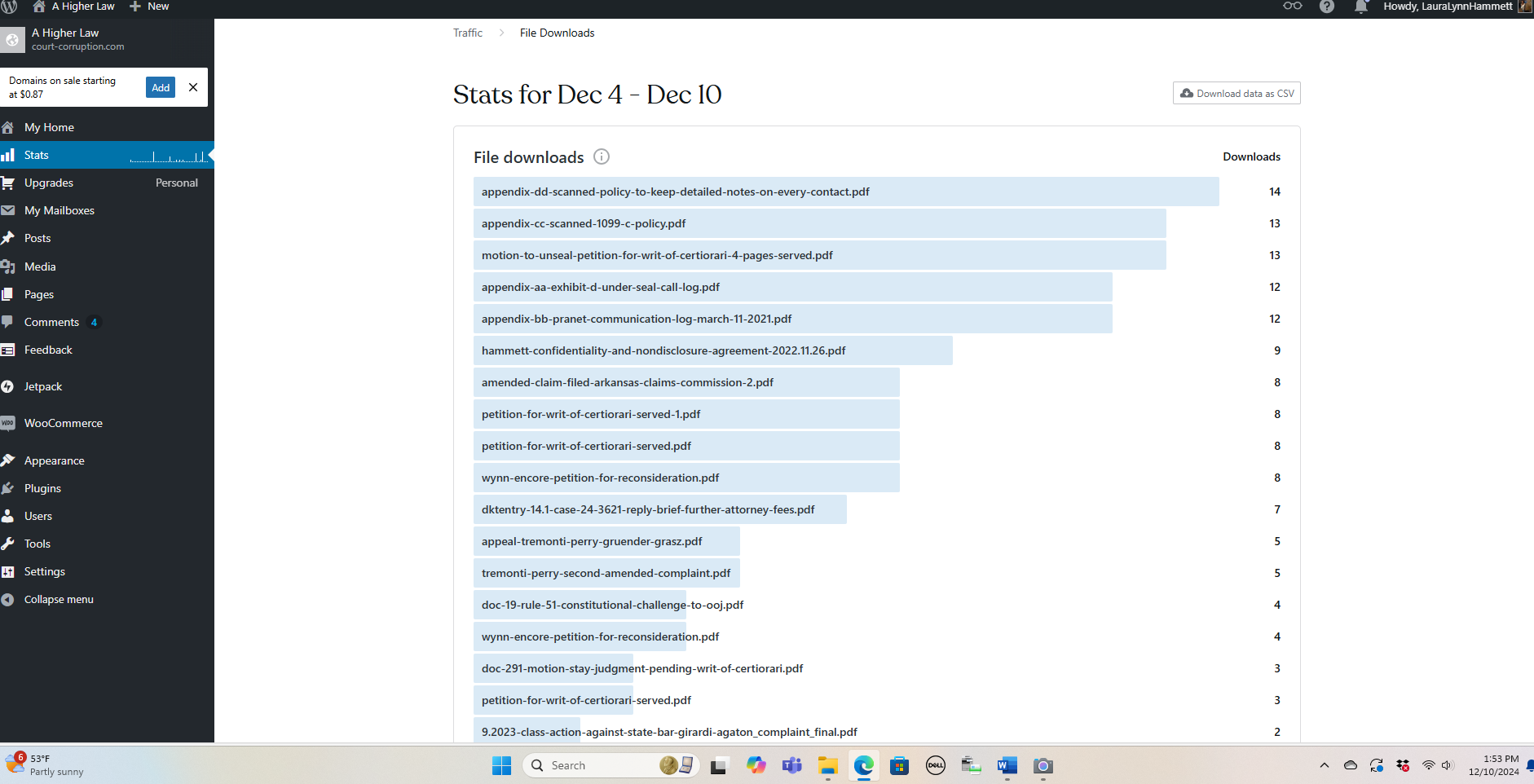



Hopefully SCOTUS revisits the motion after the petition for writ of certiorari is docketed. But wouldn’t they have made some reference to that procedure on the motion docket??? Seriously, if anyone has experience with Supreme Court procedure, comment or send me a private message to bohemian_books@yahoo.com.
UPDATE December 11, 2024: For some reason unknown to my non-tech mind, the appendices I posted on December 9, 2024 can still be accessed. There was a download of two of them this morning.

Maybe people who receive my blog by email are able to access the files that I deleted on the 10th. I did not receive an emailed copy. I used to get the emailed copies and they did not change after I edited a post.
Biden Kills Any Hope of Justice for All…Maybe.
Both “sides of the aisle” are corrupt as all Hell.
The Republicans have Judge Susan Weaver of Arkansas, and Trump appointees Judge Lee P Rudofsky and Todd W. Robinson.
Democrats gave us Federal Judge Linda Lopez.
Now Joe Biden made it clear. There will be no justice if any of the oligarchy are involved. Pardon his son, but not the multitudes of commoners convicted of similar drug related crimes. I know one man who did his time for growing weed, and he did not own a gun. An inordinate percentage of the incarcerations are men who have darker pigmentation than the Bidens.
Maybe I should keep my mouth shut until the transfer of power is complete. I’m not certain that Daddy Biden can’t pardon himself for all the crimes he committed while in office. If not, hopefully he can be charged as an accessory to the crimes committed by his son.
Just brainstorming here, but what would the effect of an impeachment of Joe Biden be? Or if it can be proven that he was complicit in an act that he pardoned?
Think about the trial. Hunter could not plead the fifth. But if he lies, that will be perjury. lol
I can’t say the Trump lawyers are honest, but they are smart. Try using some of that genius for goodness instead of evil. Stop the Biden pardon.
Judge Velia J. Meza: What is Good and Right in Our Legal System.
A little off topic, but this is the Thanksgiving Weekend and time for a break from the grind. The story touches me personally, because I love to walk, and am petrified of pit bulls and other aggressive dogs that whose owner’s allow to wander the neighborhood.
There is a reason for our court system to exist. It is to protect each of us from those who are stronger, whether it be because of physical strength, weaponry, attack dog ownership, or extreme money and power accumulation.
Unfortunately, there are not more judges like the Honorable Velia J. Meza who protect us from pit bulls and the big business and governors who unleash them to terrorize the rest of us.
Is the United States Supreme Court more Amazon or more Walmart?
This was sent in an email by Amazon.

Amazon warns the public of two scams. Scammers may claim there is a fraud investigation and that you must “verify” your account. Or the scammer may claim there is unauthorized or fraudulent activity on your Amazon account. Amazon suggests that you don’t “verify sensitive personal information over the phone.”
In contrast, numerous persons called me and said their name was Joe Blo or Jane Doe and asked me to verify who I was. If pressed what company put them up to the call, they said “Portfolio Recovery Associates.” They asked me to verify my name, birthdate and address or past address, and if I did not answer, refused to tell me what the call was about.
Judge Lee P. Rudofsky gave the opinion that it was reasonable for Portfolio Recovery Associates to demand the person they called to identify themselves and verify sensitive personal information over the phone, on a recorded line. Judge Rudofsky’s gig right before taking his lifetime position on the bench was as counsel to Walmart. Walmart partners with credit card companies that sell questionable debts to Portfolio Recovery Associates.
But Judge Rudofsky doesn’t acknowledge any bias created by that past client relationship. No, he asserts that people who agree with Amazon and don’t want to talk with random callers on the phone are unreasonable.
Will the United States Supreme Court agree with Judge Rudofsky? We may find out, if SCOTUS agrees to grant certiorari after the December conference.
In this story, a Democrat judge is the Lying Cheat
Nate the Lawyer acts like democrats have a monopoly on corrupt acts. Corruption is definately a polyopoly.*
*I like my word invention better than “oligopoly”.
Oligopolies: UAMS, Walmart and Licensed Casinos Controlling Our Courts
“Oligopoly – the market condition that exists when there are few sellers, as a result of which they can greatly influence price and other market factors.” – Dictionary.com
What do you think about when you are taking a shower? Probably how great it is that we have indoor hot water. Or, that you need to replenish the conditioner.
My autistic brain fixates on my legal matters. This morning it was about my poker cheating case against a Vegas casino.
There is only a small amount of money at stake – but I am asking for declaratory relief, also. I want the Gaming Commission to require that the casino make a reasonable effort to stop cheating. When cheating occurs that could easily have been stopped by the dealer, or security watching through the surveillance system, the casino should reimburse the mark.
Why? Because the industry is highly regulated, creating an oligopoly. Well, I didn’t have my dictionary in the shower… I was going to coin a word: polyopoly. Say it. It’s fun.
But, when I went to “write, don’t ruminate”, I found that a word describing the situation already existed. Oligopoly. In the case of poker, there are only so many dollars people are willing to voluntarily put in the pot. With the limited number of casinos, it puts a serious poker player at a disadvantage if even one casino is not available to play at.
The regulatory agencies know who directly butters their bread. It is easy to ignore the fact that it is the people who gave authority to the gaming commission, the CFPB, the medical boards.
UAMS, a public university hospital, literally can get away with murder. The police are sometimes the ones (allegedly) pulling the trigger.
And debt originators like Walmart, who partners with Capital One and other big credit card companies, have their counsel shimmy on in to positions on the bench, deciding cases against creditors and debt buyers like Portfolio Recovery Associates.
It is all very frustrating. Why are We the People standing for it? Let’s put up a fight. Let’s get loud.
More Evidence of Bias Against Common Citizens: If you can’t afford your own attorney, you will probably be ordered to pay for the other party’s.
UNITED STATES COURT OF APPEALS FOR THE NINTH CIRCUIT
9th Cir. Case No. 24-3621
Case No. 3:19-cv-00605-LL-AHG
APPELLANT’S INFORMAL REPLY BRIEF
(Optional Reply in Response to Appellee’s Answering Brief)
Issue/Argument Number 1
What is the first argument in the answering brief to which you are replying?
The 9th Circuit failed to rule on my request for an extension of time before the due date, and the S&G Defendants opposed any accommodation to address my husband’s critical health situation.
What is your reply to that argument?
The S&G Defendants’ opposition to my extension request ignored the reality of my circumstances, which include managing my husband’s diagnosis of inoperable, metastatic prostate cancer. Courts should adopt a policy ensuring that life-altering events, such as terminal illnesses, warrant automatic stays or extensions for unrepresented litigants. This is not about preferential treatment but a necessary accommodation for access to justice.
S&G’s rigid opposition compounds the systemic issues self-represented litigants face. This is not the first time no courtesy was extended in response to illness in this case, even at the lower court where limited scope representation was denied even in the case of illness. Denying my request for an extension, even after I promptly notified the court of my illness, effectively punished me for circumstances beyond my control.
This denial of extensions, stays and continuances to pro se litigants underscores the systemic bias against the majority class who cannot afford legal representation in civil matters.
I am not an attorney, and thus have limited experience. Yet, I can name three cases I am involved in where the court used its “discretion” to grant requests that did not have any more compelling reasons to parties who were represented by licensed attorneys.
In Hammett v. Portfolio Recovery Associates, LLC, 4:21-cv-00189-LPR, USDC ARED, Hon. Lee P. Rudofsky presiding, PRA was represented by two firms: Rose Law Firm of Former First Lady Hillary Clinton Fame and Premiere National Corporate Defense Firm Troutman Pepper. Yet extension were issued to PRA when “lead” attorney’s wife fell ill, twice, once with only an informal request made without electronic filing. The case is at the U.S. Supreme Court.
In Hammett, et al v. University of Arkansas Medical Sciences which is a claim pending at the Arkansas Claims Commission, UAMS attorney Sherri Robinson filed a motion for extension of time to file the answer of the largest government agency in Arkansas, concurrently with the late answer. Her stated reason for tardiness was that her mother broke her wrist and the attorney daughter had to help her with such things as rides to doctor’s appointments. The request was granted.
In Pietrczak v Lynn [Hammett], Searcy County Arkansas Circuit Case 65CV-21-20, Hon. Susan Weaver failed to respond to Hammett’s motion for continuance of the “final hearing”. Hammett argued that she was not served a summons, the co-defendant did not have a summons issued in its name yet, and there was no discovery done. The court demanded and gave specific verbal instruction to Hammett to bring in all her exhibits for trial. Hammett complied. The plaintiff entered no exhibits. On the day of the trial, the plaintiff made a verbal motion for continuance which was granted, against Hammett’s opposition. That case is at the Arkansas Supreme Court.
Issue/Argument Number 2
What is the argument in the answering brief to which you are replying?
The S&G Defendants argue that the attorney fee award is a collateral order, beyond the scope of final appellate review, and thus the court should affirm its validity regardless of jurisdictional defects.
What is your reply to that argument?
The S&G Defendants’ argument directly contradicts the Ninth Circuit’s own prior refusal to exercise jurisdiction over my interlocutory appeal concerning the attorney fee award. Specifically, the Ninth Circuit rejected my assertion that the attorney fee issue qualified as a collateral order at an earlier stage of this litigation. This denial underscores the inconsistency in their current position and undermines their argument.
The Ninth Circuit’s refusal to hear the interlocutory appeal was effectively a finding that the attorney fee order did not meet the criteria for immediate review under the collateral order doctrine. The court’s silence on Carden at that time further complicates the appellees’ reliance on the doctrine. If the fee award was not collateral then, it cannot suddenly gain that status now to shield itself from jurisdictional scrutiny.
This inconsistency exposes the flaw in S&G’s argument. By refusing interlocutory review, the Ninth Circuit signaled that the attorney fee award was not “separate from the merits” of the underlying litigation. The merits of the fee award are inextricably linked to the jurisdictional defect—an issue that has been central to this case from the start. The Ninth Circuit’s rejection of my early appeal reinforces that the attorney fees cannot be treated as an insulated, collateral matter.
Furthermore, jurisdictional defects strip the court of its power to issue any orders, including those deemed “collateral” in other contexts. As noted in Kelly v. Fleetwood Enterprises, Inc., 377 F.3d 1034, 1036 (9th Cir. 2004), and Steel Co. v. Citizens for a Better Environment, 523 U.S. 83, 94 (1998), subject matter jurisdiction is fundamental. Without it, all rulings—including fee awards—are void. Thus, even if this fee award were considered collateral, its validity still hinges on the court’s jurisdiction, which was absent under Carden.
Issue/Argument Number 3
What is the third argument in the answering brief to which you are replying?
The S&G Defendants misrepresented key facts, particularly regarding the ownership and structure of Silver Strand Plaza (SSP).
What is your reply to that argument?
Contrary to S&G’s assertions, SSP is not an apartment complex but a 40,000 sq. ft. commercial mall. They omit critical details about improper share transfers violating SSP’s operating agreement. Moreover, their attempt to downplay the roles of Erik Von Pressintin Hunsaker and Jeffrey M. Sherman as defendants further demonstrates their pattern of factual distortion. Accurate representation of these facts is essential to understanding the broader context of this litigation.
Issue/Argument Number 4
What is the fourth argument in the answering brief to which you are replying?
S&G Defendants claim I admitted my derivative claim was improper under California’s anti-SLAPP statute.
What is your reply to that argument?
The S&G Defendants mischaracterize my position. I acknowledged the derivative claim’s procedural barriers but did not concede its impropriety under anti-SLAPP. My claims of malpractice and conversion were legitimate under the statute, and the dismissal was purely procedural, driven by the court’s refusal to permit limited scope representation and the illegality of my advocacy on a derivative action.
Their failure to engage substantively with these points undermines their argument. If they rely on anti-SLAPP protections, the court owes me a reasoned explanation of why my procedural hurdles negate substantive claims.
Issue/Argument Number 5
What is the fifth argument in the answering brief to which you are replying?
The purported lack of subject matter jurisdiction, raised for the first time on appeal, does not void the district court’s order granting attorney fees.
What is your reply to that argument?
The Carden precedent unequivocally establishes that federal courts lack jurisdiction over cases involving non-diverse LLC members. This jurisdictional defect existed from the inception of the case. Allowing the district court to retain authority to award fees contradicts foundational principles of jurisdictional competence.
For six years, all parties, including the court, overlooked this defect. This failure should not permit S&G to exploit a procedural loophole to extract fees. They chose to continue litigating and are asking for the costs incurred by continuing. At the risk of sounding snarky, they are asking for top dollar fees for a business attorney who wants to feign lack of knowledge of Carden.
Stern & Goldberg’s inaction in flagging this jurisdictional flaw arguably constitutes malpractice against their client Silver Strand Plaza, LLC, further highlighting the injustice of awarding fees under these circumstances.
Stern & Goldberg committed malpractice. Current counsel to SSP is committing malpractice. They are still denying me access to company books and records, causing further damages. The only reason the claim was dismissed was because I could not afford an attorney for all purposes.
Issue/Argument Number 6
What is the fifth argument in the answering brief to which you are replying?
S&G Defendants misrepresented the nature of claims in the First Amended Complaint (FAC).
What is your reply to that argument?
My FAC alleged serious breaches of fiduciary duty, including unequal distributions favoring other members. S&G’s dual representation of individual members and SSP created conflicts of interest, compromising SSP’s operations. Their selective presentation of facts obscures these conflicts and the coercive tactics used to devalue my share.
S&G’s omissions about their extortionate settlement tactics and their prioritization of other members’ interests over SSP’s duty to all shareholders were scrutinized in my response to their motion to strike and the FAC.
Issue/Argument Number 7
What is the seventh argument in the answering brief to which you are replying?
S&G Defendants claim the district court did not abuse its discretion in denying my request for limited scope representation, where such representation was sought specifically to address the complex legal requirements of derivative claims, and where I also intended to pursue non-derivative claims that were excluded from the FAC due to procedural considerations.
What is your reply to that argument?
This argument is a red herring. The court’s refusal to allow limited scope representation effectively barred me from pursuing derivative claims. My decision to dismiss was a consequence of procedural limitations, not a concession on the merits. The district court’s failure to accommodate this procedural request ignored established principles of fairness, especially when litigants face financial and logistical constraints.
The fact that I misunderstood what a derivative claim entailed highlights the importance of legal guidance. My request for limited scope representation was a proactive step to address this confusion. Courts generally recognize that pro se litigants face unique challenges, and allowing limited scope representation could have facilitated a more efficient and fair resolution of this issue.
The court had discretion under its local rules to allow limited scope representation in appropriate circumstances. Given that my misunderstanding was central to the procedural missteps, granting my motion would have helped clarify and streamline the litigation, potentially saving judicial resources.
Not all my intended claims against S&G were derivative. Claims involving conspiracy or aiding and abetting breaches of fiduciary duty are distinct and require separate procedural steps, including seeking court permission under California Civil Code § 1714.10.
My decision to omit these claims made practical sense—I was waiting to gather more facts through discovery before formally presenting them. This is a prudent approach, particularly in complex cases where the full scope of wrongdoing might not be clear without further investigation. The court never allowed for discovery.
By denying my motion for limited scope representation, the court effectively impeded my ability to navigate these procedural nuances. This decision not only exacerbated my difficulties as a pro se litigant but also delayed or potentially barred me from bringing legitimate claims once I had the necessary information.
Courts have a duty to ensure that pro se litigants are not disadvantaged by procedural complexities. Allowing limited scope representation would have been a reasonable accommodation to ensure I could fully present my case.
The Southern District of California I not only contradictory to other circuits, it creates an intra-circuit inconsistency.
The court’s discretion should have been exercised in favor of fairness, particularly since my request for limited scope representation was targeted and would have addressed a critical issue—the derivative claim—and allowed me to advance my non-derivative claims in due course. The failure to correct the jurisdictional issue under Carden increased the delay.
Allowing limited scope representation would have likely prevented the procedural missteps and delays that followed, serving the interests of judicial economy.
Issue/Argument Number 8
What is the eighth argument in the answering brief to which you are replying?
S&G Defendants argue I must pay their legal fees despite dismissing claims due to procedural issues under Gottesman v. Santana.
What is your reply to that argument?
Gottesman allows plaintiffs to rebut the presumption that dismissal makes defendants prevailing parties by providing non-merits-based reasons for dismissal. I presented such reasons: procedural barriers, including denial of limited scope representation, compelled dismissal. S&G’s reliance on Gottesman without addressing my stated rationale ignores this rebuttal and the case’s procedural complexities.
Moreover, awarding fees under these circumstances punishes a good-faith attempt to comply with procedural requirements and pursue claims appropriately.
Issue/Argument No. 9
What is the ninth argument in the answering brief to which you are replying?
The S&G Defendants argue that “Plaintiff clearly dismissed the claims since she knew they were legally untenable. Plaintiff’s further assertion that she may re-file claims… supports that the dismissal was not a result of achieving her litigation goals.”
What is your reply to that argument?
The procedural dismissal of claims does not automatically render the defendants prevailing parties entitled to fees. As established in Coltrain v. Shewalter, 66 Cal. App. 4th 94 (1998), the focus is on which party achieved its litigation objectives. I clearly stated my intent to reframe and pursue claims individually, demonstrating that the dismissal was not an acknowledgment of the merits of S&G’s defense but rather a tactical response to procedural barriers imposed against non-attorney members representing the dissenting members in a derivative action, even if the litigant is the sole dissenting member.
Awarding fees in this context would contravene the purpose of the anti-SLAPP statute, which is to protect against meritless suits, not to penalize valid claims dismissed for procedural reasons.
Issue/Argument No. 10
What is the tenth argument in the answering brief to which you are replying?
The S&G Defendants assert that I failed to exhaust alternative remedies, such as pursuing claims in state court.
What is your reply to that argument?
This assertion is misleading. The procedural landscape of the case, including the federal court’s refusal to acknowledge jurisdictional defects early on, left limited avenues for relief. Moreover, the suggestion that I could have pursued state court remedies ignores the financial and logistical barriers I faced, compounded by the refusal to permit limited scope representation.
Pointedly, a seasoned attorney represented me on contingency for Lynn v. Sherman and filed in Federal District Court. Neither the attorney defendants nor my attorney mentioned Carden in the emails that they exchanged which were in the file my attorney gave me upon withdrawing.
The district court’s failure to address these barriers while proceeding for years under a known jurisdictional defect underscores the inequity of blaming me for not seeking alternative remedies sooner.
What is the eleventh argument in the answering brief to which you are replying?
S&G Defendants argue that their actions were in line with ethical obligations and that any conflicts were properly disclosed or addressed.
What is your reply to that argument?
This is factually and legally inaccurate. S&G’s dual representation created an inherent conflict of interest, which they failed to manage adequately. They prioritized certain members’ interests over SSP’s fiduciary obligations to all shareholders, including me. Their attempt to coerce me into an undervalued settlement, while simultaneously representing parties with conflicting interests, violates basic principles of professional ethics as outlined in California Rules of Professional Conduct.
Their claim that any conflicts were disclosed is unsupported by the record. No meaningful disclosures or waivers were presented, and the damage caused by these conflicts has yet to be remedied.
Issue/Argument No. 12
What is the twelfth argument in the answering brief to which you are replying?
S&G Defendants argue that the none of the judges involved showed a bias.
What is your reply to that argument?
The entirety of the nature of the errors made by the court reflect that the errors were intentional. Several are in direct conflict with decisions made that favor the represented party.
From the start, the clerk did a favor for the represented Kramer party, back dating her entry into the case. Then when I informed the clerk that I had evidence of the backdating, he changed it back. Neither change was noted on the docket, as is customary in other jurisdictions. When I reported this dishonest service to the court, the judge made a threatening and intimidating comment to me.
It is reasonable to believe that at least one of Judge Sammartino, Judge Robinson, Judge Lopez, their magistrates and law clerks and the full Ninth Circuit panel that rejected my plea for an interlocutory appeal on a different jurisdictional issue knew about Carden before 2024. Informed silence is an intentional error. It is malicious.
Denying limited scope representation for the specific purpose of helping when the pro se is ill, then ruling against the pro se based on an improperly filed motion for an extension of time to file a document while seriously ill, is incredibly mean spirited and is directly contrary to the “professional curtesy” extended to representatives of the parties who can afford representation.
Judge Robinson made a compelling argument that a party opting to use an anti-SLAPP motion to dismiss a case—rather than relying on a straightforward jurisdictional defect like the one in Carden—is responsible for any additional litigation expenses. While the court has discretion to award attorney fees under such circumstances, it should exercise that discretion cautiously, ensuring it does not penalize pro se plaintiffs who are forced into protracted litigation. This approach emphasizes the importance of fairness, preventing the misuse of anti-SLAPP statutes to impose undue financial burdens on individuals representing themselves.
_Laura Lynn Hammett_______ /s/Laura Lynn Hammett

