Podcast Episode: Judge Lee P. Rudofsky Nomination for 8th Circuit COA
Pip: When a federal judge gets nominated to a higher court, the official record is one thing — but the litigants who actually stood before him have a different kind of evidence entirely.
Mara: Today we're covering LauraLynnHammett's detailed account of Judge Lee P. Rudofsky's nomination to the Eighth Circuit — his corporate background, a Voting Rights Act ruling, and her firsthand experience as a pro se plaintiff in his courtroom. Let's start with the nomination itself and what the record actually shows.
Judge Rudofsky's Nomination and the Record Behind It
Mara: Judge Lee P. Rudofsky is a federal district judge in the Eastern District of Arkansas, nominated by President Trump — for the second time — now to the Eighth Circuit Court of Appeals. The question the post puts directly to readers is whether his record, not his résumé, holds up to scrutiny.
Pip: The résumé is substantial — associate general counsel at Walmart, Arkansas solicitor general, foreign corruption compliance work. The concern is whether that background shaped how he handled a case between an individual and a major debt-collection company.
Mara: That case is Hammett v. Portfolio Recovery Associates. The post's central charge is specific: "Judge Rudofsky mischaracterized my statements about the underlying debt. He took language that described consumer debt and presented it as an admission that I owed money."
Pip: That distinction matters enormously for a pro se litigant. Saying you incurred consumer debt is not the same as admitting you owe a particular balance to a particular collector — especially when, as the post notes, neither party had a record of how the account reached over two thousand dollars.
Mara: There's also a protective order issue. The post argues the order was far broader than necessary, allowed Portfolio Recovery Associates to seal extensive material, and that a lecture the judge gave about it never made it into the transcript. Attempts to unseal documents were unsuccessful.
Pip: And then there's the recusal — which came after the judge reviewed the blog, apparently without notifying the parties first. By that point, significant proceedings had already concluded.
Mara: On the Voting Rights Act, Judge Rudofsky ruled that private individuals could not bring a particular enforcement claim — leaving it to the state. The post frames the problem plainly: if enforcement belongs to the state, and the state drew the district lines being challenged, the practical availability of judicial review depends entirely on whether officials will sue themselves.
Pip: Meanwhile, the CFPB later settled with Portfolio Recovery Associates for roughly twenty-five million dollars over conduct that substantially overlapped with the original complaint. The gates analogy the post ends on — that confirming Rudofsky "locks the gates around our courts" — lands harder with that number attached.
Mara: The post invites journalists, researchers, and anyone examining the nomination to review the case record directly and reach their own conclusions.
Pip: Which is a reasonable ask. The record is public. The nomination is live. The questions are specific enough to follow.
Pip: Access to courts, who gets to sue, and what happens when the record is sealed — these aren't abstract questions.
Mara: They're the ones that determine whether the system is actually available to the people it's supposed to serve.
Judge Lee P. Rudofsky Nomination for 8th Circuit COA
Judge Lee Rudofsky’s Nomination to the Eighth Circuit: A Look at His Record in My Case
Judge Lee P. Rudofsky, currently a federal district judge in the Eastern District of Arkansas, has been nominated by President Trump to serve on the U.S. Court of Appeals for the Eighth Circuit. This is the same president who nominated him to his current position, where his confirmation received 51 votes in favor and 41 against.
I have serious concerns about this nomination. Those concerns are not based solely on his professional background or his views on particular legal issues. In fact, they are primarily rooted in my personal experience as a litigant before him in a case involving Portfolio Recovery Associates, LLC.
A Background Closely Tied to Corporate Interests
Judge Rudofsky has substantial experience in corporate law and government service. He worked as an associate general counsel for Walmart and later returned to the company, where he held a position involving foreign corruption compliance. He also served in government, including as Arkansas solicitor general.
His professional background raises questions worth considering about how his experience shaped his approach to cases involving corporations and individuals.
He has also been involved in litigation concerning Planned Parenthood. While people hold differing views on abortion, judicial nominations should be evaluated in part by examining a nominee’s actual legal record rather than assuming how he will rule based on a general political label.
One decision of particular concern to me involves the Voting Rights Act and the ability of private individuals to bring lawsuits challenging alleged violations.
The Voting Rights Act and the Right to Sue
Judge Rudofsky issued a decision rejecting the ability of private individuals to bring a particular Voting Rights Act claim, concluding that enforcement in that context belonged to the state.
This raises an important question: What happens when the state itself has little incentive to challenge the way its own legislative districts are drawn?
Gerrymandering can affect political representation by manipulating district boundaries. In some circumstances, district lines are drawn to concentrate or disperse racial groups in ways that affect their ability to elect candidates of their choice.
The issue is particularly complicated when the government responsible for drawing district boundaries is also the government expected to challenge those boundaries in court.
If private individuals cannot bring a lawsuit and enforcement is left to state officials, the practical availability of judicial review may depend on the willingness of those officials to challenge the very system in which they operate.
That is why I believe the legal question of who has the right to sue deserves serious attention during Judge Rudofsky’s confirmation process. The issue is not simply whether one agrees with a particular outcome in a voting rights case. It is whether the legal system provides a meaningful avenue for challenging alleged violations.
My Experience as a Litigant Before Judge Rudofsky
My concerns about Judge Rudofsky are also personal.
I was a plaintiff in Hammett v. Portfolio Recovery Associates, LLC, a case in the U.S. District Court for the Eastern District of Arkansas involving a major debt-collection company.
During the Federal Debt Collection Practices Act litigation, Judge Rudofsky mischaracterized my statements about the underlying debt. He took language that described consumer debt and presented it as an admission that I owed money.
My distinction was straightforward: I had explained that any credit-card debt I had incurred was consumer debt, because I had not borrowed money for a business at that time. I did not admit that I owed the debt Portfolio Recovery Associates was attempting to collect. I said neither PRA nor I had a record of how the balance on the account went from zero to over $2K.
I also disagreed with the way the court treated my use of the word “belief.” In legal pleadings, statements made on information and belief are common. Even attorneys representing the government use that language in formal court documents.
Yet I believed the court used my wording to justify an interpretation of my statements that I had not made.
These disagreements matter because a judge’s treatment of a litigant’s words can have significant consequences, especially when the litigant is representing herself.
The Portfolio Recovery Associates Litigation
Portfolio Recovery Associates has faced significant regulatory scrutiny over its debt-collection practices.
After I filed my complaint, the Consumer Financial Protection Bureau brought its own action against the company. The government action addressed alleged similar violations of consumer-protection laws to my complaint and ultimately resulted in a settlement of about $25 million.
I saw substantial overlap between the issues raised in my complaint and those pursued by the CFPB. From my perspective, the government’s later action reinforced the importance of the concerns I had raised.
My experience left me questioning whether the court gave sufficient consideration to the claims of an individual litigant challenging a large corporate defendant.
I appealed the decision to the Eighth Circuit, which affirmed the district court’s ruling. Judge Rudofsky later recused himself from the case.
A Protective Order and Questions About Public Access
Another issue that concerns me is a protective order entered during the litigation.
I believe Judge Rudofsky encouraged me to agree to a protective order that was far broader than necessary. The lecture I remember him giving me did not find its way into the transcript. In practice, the protective order allowed Portfolio Recovery Associates to place extensive material under seal.
I attempted to have certain documents unsealed, but those efforts were unsuccessful.
Court records are not merely private paperwork between litigants. Public access to judicial proceedings is an important part of accountability, particularly when a case involves allegations concerning the conduct of a large corporation.
The scope of the protective order in my case deserves closer examination. The public should be able to evaluate whether the sealing of documents was justified and whether the order unnecessarily restricted access to information relevant to the litigation.
A Recusal After Reviewing My Blog
Judge Rudofsky eventually recused himself from my case after reviewing material I had published on my blog.
My concern is not simply that he read my writing. It is that, to my knowledge, the parties were not given notice or an opportunity to address the blog material before he reviewed it.
I also questioned the timing of the recusal. By the time it occurred, significant proceedings had already taken place.
A judge’s impartiality is fundamental to public confidence in the judicial system. When a judge reviews material outside the record concerning a litigant and then recuses, questions naturally arise about the circumstances and timing of that decision.
The circumstances surrounding his recusal deserve scrutiny.
Why This Matters for an Appellate Court Nomination
A federal appellate judge has an important role in shaping how the law is interpreted and applied. The Eighth Circuit hears appeals involving constitutional rights, federal statutes, government conduct, and disputes between individuals and powerful institutions.
My experience with Judge Rudofsky has left me with serious concerns about his handling of litigation involving an individual plaintiff and a large corporation. His decision concerning private enforcement of the Voting Rights Act raises additional questions about access to the courts.
These are matters that senators and the public can examine through the judicial record, the parties’ filings, and the judge’s own decisions.
I am not asking anyone to take my word for what happened. I encourage interested readers to review the documents from my case and form their own conclusions.
Help Bring the Record to Public Attention
I have published blog posts and documents relating to my litigation against Portfolio Recovery Associates. Those materials may be useful to journalists, legal researchers, public-interest organizations, and anyone examining Judge Rudofsky’s record.
The case is Laura Lynn Hammett v. Portfolio Recovery Associates, LLC, filed in the U.S. District Court for the Eastern District of Arkansas.
If you are researching Judge Rudofsky’s nomination or are interested in examining the underlying court records, I welcome you to contact me at bohemian_books@yahoo.com.
I would also be willing to assist anyone seeking to understand the case or prepare a concise presentation about the issues it raises.
Judicial nominations deserve careful scrutiny. That scrutiny should include not only a nominee’s résumé and public statements, but also the decisions he has made and the way he has handled the people who have appeared before him.
The public deserves a judicial system in which individuals, regardless of their resources or legal representation, can expect their claims to be heard fairly.
A confirmation of Judge Lee P. Rudofsky to the Eighth Circuit Court of Appeals locks the gates around our courts.
Courts Help Portfolio Recovery Associates: Here is help for You
Portfolio Recovery Associates is not slowing down.
Even as the stock of parent company PRA Group, Inc. plummets, the debt buyer is dialing for dollars.
It took me filing a lawsuit for violation of the FDCPA and intrusion on seclusion for me to convince Portfolio to quit their incessant calling.
It didn’t end well for me. Judge Rudofsky said no reasonable juror could think that the debt collector’s calls were too annoying. PRA got a judgment for over $8,000 to reimburse their costs of defending themselves. Judge Rudofsky said that even though that is more than my annual income, I didn’t list my expenses, so it wasn’t unjust to make me pay the equivalent of a year’s pension to the billion-dollar company. Easy for him to say, living off a six-figure government job.
But, don’t give up. In a different jurisdiction, for similar conduct, PRA was hit with an $82 million jury verdict. Other pro se litigants are making leeway. And Portfolio Recovery did make a $5,000 Offer of Judgment to me – I just went all in and the dealer pulled PRA’s card off the bottom of the deck.
I hope this document showing a Portfolio Recovery Associates call log, charge off data compiled and contact log will help you convince your judge not to let the defendant cover-up similar documents in your case.
Open Response to Email By Someone Interested in Joining a Class Action Against Debt Collectors in New York
Hi. I already filed a lawsuit on my own and lost. Lost on appeal. Was denied discretionary review at the Supreme Court.
I am not an attorney. I scored 162 on the LSAT (Ivy League score) and am accepted tuition free to law school. So, it is over three years before I can help anyone else in court.
I have uploaded many of my filings and filings that won on my website. http://www.court-corruption.com. Also some videos on my YouTube @StopBigBusinessBillionaires
Where did you find me?
The most important advice I can give you in a nutshell, record and document every call. The collector in my case claimed the first hundred calls to my cell phone in 2020 were not made. I hadn’t recorded them and all the numbers I called that were on my phone bill (including the ones they said they called from) they had disconnected.
If a person owed the debts and the statute of limitations expired, the person still owes the money. But the creditor can’t collect in court. They can still call or write to ask the debtor to pay, but are supposed to stop if asked in the same way they contact the person. Regulation F. The calls to me happened before Regulation F went into effect. I was required to put my Cease and Desist in writing. It was a violation for them to try to collect after the C+D. The judge on my case said the interrogatories and affidavit of identity theft or fraud they tried to get me to fill out was not an attempt to collect a debt.
If one of the collectors is Portfolio Recovery Associates, look at the 2015 consent order and the 2023 stipulated judgment for violating that restraint order. Those documents and documents of a winning case with an $82 million jury verdict called Mejia v. Portfolio Recovery Associates, LLC are on my blog and you can download them for free.
If you write your own lawsuit, based on a winning lawsuit or one that was settled as a template, they may throw a little money at you. I had an offer of judgment for $5,000. I think a jury would find damages to be significantly higher, but the judge in Arkansas was not letting it go to trial if I had a video of the debt collector handing him a briefcase full of cash.
Thank you for writing. I almost didn’t open your email because the name of the sender sounded like scam. I’m glad I did open it and hope you find someone who will represent you.
Laura
Stop Laughing! There is nothing funny about Judge Rudofsky ordering us to give scam callers our personal info.
This video is a scam caller who called me back to ask what my YouTube channel is called.
He and his partner in crime called earlier to try to trick me into divulging information about myself, such as where I bank and approximately how much money I have in my accounts.
Portfolio Recovery Associates, a debt buyer and collection company owned by PRA Group, Inc., also made calls trying to gain information about me, even after I told them I have no debt and to quit calling me.
Instead of messing with them like I did with this caller, I sued for violations of the FDCPA and invasion of privacy.
PRA got the last laugh (so far) on that one. Trump appointed judge Lee Rudofsky threw my case out on summary judgment, meaning I did not get a jury trial. The Harvard educated judge also ordered me to pay over $8,000 of the scam caller’s costs. He even lied – flat out – that I said I owed the debt.
The Eighth Circuit justices said they agreed completely with Judge Rudofsky, but failed to elaborate at all on the reasons they disagreed with my full-length appellate brief and reply.
By this order and failure to reverse on appeal, the courts are ordering us to answer questions from scammers or expect the scammers to call us again until we comply with their demands for information.
A good question that was not addressed in Hammett v. Portfolio Recovery Associates: If a person lies to a scam caller on a recorded line, can that lie be used against the recipient of the call in a court of law to prove the recipient is somehow less than honest?
Here are the aforementioned briefs and the Eighth Circuit Order affirming Rudofsky’s B.S. summary dismissal.
Judge’s Pet, PRA Group (PRAA), Owner of Unethical Debt Collector, Stock is Stuck!
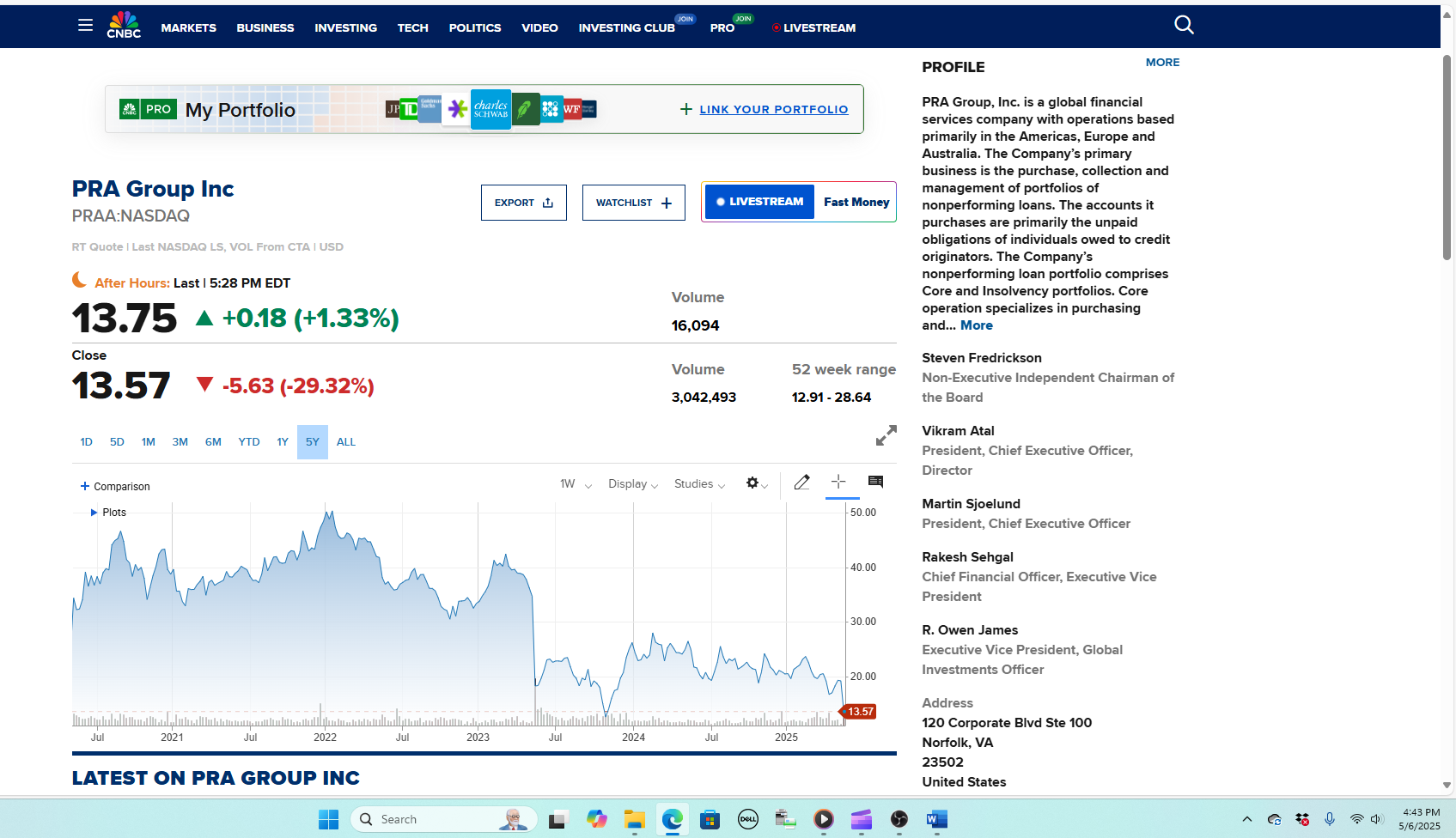

When I filed my lawsuit against Portfolio Recovery Associates in 2021, its parent company PRA Group, Inc’s stock was selling around $20 per share. Today it sold for $13 plus change.
I don’t mean to be a schadenfreudist, but watching PRAA’s stock nosedive genuinely made my day. Maybe true schadenfreude is about undeserved suffering — and this isn’t that. This is earned misery. PRAA is a pet litigant of Federalist Society cabalist Judge Lee Rudofsky, and if justice exists, this is just the beginning of their bad news.
Attorney Knows Better Than to Confirm Info — Even When Caller Has Accurate Private Details. But According to Judge Rudofsky and the Eighth Circuit, You’re Supposed to Cooperate Anyway
Portfolio Recovery Associates, the Nation’s second largest debt buyer, made 100s of phone calls to me before I agreed to confirm (or deny) my identity, birthdate and address. After I confirmed my name and birthdate and denied the address they had was one I was familiar with, they told me that I owed $2,297.63 but not by whom, on what, where, or when the account they purportedly purchased was used.
I sued PRA.
The CFPB had already obtained a consent agreement against the debt collector against making phone calls exactly like this one. A couple years after I filed my suit, Portfolio Recovery stipulated to an order to pay another $24 million for continuing to make the harassing collections.
Judge Lee P. Rudofsky threw my suit out on summary judgment. He said it was not more than an acceptable annoyance for a debt collector to make repeated calls if the recipient refused to confirm personal information about themselves on a recorded line. The Eighth Circuit confirmed. SCOTUS denied writ of certiorari to review the orders. (Steve Lehto, at 5:20 of the YouTube video said, “so I said, ‘just so you know, I find this entire phone call annoying’, and I hung up on her.”)
The courts also allowed the supposed evidence that their decision was based on to be kept under seal. I can tell you that the evidence provided did not show that I owed PRA any money and did not show that my estimate of the number of calls made was inaccurate. This begs the question, why would PRA want to keep the records of my account confidential if I begged to have the records made public?
I can’t answer Steve Lehto’s question, but agree with him whole-heartedly that a caller has no right to demand confirmation of identity or anything else. (At 10:10, Mr. Lehto said, “in fact, I didn’t even confirm some of the things that she asked me.”
I pointed out to Judge Rudofsky that the Fourth Amendment of that pesky Constitution forbids demands for identification. The judge said the 4th amendment only applies to government intrusion. By that reasoning, there is separation of church and state, but it is perfectly fine for an individual to tie you to a rock and force you to profess faith in Jesus Christ as your Lord and Savior before the tide comes in. – Well, that is hyperbole. A more literal analogy is that Portfolio Recovery Associates can call you as often as they want if you let the calls go to voicemail and once every three days for answered calls, indefinitely, until you state on a recorded line that Jesus Christ is your Lord and Savior. (For me, that is a true statement, but I don’t think I should have to confirm my faith on a recorded line, nor wear a Star of David on my sleeve.)
And isn’t it interesting, when I said that I could not confirm the address they had on file, PRA went ahead and discussed the alleged debt with me anyhow?
Judges Having Ex Parte Communications: The New Normal?
This blogger Laura Lynn Hammett
Michigan Attorney Steve Lehto discussing communications a judge partakes in that are not ethical.

